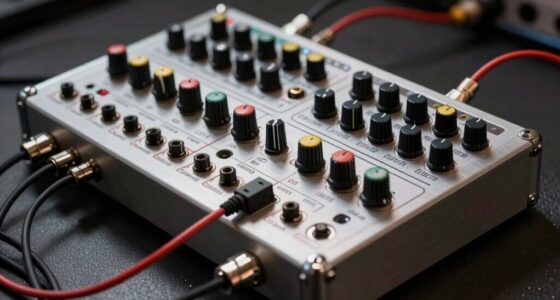
Physical modeling shows how plucking, blowing, and bowing produce sound by simulating vibrations, resonance, and material properties. When you pluck a string or blow into an instrument, specific vibrations match natural frequencies, amplifying particular tones. Bowing causes sustained vibrations through friction, creating unique sounds. Understanding these physical interactions helps predict how instrument design and your actions influence the sound. Keep exploring to learn how these principles shape the rich variety of musical tones.

Get audio and creator gear delivered free with Prime
- Fast, free delivery on millions of items
- Prime Video, Amazon Music and more included
- Member-only deals all year
Key Takeaways
- Physical modeling simulates how plucking, blowing, and bowing generate vibrations and sound in musical instruments.
- Resonance phenomena amplify specific vibrations, shaping the characteristic tones of plucked, blown, or bowed instruments.
- Material properties like tension, elasticity, and damping influence how vibrations are initiated and sustained.
- Mathematical equations model the propagation of vibrations through strings, air columns, and body materials during playing actions.
- Understanding these models aids in designing, modifying, and controlling instrument sounds for desired tonal qualities.

Have you ever wondered how complex systems can be understood and predicted? When it comes to musical instruments, physical modeling helps you grasp how sound is produced through simple actions like plucking, blowing, or bowing. At the heart of this understanding are resonance phenomena and material properties, which shape the tone and behavior of each instrument. Resonance phenomena occur when vibrations match an object’s natural frequency, amplifying specific sounds and creating the characteristic tones you hear. These phenomena are vital because they determine how efficiently an instrument responds to your actions. For example, when you pluck a string, the string vibrates at its natural frequency, and if the body of the instrument resonates at that same frequency, the sound becomes richer and louder. Material properties, such as density, elasticity, and damping, influence these vibrations profoundly. The stiffness of a string, the density of the wood, or the tension you apply all modify how vibrations propagate and sustain. Understanding these properties allows you to predict how a change in material or technique will alter the sound. Additionally, material damping affects how quickly vibrations fade, shaping the instrument’s tonal decay and sustain. Physical modeling translates these complex interactions into mathematical equations that describe how vibrations move through different materials. When you blow into a flute, for instance, the air column inside resonates at certain frequencies based on its length and the material of the instrument. By modeling these resonance phenomena, you can predict how changing the length or the material affects pitch and tone. Similarly, bowed instruments like violins rely on the friction between the bow and the string, which causes vibrations to initiate and sustain oscillations. The material properties of the string and bow, along with the shape of the instrument, determine the quality of tone and sustain. These models allow you to simulate and manipulate the sound without needing physical prototypes, making it easier to understand how each component influences the overall sound. In essence, physical modeling provides you with a window into the mechanics behind musical sounds. By understanding the resonance phenomena and material properties involved, you gain insight into how different actions produce diverse tones and how instruments can be designed or modified for specific sounds. Whether you’re a musician, a designer, or a researcher, this knowledge empowers you to predict and control sound production more accurately. It’s a powerful tool that bridges the gap between physical interactions and auditory experience, revealing the intricate dance of vibrations that create music.
acoustic guitar string tension tuner
As an affiliate, we earn on qualifying purchases.
As an affiliate, we earn on qualifying purchases.
Frequently Asked Questions
How Do Physical Models Simulate Non-Traditional or Experimental Instruments?
You can simulate non-traditional or experimental instruments using physical models by leveraging digital waveguides and material modeling. Digital waveguides allow you to recreate complex wave interactions, giving you control over unique sound behaviors. Material modeling helps you mimic unconventional materials or structures, enabling the creation of sounds from strange or experimental instruments. This combination offers a flexible way to explore new sonic possibilities beyond traditional instrument boundaries.
What Are the Limitations of Current Physical Modeling Techniques?
Think of current physical modeling techniques as a delicate web that sometimes struggles to hold all the threads. You’ll find limitations in computational complexity, making real-time simulations demanding and resource-heavy. Material realism also remains a challenge, as accurately capturing the nuanced behavior of diverse materials is tough. These constraints can hinder your ability to perfectly emulate the rich textures and subtle variations of experimental instruments.
How Is Real-Time Control Achieved in Physical Modeling Synthesis?
You achieve real-time control in physical modeling synthesis by using gesture recognition to interpret your movements, which then directly modulates parameters like string tension or breath pressure. This allows you to manipulate the sound dynamically as you perform. By mapping gestures to specific parameters, the system responds instantly, giving you expressive control over the instrument’s tone and behavior, making your performance more intuitive and immersive.
Can Physical Modeling Replicate Complex Acoustic Environments?
You can definitely replicate complex acoustic environments with physical modeling. It uses virtual acoustics and spatial rendering techniques to simulate how sound interacts with different spaces. By modeling how sound waves reflect, diffract, and disperse, you create realistic environments that respond dynamically to your input. This makes your virtual spaces feel authentic, immersing you in a convincing audio landscape that mimics real-world acoustics closely.
What Advancements Are Expected in Physical Modeling Accuracy?
You can expect advancements in physical modeling accuracy through improved digital precision and enhanced computational efficiency. These developments will allow you to create more realistic and detailed sounds, capturing subtle nuances of acoustic environments. As computational power grows, you’ll benefit from faster simulations that don’t sacrifice quality, making complex sounds more accessible in real-time applications. This progress will lead to richer, more immersive audio experiences tailored to your needs.
Conclusion
In exploring plucks, blows, and bowed tones, you discover how physical modeling captures the essence of musical expression. You understand how vibrations shape sound, how techniques influence tone, and how every detail contributes to authenticity. You feel empowered to experiment, to create, to refine your musical voice. With this knowledge, you embrace the art of sound design, the science of acoustics, and the joy of making music come alive—because every pluck, blow, and bow tells your unique story.
Fall Picks
fall essentials
As an affiliate, we earn on qualifying purchases.