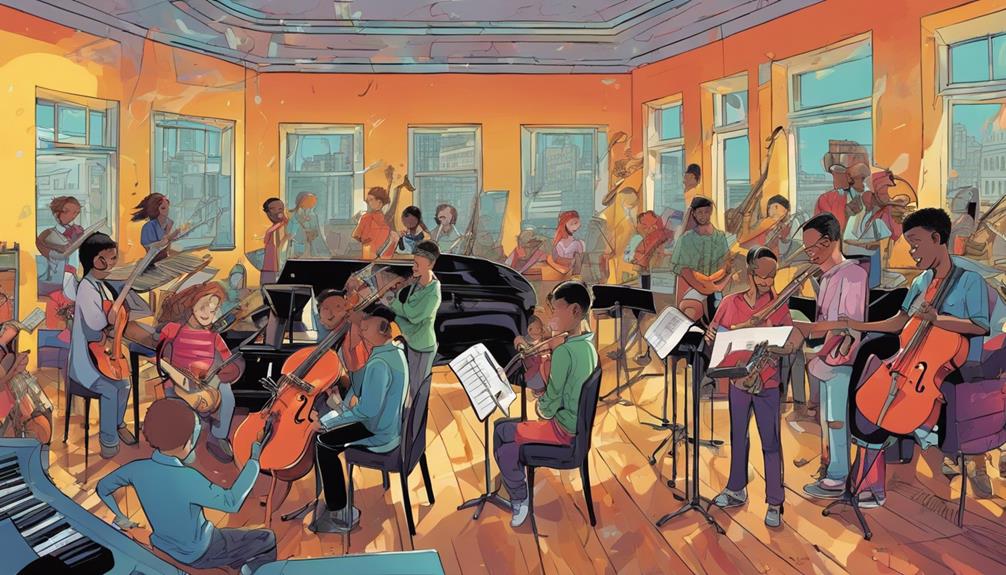
To master jazz harmony, you should understand basic chord structures like major, minor, and dominant sevenths, and how to use extensions such as 9ths, 11ths, and 13ths to add richness. Practice smooth voice leading and explore chord substitutions, including tritone exchanges, to create color and tension. Incorporate modal interchange and blues scales for emotional depth, and develop improvisation strategies that emphasize rhythmic variation and groove. Keep exploring these concepts to elevate your jazz-inspired productions.

Get audio and creator gear delivered free — and shop member deals
- Fast, free delivery on millions of items
- Access to Prime Big Deal Days deals on October 6–7
- Prime Video, Amazon Music and more included
Key Takeaways
- Master seventh chords, extensions, and voice leading to create smooth, colorful harmonic progressions.
- Incorporate chord substitutions like tritone and modal interchange for harmonic interest.
- Use swing rhythm and rhythmic variation to establish an authentic jazz groove.
- Explore improvisation techniques including motifs, call-and-response, and chromaticism.
- Blend blues scales and emotional dynamics to add depth and expressiveness to jazz productions.
Jazz harmony chord extension packs
As an affiliate, we earn on qualifying purchases.
As an affiliate, we earn on qualifying purchases.
Understanding Basic Jazz Chord Structures

Have you ever wondered what makes jazz chords sound so rich and complex? It starts with understanding basic jazz chord structures. Jazz often relies on seventh chords, like major 7, minor 7, and dominant 7, which add depth and color. These chords are frequently played with swing rhythms, giving them a laid-back, syncopated feel that’s essential to jazz groove. Bebop phrasing also influences chord voicings, emphasizing quick passing tones and colorful extensions. You’ll notice jazz musicians often substitute simple chords with more intricate voicings, using chord inversions and extensions to create a sense of movement. Mastering these foundational structures and rhythmic patterns helps you grasp the core of jazz harmony, setting the stage for more advanced concepts later on. Additionally, understanding chord extensions can significantly expand your harmonic vocabulary, allowing for more expressive and sophisticated improvisations.
Exploring Common Chord Extensions and Alterations

Building on your understanding of basic jazz chords, exploring common extensions and alterations reveals how musicians add richness and complexity to their voicings. Extensions like ninths, elevenths, and thirteenths deepen harmony, while alterations such as flattened fifths or sharpened ninths create tension. Altered dominants, in particular, introduce dissonance that resolves beautifully, adding color to your progressions. Quartal voicings, built on stacking fourths, give a modern, open sound. To incorporate these elements effectively, consider:
Enhance jazz harmony with extensions, alterations, quartal voicings, and creative resolutions for richer, more dynamic progressions.
- Using altered dominants to add tension before resolving
- Incorporating quartal voicings for a contemporary feel
- Adding 9ths, 11ths, and 13ths for richer harmonies
- Applying alterations to create dissonance and release
- Experimenting with extensions over altered chords for color
- Understanding sound wave influence can help you better grasp how sound vibrations enhance harmonic richness.
These techniques elevate your harmonic palette, making your jazz arrangements more compelling.
The Art of Chord Substitutions in Jazz Harmony

Chord substitutions are a powerful tool in jazz harmony that allow you to add variety, color, and sophistication to your progressions. By mastering sophisticated voice leading, you can seamlessly replace chords with alternatives that maintain harmonic coherence while creating fresh sounds. One essential technique is tritone substitution, where you swap a dominant seventh chord with another a half-step away, producing rich, unexpected colors. This approach adds harmonic complexity and jazz flavor to your progressions. Understanding how these substitutions function within your chord context helps you craft more dynamic, engaging arrangements. Experimenting with different substitutions broadens your harmonic palette and gives your music a more professional, polished sound. Additionally, exploring the concept of harmonic coherence can deepen your understanding of how to effectively implement these substitutions without disrupting the musical flow. With practice, you’ll develop an intuitive sense of when and how to apply these techniques for maximum musical impact.
Voice Leading Techniques for Smooth Progressions

To create seamless jazz progressions, mastering voice leading is essential. It guarantees your chords move smoothly from one to the next, enhancing musical flow. Focus on minimal movement between voices, especially common tones and stepwise motion. Use these techniques:
- Connect chords by moving individual voices by half or whole steps for fluid transitions
- Keep common tones steady to anchor the progression
- Resolve dissonances by stepwise motion to maintain coherence
- Prioritize smooth bass line movement to support overall flow
- Avoid large leaps that disrupt the natural voice leading flow
These strategies help you craft smooth progressions that sound natural and compelling. Effective voice leading makes your harmonic movement more engaging, creating a polished jazz sound that’s pleasing to the ear.
Using Modal Interchange to Add Color

Modal interchange is a powerful tool that lets you add color and interest to your jazz progressions by borrowing chords from parallel keys or modes. This technique introduces chromaticism and fresh color tones, enriching your harmonic palette. By using borrowed chords, you can subtly shift the mood or create surprising moments without disrupting the overall flow. For example, borrowing a ♭III from the parallel minor adds a warm, modal flavor, while a bVI from the minor key provides a darker, more dramatic touch. These color tones make your progressions more expressive and dynamic. Modal interchange invites creativity, allowing you to craft unique harmonic textures that elevate your jazz compositions and productions. Exploring the underlying music theory behind borrowed chords can deepen your understanding and expand your harmonic vocabulary. Experimenting with borrowed chords opens new pathways for emotional and tonal variation.
The Role of Tritone Substitutions and Their Impact

Have you ever noticed how a jazz progression suddenly feels more tense or resolved? That’s often due to tritone substitutions, which introduce unexpected chromatic movement and dissonance. These substitutions swap a dominant chord with another a tritone away, creating a heightened sense of tension. When resolved properly, this dissonance resolves smoothly, enhancing the emotional impact. To understand their role:
Tritone substitutions add tension and color by swapping chords a tritone apart, resolving smoothly for emotional impact.
- They increase harmonic interest through chromatic movement.
- They add tension that begs for dissonance resolution.
- They create a richer, more colorful harmonic palette.
- They subtly shift the tonal center, adding complexity.
- They help smooth transitions between chord progressions.
- Recognizing their use can deepen your understanding of harmonic tension and how it shapes musical expression.
Incorporating Jazz Scales and Modes in Composition

Incorporating jazz scales and modes into your composition can considerably enhance its melodic and harmonic richness. Using scales for improvisation helps you explore new melodic ideas, while modal interchange techniques add color and depth to your progressions. For example, blending the Dorian or Mixolydian modes can create a fresh sound within familiar chords. Experiment with modal interchange by borrowing chords from parallel modes to add surprising shifts. These techniques allow you to craft complex yet cohesive melodies that evoke jazz’s expressive qualities. By consciously integrating different scales and modes, you expand your harmonic vocabulary, making your compositions more dynamic and engaging. This approach opens up new pathways for creativity, helping your music resonate with the intricate beauty characteristic of jazz harmony.
Improvisation Strategies for Jazz-Inspired Solos

Building on your understanding of scales and modes, developing effective improvisation strategies allows you to create compelling jazz-inspired solos. To do this, focus on incorporating a swing feel, which gives your playing a relaxed, groovy pulse. Experiment with blues scales, adding soulful flavor and emotional depth. Here are some strategies to enhance your improvisation:
- Emphasize rhythmic variation to maintain interest
- Use call-and-response patterns for interaction
- Incorporate motifs and develop them throughout your solo
- Play with swing feel to add groove and swing
- Practice phrasing techniques to shape your lines dynamically
Practical Tips for Integrating Jazz Harmony Into Modern Genres

To successfully blend jazz harmony into modern genres, you need practical approaches that bridge traditional jazz concepts with contemporary sounds. Start by incorporating a swing feel, which gives your groove a jazz-specific rhythmic foundation, making the fusion more authentic. Use bebop language—complex melodies, chromaticism, and quick chord changes—to add sophistication and energy. Experiment with incorporating jazz voicings and extended chords into your tracks, but simplify them to fit the modern style. Listen to jazz recordings for inspiration and analyze how they handle harmony and rhythm, then adapt those ideas creatively. Keep your improvisations rooted in jazz language but framed within the context of your genre. This blend will create a dynamic, fresh sound that respects jazz roots while embracing modern production. Incorporating trailer music techniques such as building tension and using dynamic contrasts can also enhance the emotional impact of your fusion.
Frequently Asked Questions
How Can I Apply Jazz Harmony Concepts to Electronic Music Production?
You can apply jazz harmony concepts to electronic music by experimenting with chord substitution to create richer progressions. Incorporate modal interchange to add surprising tonal colors and emotional depth. Use these techniques to craft more dynamic, expressive sounds that stand out. Don’t be afraid to blend jazz-inspired chords and progressions into your tracks—this approach adds sophistication and complexity, elevating your production in fresh, innovative ways.
What Are Common Pitfalls When Incorporating Jazz Harmony Into Modern Genres?
When you incorporate jazz harmony into modern genres, watch out for common pitfalls. You might overuse complex chords, making your track sound cluttered or inaccessible. Also, neglecting the genre context can cause your harmony choices to clash with the overall vibe. To avoid this, balance interesting chord progressions with simplicity, and always consider how jazz elements fit within the style you’re producing.
How Do Jazz Harmony Techniques Influence Songwriting and Arrangement?
You should consider how jazz harmony techniques like chord substitution and improvisation techniques influence your songwriting and arrangements. These methods add richness and complexity, allowing you to create more interesting progressions and dynamic solos. By applying chord substitution, you can surprise listeners with unexpected harmonic shifts, while improvisation techniques help you develop melodic ideas spontaneously. Integrating these jazz elements elevates your music, making it more engaging and expressive.
Are There Specific Jazz Harmony Tools Suitable for Beginner Producers?
Did you know that many beginner producers find jazz harmony tools like triadic voicings and modal interchange surprisingly accessible? These techniques help you add richness to your arrangements without complex theory. You can start by experimenting with triadic voicings to create fuller chords or use modal interchange to introduce unexpected color. Both tools are beginner-friendly and can markedly elevate your songwriting and arrangement skills quickly.
How Can I Adapt Jazz Harmony Principles for Solo Instrument Recording?
To adapt jazz harmony principles for solo instrument recording, you should focus on capturing a swing feel and incorporating chord extensions. Play with rhythmic phrasing to evoke the groove, and add extensions like 9ths, 11ths, or 13ths to enrich your sound. Use subtle dynamics and articulation to bring out the harmony’s complexity, making your recordings more authentic and expressive while maintaining the jazz vibe.
Conclusion
Mastering jazz harmony opens endless creative doors—think of it as having the key to musical freedom. By understanding chord structures, substitutions, and scales, you’ll craft richer, more expressive progressions. Remember, Rome wasn’t built in a day, so be patient and keep experimenting. With dedication, you’ll soon find your unique voice blending jazz’s timeless elements into your modern productions. Embrace the journey, and let your music speak volumes beyond words.
Fall Picks
fall essentials
As an affiliate, we earn on qualifying purchases.