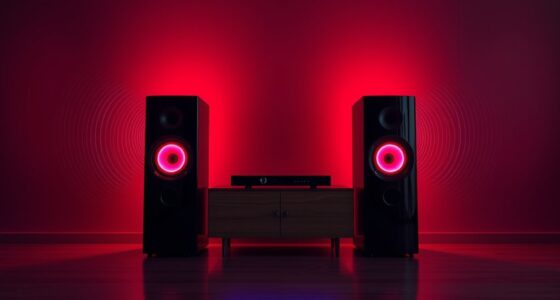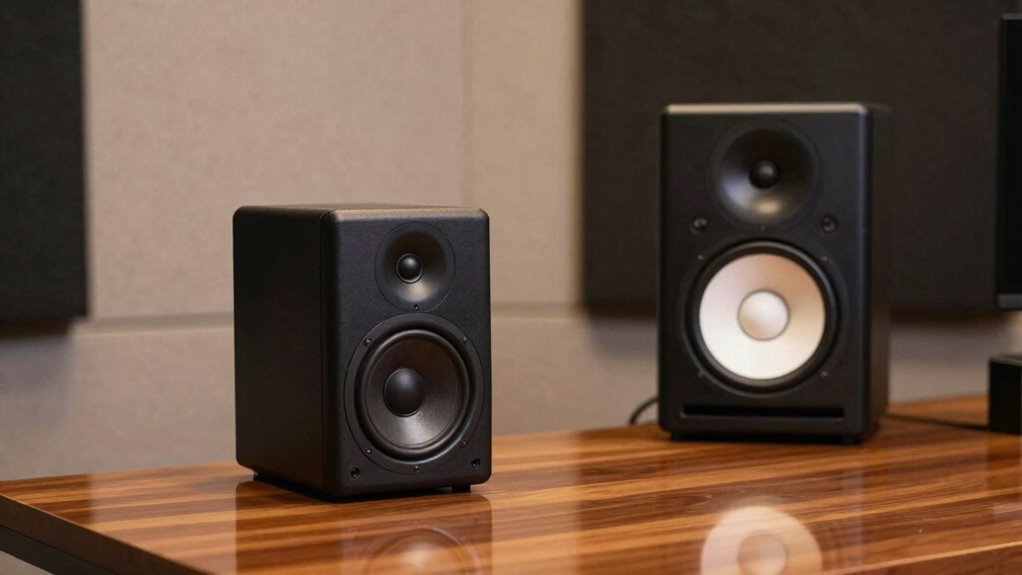
Choosing the right listening distance depends on your space, monitor type, and workflow. Nearfield monitors sound best when placed 3 to 4 feet from you, reducing room influence and ideal for small setups. Midfield monitors are better for larger rooms, placed 4 to 8 feet away, offering a more immersive soundstage but requiring more room treatment. Understanding these distances helps guarantee accurate listening; keep exploring to find what works best for your environment.
Key Takeaways
- Nearfield monitors are ideal for listening within 3 to 4 feet, minimizing room acoustics influence.
- Midfield monitors are suited for listening distances of 4 to 8 feet, requiring more room treatment.
- Proper placement in an equilateral triangle enhances sound accuracy for nearfield setups.
- Midfield monitors benefit from careful positioning to reduce reflections in larger spaces.
- Choose nearfield for small rooms and midfield for larger studios needing immersive sound.

Are you wondering whether nearfield or midfield monitors are better suited for your studio? The answer depends largely on your space, your goals, and how you manage your room acoustics. Both types of monitors are designed to deliver accurate sound, but their ideal placement and performance vary based on how your room is set up. When choosing between them, you need to consider how your room’s acoustics affect sound clarity and how you position your speakers to maximize listening accuracy.
Choosing between nearfield and midfield monitors depends on your room size, acoustics, and listening goals.
In small to medium-sized rooms, nearfield monitors are often recommended because they’re designed to be placed close to your ears—typically within 3 to 4 feet. This proximity helps minimize the impact of your room’s acoustics, like reflections and standing waves, which can muddy the sound. When setting up nearfield monitors, speaker placement is vital. You want to position them so they form an equilateral triangle with your listening position, with tweeters at ear level. Proper speaker placement guarantees you’re hearing a direct sound with minimal coloration from the room, giving you a more precise representation of your mix.
Midfield monitors, on the other hand, are larger and intended for placement farther away, around 4 to 8 feet from your ears. They’re ideal for larger studios or for producers working on full mixes where a broader soundstage is necessary. Because they’re farther from your listening position, room acoustics play a bigger role in how you perceive sound. Proper speaker placement becomes even more critical here because reflections from walls and other surfaces can considerably color the sound. To get the most out of midfield monitors, you’ll need to carefully treat your room acoustics—adding bass traps, diffusers, and absorbers to control reflections and standing waves. Additionally, understanding the listening distance is crucial to optimize your monitoring environment.
In essence, your choice hinges on your room size and how well you can manage acoustics. If you’re working in a smaller space with limited room treatment, nearfield monitors are usually the better choice—they’re less affected by room acoustics and easier to set up ideally. If your studio is larger and you have the space and resources to treat it properly, midfield monitors can give you a more immersive listening experience, but they demand more attention to speaker placement and acoustic treatment. Ultimately, understanding how room acoustics influence sound and mastering speaker placement will help you select the monitors that fit your environment and produce the most accurate mixes.
Frequently Asked Questions
How Do Room Acoustics Affect Monitor Selection?
Room acoustics substantially influence your monitor selection because untreated spaces can distort sound. By adding acoustic panels and proper room treatment, you minimize reflections and unwanted resonances, allowing you to hear more accurate audio. With good acoustics, you can confidently choose nearfield or midfield monitors that suit your space, ensuring precise mixing. Ignoring room acoustics leads to misleading sound, so prioritize treatment for ideal monitor performance.
Can I Use Nearfield Monitors in a Large Control Room?
Yes, you can use nearfield monitors in a large control room, but keep in mind that proper speaker placement and sound isolation are essential. Position the monitors carefully to minimize reflections, and guarantee your room allows for ideal acoustics. While nearfield monitors excel at reducing room influence, they may not fill a large space adequately, so consider supplementing with midfield monitors for better coverage and more precise sound.
What Maintenance Is Required for Midfield Monitors?
You should regularly check your midfield monitors for dust and guarantee speaker placement remains stable to maintain sound quality. Keep cables organized with proper cable management to prevent damage and interference. Periodically inspect connections and clean the speakers’ surfaces. Also, verify that the monitors are properly aligned and avoid placing objects around them that could affect acoustics. Consistent maintenance ensures your midfield monitors deliver ideal performance.
Are There Specific Genres Best Suited for Nearfield Monitors?
Think of nearfield monitors as your musical magnifying glass, ideal for genre pairing that demands detail and intimacy. They’re perfect for mixing genres like acoustic, vocals, or singer-songwriter tracks, where you want to hear every nuance. Your listener preferences also matter—if you prefer a cozy, focused sound, nearfield monitors are your best bet. They offer clarity in smaller spaces, making them ideal for genres that thrive on subtleties.
How Do I Calibrate Monitors for Optimal Sound?
To calibrate your monitors for ideal sound, start with proper monitor placement, positioning them at ear level and forming an equilateral triangle with your listening position. Use calibration techniques like pink noise and a SPL meter to adjust volume levels evenly. Then, fine-tune the balance and EQ settings to eliminate room reflections and resonances. Regularly check and adjust your setup to guarantee consistent, accurate sound reproduction during your sessions.
Conclusion
Imagine your listening space as a garden. Nearfield monitors are like close-up flowers, revealing intricate details up close, while midfield monitors are the trees standing tall in the distance, offering a broader view of the landscape. Choosing between them is like deciding whether you want to tend to tiny blooms or oversee the entire garden. By matching your monitors to your space and needs, you’ll cultivate a sound environment that helps your music flourish.