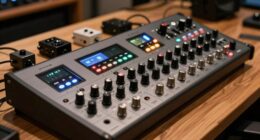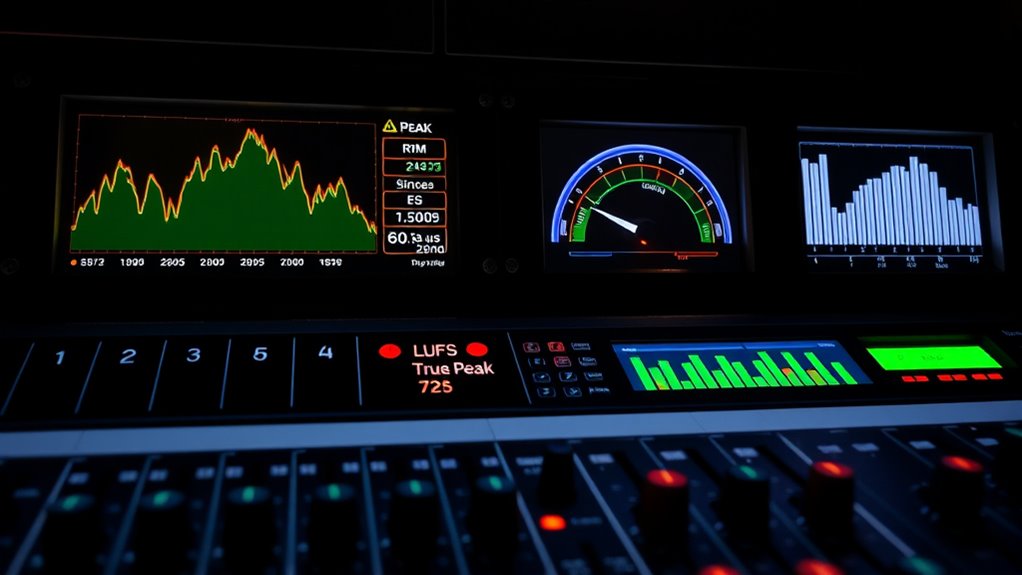

Metering involves using different tools to monitor your audio levels accurately. Peak meters show the highest level at any moment, helping you avoid clipping. RMS meters measure the average power of your sound, while LUFS meters quantify perceived loudness for consistency across platforms. True peak meters detect inter-sample peaks that could cause distortion during playback. Understanding these meters guarantees your audio stays clear, balanced, and professional—if you keep exploring, you’ll discover how to master each type effectively.
Key Takeaways
- Peak meters measure the highest level reached, preventing clipping and distortion during audio peaks.
- RMS meters provide an average of the audio signal’s power, reflecting perceived loudness.
- LUFS meters quantify loudness based on human hearing, ensuring consistent loudness across platforms.
- True peak meters detect inter-sample peaks that can cause distortion during digital-to-analog conversion.
- Combining different meters offers a comprehensive view for balanced, compliant, and high-quality audio production.
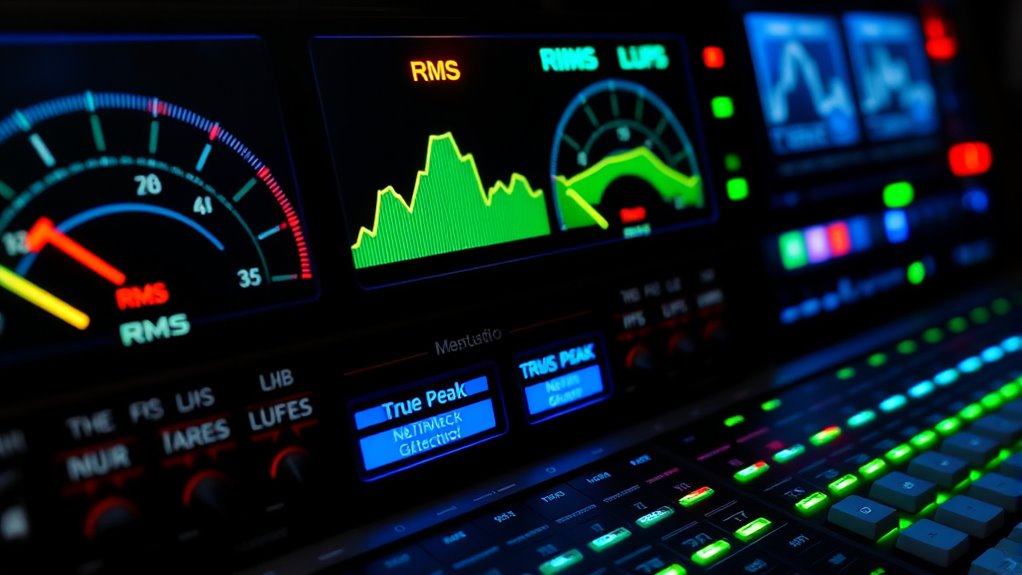
Metering is a critical process that involves measuring the consumption of resources like electricity, water, or gas. In audio production and broadcasting, metering takes on a different but equally important role. It helps you gauge the loudness, peaks, and overall levels of your audio signals to guarantee consistent quality and compliance with industry standards. Understanding the different types of meters—like peak meters, RMS meters, LUFS meters, and true peak meters—is essential for achieving professional results. These tools allow you to monitor your audio levels accurately, preventing distortion and ensuring a balanced listening experience.
Metering ensures professional, consistent audio quality by accurately monitoring loudness and peaks across various standards.
When working with audio, you’ll often hear about the importance of managing the dynamic range. Dynamic range refers to the difference between the quietest and loudest parts of your audio. Proper metering helps you control this range so your audio isn’t too compressed or too wide open, which could lead to a loss of detail or listener fatigue. Loudness normalization is another key concept tied closely to metering; it’s a process that adjusts the overall volume of your audio to meet industry standards, ensuring your content sounds consistent across different platforms. Using meters that measure loudness in LUFS (Loudness Units relative to Full Scale) helps you meet these standards, making your audio sound equally loud whether it’s on streaming services, broadcast, or radio.
Peak meters are the most straightforward, showing the highest level reached by your audio signal at any given moment. They’re essential for preventing clipping, which occurs when the signal exceeds 0 dBFS, causing distortion. RMS meters, on the other hand, provide a more averaged measurement of your signal’s power, giving you a sense of perceived loudness and helping you maintain consistent levels throughout your mix. LUFS meters go a step further by quantifying loudness in a way that aligns with human hearing, which is more sensitive to certain frequencies and quieter sounds. This makes LUFS an indispensable tool for loudness normalization, especially for streaming platforms that enforce specific loudness standards.
True peak meters are designed to measure inter-sample peaks that can occur between digital samples. They’re essential because even if your peak meter shows no clipping, true peak meters might reveal potential distortion during playback. By paying attention to true peaks, you guarantee that your audio remains clean and undistorted across all playback systems. Additionally, understanding the digital audio resolution ensures that your meters are calibrated correctly for accurate measurements. Combining these metering techniques gives you a thorough view of your audio levels, helping you produce content that’s balanced, loudness-normalized, and free from unwanted distortion. This meticulous approach to metering ultimately elevates your work, making sure your audio sounds professional and consistent across all listening environments.
Frequently Asked Questions
How Do Different Metering Standards Affect Streaming Platform Loudness?
Different metering standards directly impact streaming platform loudness because they influence loudness normalization. When platforms use LUFS or True Peak measurements, your audio gets adjusted to a consistent streaming loudness level, ensuring your track sounds balanced across all devices. If your metering doesn’t align with platform standards, your music might be turned down or up unexpectedly, affecting listener experience and overall loudness consistency on streaming services.
Can Metering Tools Detect All Types of Audio Distortion?
Imagine you’re mixing an album, and you rely on metering tools for distortion detection. While these tools catch common issues like clipping, their limitations mean some distortion types, such as subtle harmonic or intermodulation distortion, may go unnoticed. Metering limitations prevent detection of all audio distortions, so you should complement them with listening tests and additional analysis to make certain the overall sound quality remains pristine.
How Often Should I Calibrate My Metering Equipment?
You should calibrate your metering equipment at least once every six months to guarantee optimal metering accuracy. Regular calibration maintains measurement precision, especially if your environment or equipment changes. If you notice inconsistent readings or after firmware updates, consider calibrating more frequently. Proper calibration helps you trust your meters, ensuring your audio levels stay accurate and compliant with industry standards.
What Is the Impact of True Peak Limiting on Audio Quality?
Think of true peak limiting like a safety net for your audio; it prevents clipping but can impact audio fidelity if overused. It reduces the risk of limiting artifacts, but excessive limiting may cause a loss of detail or unwanted distortion. When applied carefully, it maintains loudness without sacrificing sound quality. However, over-limiting can make your mix sound dull or squashed, so balance is key for preserving clarity and punch.
Are There Industry Standards for Peak and RMS Levels Across Genres?
You’ll find that industry standards for peak and RMS levels vary across genres. For example, pop and electronic music often aim for louder levels, while classical recordings prioritize dynamic range. Although there aren’t strict universal rules, many professionals follow common practices to guarantee consistent loudness and quality. By understanding genre variations, you can better tailor your metering to meet industry expectations and achieve the desired sonic impact.
Conclusion
Mastering metering methods like peak, RMS, LUFS, and true peak helps you monitor your music’s magic. Remember, precise peaks prevent problems, while consistent RMS and LUFS levels keep your sound balanced. By blending these measurements, you build a better, bigger, and more broadcasting-ready sound. So stay sharp, stay savvy, and let your levels lead to loud, clear, and enthralling creations that captivate listeners every time.