Choosing between 2.4 GHz and UHF wireless microphone systems is mainly a choice between easier operation and greater control over radio conditions. Both can carry clear speech or music without a cable, but they behave differently when Wi-Fi traffic, other wireless devices, venue size, and the number of microphones enter the picture. A compact 2.4 GHz kit can suit a creator, presenter, or small event that needs quick setup. A UHF system is usually the safer fit for live production, larger rooms, and users who need to coordinate several microphones. The practical difference is not simply sound quality: it is how reliably the system can find and hold a usable radio connection in the places you work.

Get audio and creator gear delivered free with Prime
- Fast, free delivery on millions of items
- Prime Video, Amazon Music and more included
- Member-only deals all year

Phenyx Pro PTU-7000-4H 4-Channel UHF Wireless Microphone System
- ✔ Channels: 4
- ✔ Selectable frequencies: 40 per channel; 160 total
- ✔ Frequency range: 530–580 MHz

Phenyx Pro PTU-71-2H Dual UHF Wireless Handheld Microphone System
- ✔ Microphones: 2 handheld dynamic
- ✔ Channels: 2
- ✔ Selectable frequencies: 100 per channel
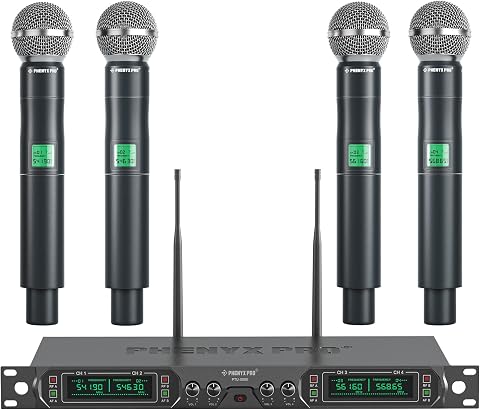
Phenyx Pro PTU-5000-4H 4-Channel UHF Wireless Microphone System
- ✔ Channels: 4
- ✔ Wireless technology: UHF
- ✔ Frequencies: 541.9, 546.3, 561.6, and 568.65 MHz
These labels cover a range of products. Some systems automate frequency selection, while others give users detailed manual controls; transmission power, antennas, receivers, and local spectrum rules also affect performance. The comparison below describes common design tendencies, not a guarantee about every model. For a single microphone in a familiar room, convenience and total kit cost may matter most. For critical events or changing venues, frequency coordination and the ability to respond to interference can justify a more involved setup.
At a Glance
| Criteria | 2.4 GHz wireless microphone systems | UHF wireless microphone systems | Winner |
|---|---|---|---|
| Setup and ease of use | Often quick to pair, with automatic channel selection and simple controls. | May require scanning, channel selection, or more knowledge of frequency coordination. | A |
| Performance in crowded RF environments | Shares spectrum with Wi-Fi and many household devices, so local congestion can affect performance. | Can offer more selectable frequencies, though available spectrum and local rules still apply. | B |
| Range and venue flexibility | Often adequate for nearby use and smaller spaces; real range varies by system and surroundings. | Often provides more flexibility for larger venues, subject to the system, antennas, and environment. | B |
| Multi-microphone coordination | Convenient for a small number of channels, but options for managing many simultaneous systems vary. | Generally better suited to planning and coordinating multiple microphones. | B |
| Portability and workflow | Commonly sold in compact kits suited to cameras, phones, and mobile creators. | More likely to need a dedicated receiver and deliberate setup, with portable models also available. | A |
| Cost and value | Often less expensive to enter and straightforward for basic use. | Can cost more, with the extra expense most useful in demanding or multi-channel work. | Depends |
Phenyx Pro PTU-7000-4H 4-Channel UHF Wireless Microphone System
The PTU-7000-4H takes the top spot because it gives a four-mic setup more ways to handle both frequency coordination and audio routing. Its auto scan searches for a usable frequency, while IR sync pairs microphones with the receiver. That is a more adaptable arrangement than the PTU-5000-4H, whose four frequencies are fixed, and it avoids asking a two-channel buyer to pay attention to a larger group system’s extra inputs.Each microphone has 40 selectable frequencies, and the receiver provides four individual XLR outputs as well as a mixed 1/4-inch output. Separate outputs can help when a mixer operator wants to adjust or process each voice independently; the mixed output offers a simpler connection when the sound system takes one combined feed. Rack-mount hardware and a metal receiver also suit a fixed installation more naturally than a tabletop-only setup.There are limits to that flexibility. The advertised 328-foot range is line of sight, so walls, people, and venue conditions can reduce coverage. The stated 530–580 MHz band should be checked against local rules, and multiple compatible systems require frequency coordination. Compared with the PTU-71-2H, this model has twice the microphone channels but less frequency choice per channel, so we would choose the two-channel system when four performers are unnecessary and tuning flexibility is the priority.
Pros:
- Auto scan and IR sync simplify frequency selection and microphone pairing.
- Four individual XLR outputs plus a mixed 1/4-inch output suit different audio chains.
- Four channels provide 40 selectable frequencies each.
- Metal receiver and rack-mount hardware support installed or rack-based setups.
Cons:
- The stated 328-foot range is line of sight and depends on venue conditions.
- Coordinating frequencies is necessary when operating multiple compatible systems.
- Its four-channel capacity may be unnecessary for two-person use.
Best for: Small venues, event operators, and performers who need four handheld mics with individual mixer feeds and assisted frequency setup.
Not ideal for: Buyers who need only one or two microphones, need a region-specific band that differs from 530–580 MHz, or expect a maximum-range figure to hold through obstacles.
Bottom line: For a four-microphone setup that needs flexible routing and guided frequency selection, the PTU-7000-4H is the most versatile system in this comparison.
“For a four-microphone setup that needs flexible routing and guided frequency selection, the PTU-7000-4H is the most versatile system in this comparison.”
Phenyx Pro PTU-71-2H Dual UHF Wireless Handheld Microphone System
When two voices are enough, the PTU-71-2H is the focused choice in this lineup. It pairs two handheld dynamic microphones with a receiver that offers 100 selectable frequencies per channel, auto scan, and IR synchronization. That gives a presenter and guest, duet, or karaoke pair more frequency choices than the PTU-5000-4H’s fixed set, without the four-channel receiver capacity of either group system.Cardioid pickup is intended to favor sound in front of each microphone and reduce some sound from other directions, a useful design for spoken vocals and singing. The system also includes mute controls, and the stated battery life is up to 16 hours from eight AA batteries. Compared with the PTU-7000-4H, the PTU-71-2H has fewer channels but more selectable frequencies per channel and a simpler two-mic footprint. It is a practical fit when the extra two channels and separate XLR feeds are not needed.Its constraints are worth checking before choosing it. The 290–328-foot operating range depends on line of sight, and the listed frequency bands may not suit every region. Unlike the PTU-7000-4H, the supplied description does not specify four individual XLR outputs, so buyers planning separate mixer channels should confirm that its output arrangement meets their setup. We rank it second because its frequency control is strong for a two-mic system, while the four-channel PTU-7000-4H serves a wider range of group and routing needs.
Pros:
- Two-channel design keeps the setup suited to pairs rather than larger groups.
- Auto scan, IR synchronization, and 100 selectable frequencies per channel support tuning flexibility.
- Cardioid pickup and mute controls are useful for vocal use.
- Up to 16 hours of stated battery life supports longer events.
Cons:
- The stated range depends on line of sight and venue conditions.
- Its frequency bands may not be suitable in every region.
- Two channels cannot serve the larger groups covered by the four-mic systems.
Best for: Duos, presenters with a second microphone, and karaoke users who want selectable frequencies without moving up to four channels.
Not ideal for: Groups requiring three or four microphones, buyers who need individually routed XLR feeds, or users whose local frequency rules exclude the listed bands.
Bottom line: For two performers who value frequency choice and a manageable channel count, the PTU-71-2H is the most targeted fit.
“For two performers who value frequency choice and a manageable channel count, the PTU-71-2H is the most targeted fit.”
Phenyx Pro PTU-5000-4H 4-Channel UHF Wireless Microphone System
The PTU-5000-4H makes sense when the main requirement is simply four handheld microphones feeding a compatible sound system. It includes four dynamic cardioid mics, a metal receiver, individual volume controls, and four XLR outputs. Those separate outputs let a mixer receive each microphone on its own input, much like the PTU-7000-4H, so this is more than a single mixed group feed.The tradeoff is that its four UHF frequencies are fixed: 541.9, 546.3, 561.6, and 568.65 MHz. That makes setup straightforward in a venue where those channels work, but leaves less room to respond to interference than the PTU-7000-4H’s selectable frequencies or the PTU-71-2H’s 100 choices per channel. The PTU-5000-4H is therefore a better match for a known, stable installation than for a buyer who expects to coordinate multiple sets or change locations often.It also requires an amplifier or speaker for sound output, so the receiver alone is not a complete public-address solution. The stated range reaches up to 260 feet, below the maximum figures listed for the other two systems, and the model is not intended for multi-set operation. We place it third because it covers four voices with useful independent outputs, yet the PTU-7000-4H offers more frequency control and broader routing, while the PTU-71-2H is easier to justify for a two-microphone event.
Pros:
- Four handheld microphones support group vocals and multi-channel use.
- Four XLR outputs allow separate microphone feeds to a mixer.
- Individual volume controls support quick balancing at the receiver.
- Metal receiver and included antennas suit a straightforward installed setup.
Cons:
- Fixed frequencies provide less adjustment than the PTU-7000-4H or PTU-71-2H.
- An amplifier or speaker is required for sound output.
- Not intended for operating multiple sets together.
Best for: Karaoke hosts, community groups, or fixed event setups that need four microphones and already have a mixer, amplifier, or PA system.
Not ideal for: Buyers who need to coordinate several wireless sets, want selectable frequencies, or do not already have equipment to amplify the receiver output.
Bottom line: Choose the PTU-5000-4H for four separate vocal feeds in a compatible fixed-frequency setup, provided the sound system is already in place.
“Choose the PTU-5000-4H for four separate vocal feeds in a compatible fixed-frequency setup, provided the sound system is already in place.”
As an Amazon Associate we earn from qualifying purchases.
Key Differences
The largest difference appears when radio conditions become unpredictable. A 2.4 GHz system shares a busy part of the spectrum with Wi-Fi and other common devices. Automatic pairing can make it easy to use, but automation cannot create clear spectrum when many devices compete nearby. UHF systems often let an operator scan for usable frequencies and choose among them. That control can make a meaningful difference at a venue with many wireless devices or when several microphones must work together. It does not make UHF immune to interference: the usable frequencies depend on local conditions, equipment design, and regulations.
That added control comes with a learning curve. Many 2.4 GHz kits are designed to be picked up, paired, and used with little planning, which suits solo creators and simple presentations. UHF systems can ask more of the operator: check the venue, select compatible frequencies, and coordinate channels when adding microphones. For a one-person recording in a predictable space, that extra work may deliver little practical benefit. For an event where a dropout would disrupt a speech or performance, the ability to manage frequencies is more valuable than a faster initial setup.
Value follows the job. A lower-cost 2.4 GHz kit is often the better purchase when its range, channel count, and receiver connections match the task. Paying more for UHF makes sense when reliable operation across changing venues, channel planning, or multiple microphones matters. Compare complete systems rather than the radio label alone: microphone type, battery life, monitoring, outputs, receiver design, and support can matter just as much to daily use.
Detailed Comparison
Setup and ease of use (2.4 GHz wireless microphone systems wins — moderate)
2.4 GHz systems usually win for a fast start. Many compact kits pair automatically or handle channel selection behind the scenes, which suits a creator who wants to record without learning radio coordination. UHF systems can require a scan and a deliberate frequency choice, especially in a venue with other wireless equipment. That is a moderate convenience advantage for A, not proof that every 2.4 GHz kit is simpler or every UHF model is difficult. In practice, choose A when setup time and a simple interface matter more than manual control; choose B when you are willing to spend time planning for a more demanding job.
Performance in crowded RF environments (UHF wireless microphone systems wins — major)
UHF generally wins when nearby Wi-Fi networks and other devices make the 2.4 GHz band busy. A UHF operator may be able to scan and select a clearer frequency, which provides a useful response when conditions change. The advantage is moderate to major in crowded event spaces, depending on the venue and equipment. UHF can still encounter interference, and the available frequencies vary by location; it is not a guarantee of uninterrupted audio. A can work well in a quiet home or office, but its shared band gives the user less room to avoid congestion.
Range and venue flexibility (UHF wireless microphone systems wins — moderate)
UHF has the edge for varied rooms and larger venues because systems in this category commonly offer more options for frequency planning and antenna setup. Range still depends on the model, antenna placement, obstacles, and transmission power, so a frequency label alone cannot promise a distance. The difference is moderate for a presenter who moves across a room and more consequential for a stage or large event space. A compact 2.4 GHz system is often sufficient for a camera-side interview or a short walk around a small room, where portability and quick setup outweigh maximum coverage.
Multi-microphone coordination (UHF wireless microphone systems wins — major)
UHF is usually the stronger choice when several microphones must operate at once. Its tuning and scanning options can help an operator find compatible channels and plan a larger setup. The difference is major for multi-person events or productions with several wireless systems, though the actual number of workable channels depends on the specific equipment and local spectrum. Some 2.4 GHz systems support multiple transmitters, but support varies and shared-band congestion can complicate expansion. For one or two simple channels, that limitation may not matter; for a growing channel count, assess coordination features before buying.
Portability and workflow (2.4 GHz wireless microphone systems wins — moderate)
2.4 GHz often wins for mobile recording. Compact transmitters and receivers designed to connect directly to phones or cameras can reduce the amount of gear to carry and speed up setup. UHF systems range from portable to rack-oriented, but many require a separate receiver and more deliberate placement. This is a moderate advantage for A when recording on location or moving between quick interviews. B can still be a portable option, and a dedicated receiver may suit a camera or event rig better than a tiny receiver built for a phone.
Cost and value (moderate difference)
Neither category is automatically the better value. A commonly costs less to get started and can deliver all the needed features for a solo creator or small presentation. B can cost more, but that premium is worthwhile if frequency control, venue flexibility, or several coordinated channels reduce the chance of disruption. The gap is minor for simple work where both systems meet the same needs, and major in value terms when the UHF system prevents a costly failure at an event. Compare the full kit and its support, then pay for the capabilities the job will use.
2.4 GHz wireless microphone systems: Pros and Cons
Pros:
- Usually quick to pair and simple to operate.
- Compact kits can connect conveniently to phones and cameras.
- Often a lower-cost route to wireless recording.
- A strong fit for familiar spaces and small setups.
Cons:
- Shares spectrum with Wi-Fi and many other common devices.
- Less suitable when frequency congestion is heavy.
- Channel management and expansion vary by product.
- Automatic selection offers less direct control when conditions change.
UHF wireless microphone systems: Pros and Cons
Pros:
- Often provides more control over frequency selection.
- Better suited to planning several wireless microphone channels.
- Can offer more flexibility across venues and larger spaces.
- A practical choice for events where audio interruptions carry a high cost.
Cons:
- May take more time and knowledge to configure.
- Dedicated receivers and accessories can add cost and equipment.
- Local spectrum availability and rules affect usable frequencies.
- The extra capability may go unused in simple recording setups.
Who Should Choose What
Choose 2.4 GHz wireless microphone systems if:
- You record interviews, presentations, or videos in a home, office, or other familiar space.
- You value quick pairing, a compact phone or camera workflow, and a modest initial cost.
- You need one or a small number of microphones and can tolerate checking local conditions if connection quality changes.
Choose UHF wireless microphone systems if:
- You work in venues with many wireless devices or changing radio conditions.
- You coordinate several microphones for events, performances, or production.
- You need greater control over frequency selection and are prepared to scan and plan channels.
Skip both if: Skip wireless if you record in one fixed position and a cable will not interfere with movement; a wired microphone avoids radio coordination and may deliver better value.
Value for Money
Pay more for UHF when its controls solve a real operating problem: crowded venues, multiple microphones, or work where a brief dropout would interrupt a paid event or performance. In those settings, frequency planning can be worth the added equipment cost and setup time. For a solo creator recording nearby in a familiar room, the extra expense may buy capability that rarely gets used. A well-matched 2.4 GHz kit can be better value there. Compare the whole system, including receiver connections, microphone type, battery arrangements, monitoring, and service options. A cheaper kit that lacks the connections or monitoring your workflow needs may not save money in practice.
Final Verdict
Choose 2.4 GHz for straightforward mobile recording, small presentations, and predictable spaces where a compact kit and easy setup matter most. Choose UHF for live work across changing venues, crowded RF conditions, and setups with several microphones. The deciding factor is how much control you need over the radio link: if a system must adapt to a difficult venue or coordinate multiple channels, UHF is the better choice for most professional event users. If you need one simple wireless connection and your surroundings are manageable, spend less on a capable 2.4 GHz system and put the savings toward the microphone and receiver features you will use.
Frequently Asked Questions
Does UHF always have better sound quality than 2.4 GHz?
No. Frequency band alone does not determine sound quality. Microphone capsule, transmitter design, audio conversion, compression, and receiver output all affect the result. Compare specifications and sample recordings for the specific systems, and consider whether the receiver connects cleanly to your camera, phone, or mixer.
Which system is better for a crowded conference venue?
UHF is generally the safer starting point because frequency scanning and selection can help an operator work around congestion. Check local frequency availability and coordinate every wireless system at the venue. A 2.4 GHz system may still work, but it shares spectrum with common Wi-Fi equipment and offers less room for manual adjustment on many models.
Can I use several 2.4 GHz microphones at the same time?
Some systems support several transmitters, but the supported channel count and coordination features vary by product. Check the manufacturer’s stated limit and whether separate systems can operate together. For a setup with several microphones, a UHF system designed for channel coordination is often easier to plan.
Is a more expensive UHF system worth it for video creators?
It can be worth the added cost if you record at busy venues, need several microphones, or cannot risk losing audio during an interview or event. For one person recording in a controlled location, a compact 2.4 GHz kit may provide better value. Spend according to the places and channel count you actually need.