
TL;DR
Apple is reportedly asking Washington to clear memory purchases from China’s CXMT as a global memory shortage pushes up device prices. The move highlights a sharper European problem: the EU has chip strengths, but no leading DRAM or HBM supplier of its own.
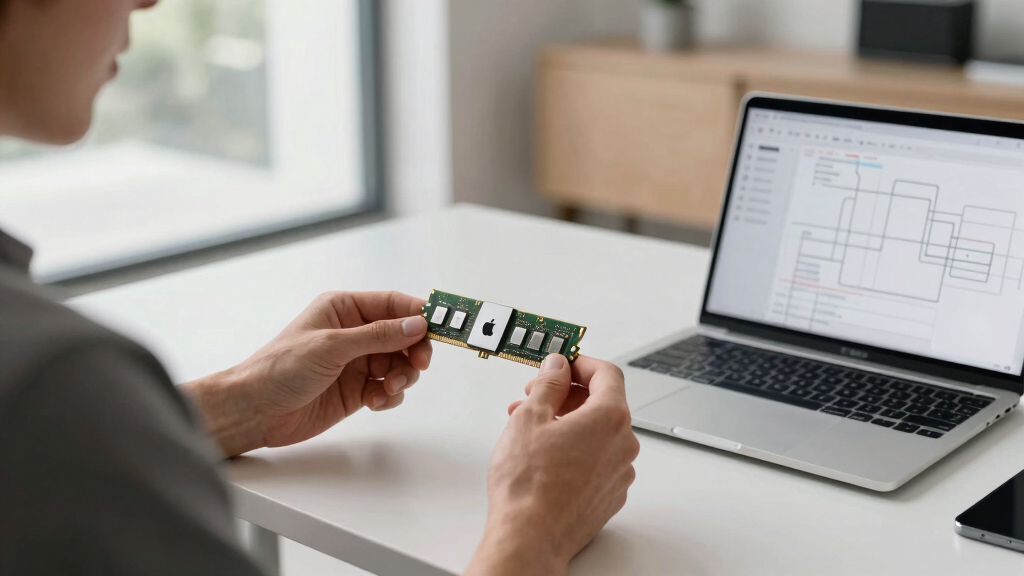
Apple is reportedly asking U.S. officials for clearance to buy memory chips from China’s ChangXin Memory Technologies, according to MarketWatch and Tom’s Hardware, both citing the Financial Times. The request matters because the memory shortage is now reaching consumer prices, while Europe lacks a comparable domestic DRAM or HBM option.
The reported request follows Apple’s price increases on Macs, iPads and other devices. The Verge reported that Apple raised several starting prices in response to memory and storage shortages, including increases on MacBook, iPad, iMac, HomePod and Apple TV models.
CXMT, short for ChangXin Memory Technologies, is a Chinese memory producer. Tom’s Hardware reported that the company is on the Pentagon’s 1260H list, which identifies certain Chinese military companies, though the report said CXMT is not the same as a fully prohibited Entity List supplier. That distinction is why Apple is described as seeking political clearance rather than simply switching suppliers.
The supply problem is wider than one Apple contract. DRAM remains dominated by Samsung, SK Hynix and Micron, with CXMT emerging as a lower-cost Chinese alternative. Europe has strong semiconductor assets, but it has no leading European DRAM or HBM maker, leaving buyers exposed when supply tightens.
Apple is reaching for Chinese memory. Europe doesn’t even have that option.
The shortage exposes America’s dependence — and Europe’s far more brutally. Apple has a domestic supplier, political weight, and the China option. Europe has no memory of its own, no seat at the table, no leverage on what counts.
- EU makes < 10% of the world’s semiconductors
- Effectively no DRAM, no HBM from Europe
- 3–4 memory makers worldwide — none European
- Pure price-taker: memory ~4× in 3 quarters
- ASML: EUV monopoly — no leading-edge chip without it
- Zeiss: precision optics, unrivalled worldwide
- imec · CEA-Leti · Fraunhofer: world-class research
- Infineon, NXP, STMicro: automotive · power · SiC
The shortage is a sovereignty test — Europe fails on supply but still holds the leverage in its hand. If even Apple can’t buy its way out, Europe’s answer isn’t to buy its way in, but to run two tracks: press the unique chokepoints as real leverage — and cut dependence wherever it can without Brussels: local-first, open weights, quantization, right-sized hardware. Bury the 20% dream, defend what’s yours, need less.
Europe Lacks Apple’s Escape Routes
Apple still has options: it can buy from Micron, press its case in Washington, or seek access to a Chinese supplier if officials allow it. European manufacturers and cloud buyers have less leverage because the continent has no domestic champion in the memory segment most affected by AI-driven demand.
That gap can reach readers through higher device prices, tighter supply of AI servers, and more expensive electronics across cars, industrial systems and public infrastructure. The Thorsten Meyer AI dispatch cited Counterpoint figures saying memory prices have roughly quadrupled over three quarters, with steeper increases in some segments.
The point is not that Europe has no chip industry. It does. The issue is narrower and more exposed: Europe is a price-taker in memory, while the AI buildout is making memory the scarce part of the computing stack.
As an affiliate, we earn on qualifying purchases.
A Supply Chain Built Elsewhere
The EU’s broader chip strategy has struggled to close the gap. The European Commission set a goal of lifting Europe’s share of global semiconductor production to 20 percent by 2030. But the European Court of Auditors said in its 2025 report that the Chips Act is very unlikely to be enough to hit that target.
The auditors said the Commission’s own forecast points to only 11.7 percent by 2030. They also said the EU’s microchip manufacturing capacity had fallen to about 9 percent in 2020, while investment and large fabs remained concentrated outside Europe.
Europe’s strengths are real but different. ASML dominates EUV lithography equipment, Zeiss supplies critical optics, and institutes such as imec, CEA-Leti and Fraunhofer support advanced research. Companies including Infineon, NXP and STMicroelectronics are strong in power, automotive and industrial chips, but those strengths do not replace DRAM or HBM production.
“very unlikely to be sufficient”
— European Court of Auditors, special report 12/2025
Approval And Volumes Remain Unsettled
It is not yet clear whether Washington will approve Apple’s reported request, whether any clearance would cover global products or only specific markets, or what volume CXMT could supply. Apple has not confirmed final purchasing terms in the reports cited.
It is also unclear how much CXMT could ease the shortage for high-end Apple devices. Analysts cited in coverage described CXMT as increasingly competitive in modern DRAM, but HBM for AI accelerators remains a separate, more constrained market led by Samsung, SK Hynix and Micron.
Brussels Faces A Memory Test
The next marker is the U.S. response to Apple’s reported request. A rejection would leave Apple more dependent on existing suppliers; approval would draw close scrutiny in Washington because of CXMT’s Pentagon designation.
For Europe, the pressure shifts to Chips Act revisions, advanced packaging, new memory architectures and procurement choices that reduce exposure to scarce components. The near-term question is whether Brussels can turn its ASML and research strengths into leverage while using less memory where software, model design and hardware choices allow it.
Key Questions
Is Apple confirmed to be buying CXMT memory chips?
No. The current development is that Apple is reportedly seeking U.S. clearance. Final approval, purchase volumes and product use have not been confirmed.
Why does CXMT require political clearance?
CXMT is on the Pentagon’s 1260H list, according to reports. That does not carry the same restrictions as the Entity List, but it makes any purchase by a major U.S. company politically sensitive.
Why is Europe more exposed than Apple?
Apple can turn to Micron, lobby Washington and explore a Chinese supplier. Europe has strong chip-related companies, but it lacks a leading domestic DRAM or HBM producer.
Does Europe have no semiconductor strength?
Europe has major strengths in ASML lithography, Zeiss optics, research institutes and power or automotive chips. The weakness in this story is specific: advanced memory supply.
Can the EU Chips Act solve the memory gap by 2030?
The European Court of Auditors says the current strategy is very unlikely to meet the 20 percent target. Memory production is even harder because DRAM and HBM are highly concentrated outside Europe.
Source: Thorsten Meyer AI