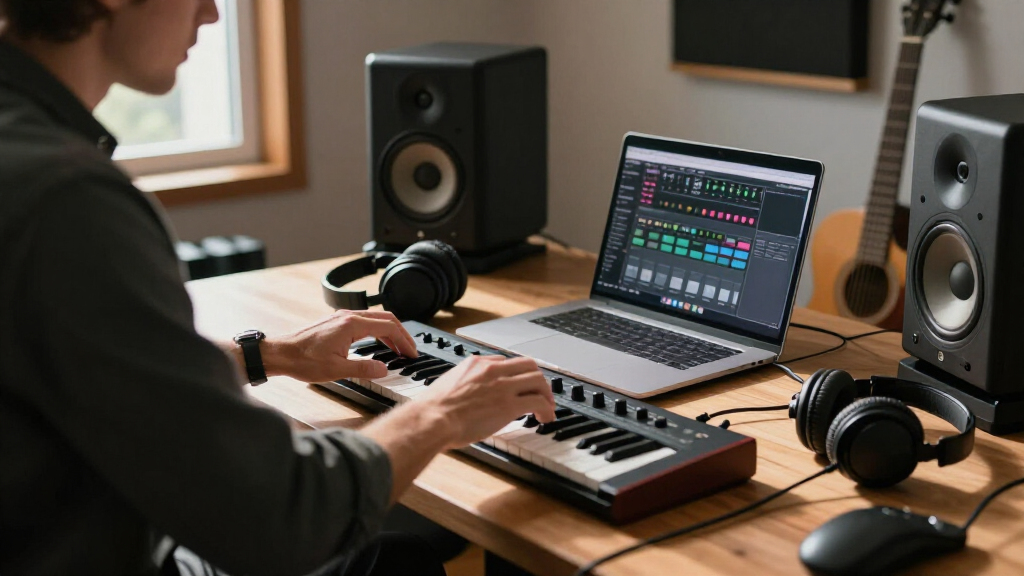
This checklist is for music makers and home studio builders choosing production gear for a new setup or deciding what to add next. It covers controllers, recording, monitoring, and headphone listening, with a separate advice-only section for hardware synthesizers.

Get audio and creator gear delivered free with Prime
- Fast, free delivery on millions of items
- Prime Video, Amazon Music and more included
- Member-only deals all year
The sections follow common studio roles: input and control, audio recording, playback, and sound generation. Each product pick has a distinct job, so consider how it fits your workflow before treating it as a must-have.
Use the checklist to compare connections, space, and compatibility with the equipment and software you already own. Confirm the details that matter for your setup, then prioritize the pieces that solve your most immediate production needs.
MIDI Keyboard Controllers
A MIDI keyboard controller gives you a hands-on way to enter notes and control music software. It can make composing, trying chords, and performing parts feel more direct than working only with a mouse. The Novation Launchkey 49 MK4 USB MIDI Keyboard Controller is the pick for this slot; before choosing any controller, think about how much keyboard range you actually use and where it will sit.
A common mistake is focusing on the number of keys without considering desk space and playing style. A larger keyboard can be useful for two-handed parts, but it also needs room to stay accessible. Check the product’s dimensions and key layout, and consider whether you need controls beyond the keys for your usual workflow. Compatibility also matters: confirm the controller works with your computer, connection setup, and intended music software, and check whether any setup steps are required.
Plan the placement before buying so the keyboard does not crowd your monitor, mouse, or other instruments. If you expect to move it between locations, account for cable routing and portability. The right fit is the controller that matches your playing habits and remains easy to reach during a session.
What to look for:
- Key count and layout suited to your playing
- Dimensions that fit your desk or stand
- USB connection compatibility with your setup
- Controls that support your software workflow
- Placement that leaves room for other equipment
Novation Launchkey 49 MK4 USB MIDI Keyboard Controller

The Launchkey 49 MK4 is a USB-C MIDI controller with 49 semi-weighted keys, 16 pads with polyphonic aftertouch, and hands-on controls for playing instruments, launching clips, and adjusting a DAW. It includes scale and chord modes, an editable arpeggiator, an OLED display, and integration with major DAWs and Native Instruments software.
Pros:
- Works with major DAWs
- Pads support polyphonic aftertouch and multiple uses
- Built-in scale, chord, and arpeggiator tools
- Includes music software and lessons
Cons:
- Requires a computer or compatible hardware setup
- Semi-weighted keys may not suit players seeking a fully weighted action
Best for: Producers who want a dedicated keyboard controller
Not ideal for: Setups with little room for a keyboard
Bottom line: Choose the Launchkey 49 MK4 if its key layout, footprint, and software compatibility suit your workflow.
Audio Interfaces
An audio interface connects studio equipment to a computer and supports recording and playback as part of a production setup. The Focusrite Scarlett 18i20 4th Gen USB-C Audio Interface is the pick for this section. Before choosing an interface, map out what you need to connect at the same time, such as microphones, instruments, and other audio equipment.
A frequent buying mistake is choosing by the product name alone without checking the input and output connections you need. Make a list of sources and destinations, including any monitoring or routing requirements, then compare that list with the interface’s documented connections and capabilities. Check that your computer has a compatible USB-C connection or that you have an appropriate, supported connection path. Confirm software and operating-system compatibility as well.
Consider where the interface will live and how you will reach its controls. If it will be mounted or tucked away, verify the physical fit and cable access before arranging the rest of the studio. Leave space for connected cables and avoid assuming that your future setup will need the same connections as your current one. A little planning can help the interface serve the sessions you actually run.
What to look for:
- Inputs for the sources you record simultaneously
- Outputs for your speakers and other destinations
- USB-C compatibility with your computer
- Software and operating-system support
- A location with room for connected cables
Focusrite Scarlett 18i20 4th Gen USB-C Audio Interface

The Scarlett 18i20 is a USB audio interface for project studios, with eight microphone preamps and extensive analog and digital connections for recording and routing studio gear. Its 24-bit/192 kHz converters, Air modes, Auto Gain, and Clip Safe features support detailed recordings and easier level management.
Pros:
- Eight microphone preamps with up to 69 dB of gain
- Extensive analog and digital connectivity
- 24-bit/192 kHz converters with 122 dB dynamic range
- Auto Gain and Clip Safe help manage recording levels
Cons:
- Weighs 8 pounds
- Requires USB connectivity to a compatible computer or device
Best for: Studios that need multiple audio connections
Not ideal for: Minimal setups that need few connections
Bottom line: Check the 18i20’s documented connections and compatibility against your recording plan.
Studio Monitor Speakers
Studio monitors provide speakers for listening to music while producing and checking a mix. The Yamaha HS7 7-Inch Powered Studio Monitor Pair is the pick for this slot. Speaker choice is closely tied to room placement and listening position, so consider the space where you will use them before settling on a pair.
A common mistake is choosing monitors based on size or appearance without checking whether they suit the room and available placement. Measure the desk, stands, and nearby surfaces, and review the product’s setup guidance for positioning. Consider where you sit in relation to the speakers and whether both can be arranged consistently. Also confirm the audio connections match your interface or other playback source; do not assume that included cables or adapters will cover your needs.
Plan for the practical details: power access, cable routing, and a stable place for each speaker. Check the manufacturer’s instructions for placement and setup, and leave enough room to make adjustments after listening in the space. The goal is a pair that fits your studio layout and connection plan, rather than one that simply fits on paper.
What to look for:
- Physical dimensions that fit your desk or stands
- Placement guidance for your room
- Connections compatible with your audio source
- Clear access to power and audio cables
- A listening position that works with the pair
Yamaha HS7 7-Inch Powered Studio Monitor Pair

This pair of two-way powered studio monitors is designed for accurate, clear sound during studio recording and mixing. Each monitor uses bi-amplification and accepts balanced or unbalanced signals through XLR and TRS inputs.
Pros:
- Designed for accurate, transparent sound
- Bi-amplification supports clear performance across frequency ranges
- XLR and TRS inputs accept balanced or unbalanced signals
Cons:
- The listed dimensions may not reflect the size of a single monitor
- The product information contains inconsistent water-resistance details
Best for: Producers building a speaker-based monitoring setup
Not ideal for: Rooms without suitable space or placement options
Bottom line: Choose the HS7 pair after checking placement, dimensions, and connection compatibility.
MIDI Drum Pads
A MIDI performance controller can add expressive, hands-on input to a production setup. The pick listed here is the Alesis Vortex Wireless 2 USB MIDI Wireless Keytar Controller. Since the product is described as a wireless keytar controller, consider whether that form and playing approach fit the way you want to perform or trigger parts.
A common mistake is treating every controller as interchangeable. Check the product documentation for its controls, connection options, power requirements, and compatibility with your computer and music software. The section name says MIDI drum pads, while the listed pick is a keytar controller; verify that the product’s actual form and functions match your intended use before buying. For a performance setup, plan the movement and connection needs around where you will stand, what you will control, and how the rest of your gear is arranged.
Wireless use can affect setup planning, so confirm the documented wireless requirements and any wired connection options. Check how the controller will communicate with your software and whether any configuration is needed. Consider a comfortable place to store it between sessions and keep the performance layout accessible. Choosing based on the product’s real controls and your intended playing style will help avoid a mismatch.
What to look for:
- Confirm the keytar form fits your intended use
- Documented controls and performance functions
- Wireless and wired connection requirements
- Compatibility with your computer and music software
- Comfortable space for playing and storage
Alesis Vortex Wireless 2 USB MIDI Wireless Keytar Controller

The Alesis Vortex Wireless 2 is a compact, wireless MIDI keytar with 37 velocity-sensitive keys, RGB trigger pads, and assignable controls, ideal for stage performances and creative music production. It includes software packages like MPC Beats and Ableton Live Lite, along with virtual instruments for versatile sound design.
Pros:
- Wireless connectivity for stage mobility
- Velocity-sensitive keys and trigger pads for expressive playing
- Includes comprehensive software package for music production
- Reversible pitch-bend wheel and assignable controls
Cons:
- Requires USB receiver for wireless connection
- Limited to Mac and PC platforms
- May have a learning curve for beginners
Best for: Performers who want a wearable MIDI controller
Not ideal for: Buyers specifically seeking a drum pad layout
Bottom line: Verify that the Vortex Wireless 2’s keytar format matches your intended controller role.
Hardware Synthesizers
A hardware synthesizer can provide dedicated sound generation within a music production setup. No specific product is listed for this section, so start by deciding what role you want a synth to play: a source for hands-on sound design, a performance instrument, or another way to create parts for a track.
A common buying mistake is choosing a synth before checking how it will connect to the rest of the studio. Consider the audio path into your interface, any MIDI connections you need, and whether the instrument can work with your intended computer and software setup. Review the manufacturer’s documentation for connectivity, power, included controls, and any required accessories. Check the instrument’s physical dimensions and make sure it has a stable, accessible place in your workspace.
Think about how you want to interact with the instrument and what sounds or workflow you are seeking, then compare documented features against those needs. If you plan to record it, consider how you will capture and monitor its output. If you plan to control it from software or another device, verify compatibility and routing in advance. A clear role and connection plan can help you choose a synth that fits the studio you are building.
What to look for:
- A sound-generation role that suits your workflow
- Audio connections compatible with your interface
- MIDI or other control options you need
- Documented software and device compatibility
- Dimensions, power needs, and accessory requirements
Studio Headphone Amplifiers
A headphone amplifier can be useful when your studio workflow calls for a separate headphone listening path. The listed pick is Headphone Amplifier with Bass Knob HiFi Amp 16-600Ω Gain Switch. Before choosing it, consider which headphones you plan to use and how the amplifier would connect to your existing audio source and listening setup.
A common mistake is relying on a product title alone to judge compatibility. The title mentions a 16-600Ω range and a gain switch; check the product documentation to confirm the supported headphone requirements, connections, and operating details. Make sure the input matches the output you intend to use, and check whether the setup needs additional cables or adapters. Do not assume the bass knob or gain switch will suit every headphone or listening preference.
Consider where the amplifier will sit and whether its controls will be easy to reach during a session. Plan for its power needs and cable routing, and confirm that using it fits your monitoring arrangement. If you use multiple headphones, check the documented outputs and intended use rather than assuming it supports every configuration. Match the amplifier to your headphone and connection requirements before adding it to the desk.
What to look for:
- Documented headphone compatibility for your pair
- An input that matches your audio source
- Output configuration suited to your listening needs
- Power and cable requirements
- Accessible placement for the gain and bass controls
Headphone Amplifier with Bass Knob HiFi Amp 16-600Ω Gain Switch

This headphone amplifier features adjustable bass control and flexible impedance matching, allowing for a personalized and balanced audio experience. It supports wired headphones via a 3.5mm connection, with a USB-C rechargeable battery providing 8-10 hours of portable use.
Pros:
- Adjustable bass control for customized sound
- Supports a wide range of headphone impedances
- Portable with long battery life and durable build
- Easy to connect to various devices
Cons:
- Performance may vary depending on headphone compatibility
- Limited to wired connection only
Best for: Listeners who need a separate headphone amp
Not ideal for: Setups whose headphones and source lack a confirmed match
Bottom line: Confirm the amplifier’s supported headphones and connections before adding it to your setup.
Build in a needs-first order: start with the gear that addresses your immediate work, such as a controller for note entry or an interface for recording. Add monitors, performance controls, a synthesizer, or a headphone amplifier when your workflow and available space call for them. Check compatibility and connections before each purchase.
You do not need to complete every category at once. Use this checklist to shape a setup around how you make music, verify the details that matter to your equipment, and add pieces as your sessions grow. A thoughtful, well-fitting setup is a solid place to start.
Halloween Picks
halloween
As an affiliate, we earn on qualifying purchases.