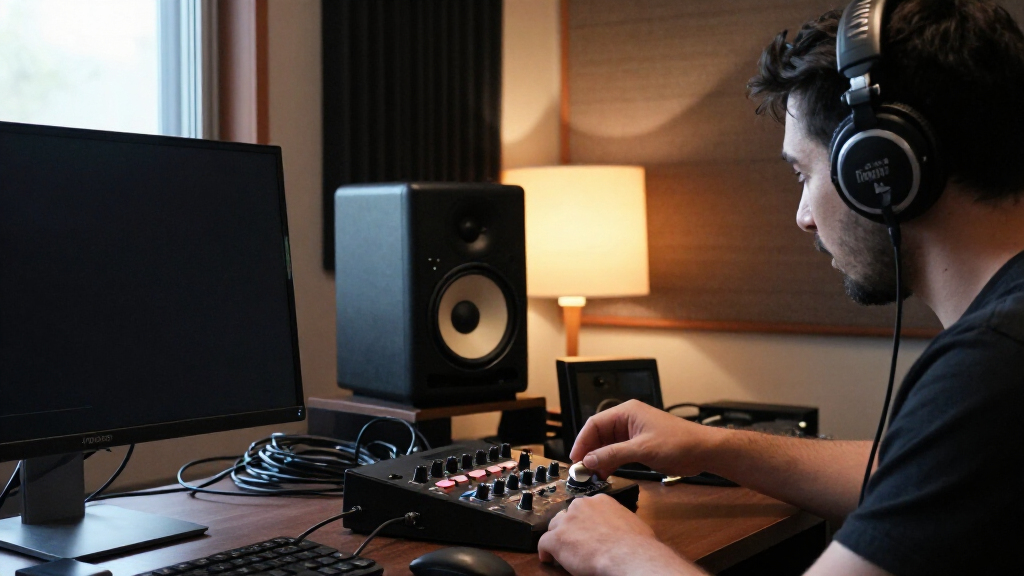
Studio monitor controllers range from simple passive volume knobs to desktop hubs with USB audio, talkback, and multiple monitor outputs. I’d put the Mackie Big Knob Studio Monitor Controller and USB Interface in the best-overall position for its blend of monitoring control and computer connectivity, while the Radial Nuance Select suits focused monitor switching and the Behringer Studio XL offers a broader control-center approach. The main tradeoff is whether you want straightforward, signal-path-focused control or extra routing and communication features. More connections can simplify a complex studio, but they also take up space and add setup decisions. Read on for the full comparison and guidance on choosing a controller that fits your workflow.

Get audio and creator gear delivered free with Prime
- Fast, free delivery on millions of items
- Prime Video, Amazon Music and more included
- Member-only deals all year
Complete the kit


Key Takeaways
- The lineup splits into two types: passive controllers such as the Mackie Big Knob Passive and StudioMan M04 prioritize level and source or speaker selection, while USB-equipped models add computer audio connectivity.
- The Mackie Big Knob Studio is the strongest all-round fit: it pairs monitoring controls with a USB interface, making it a practical choice when a separate control surface and basic computer connection would otherwise be needed.
- The Behringer Studio XL and CONTROL2USB favor larger, more connected setups: their control-center approach makes more sense when routing and communication needs outweigh desk space and simplicity.
- Several listings describe near-identical Mackie models: buyers should check the exact model name and included accessories rather than assume that Studio, Studio+, Studio Plus, and Passive versions share the same connections.
- A passive controller can be the better choice for a simple rig: fewer added functions mean less setup complexity, but these models do not replace an audio interface or provide the expanded communication features found on some active units.
| Mackie Big Knob Studio Monitor Controller and USB Interface |  | Best Overall | Brand: Mackie | Model: Big Knob Studio | Connectivity: USB | VIEW LATEST PRICE | See Our Full Breakdown |
| Mackie Big Knob Studio+ Monitor Controller and USB Interface |  | Best for Collaborative Recording | Brand: Mackie | Model: Big Knob Studio+ | Connectivity: USB | VIEW LATEST PRICE | See Our Full Breakdown |
| Behringer Studio XL Monitor Controller |  | Best for USB-Equipped Windows Studios | Brand: Behringer | Model: Studio XL | Connectivity: USB | VIEW LATEST PRICE | See Our Full Breakdown |
| Radial Nuance Select Studio Monitor Controller |  | Best for a Dedicated Analog Monitoring Setup | Model: R800 2026 00 | Stereo input sources: 2 | Speaker outputs: 2 powered outputs | VIEW LATEST PRICE | See Our Full Breakdown |
| Mackie Big Knob Passive 2×2 Monitor Controller |  | Best Simple Passive Controller | Brand: Mackie | Model: Big Knob Passive | Type: Passive monitor controller | VIEW LATEST PRICE | See Our Full Breakdown |
| Mackie Big Knob Studio Plus Monitor Controller and USB Audio Interface |  | Best All-in-One for Multiple Monitor Pairs | Audio sources: 4 | Monitor pairs: 3 | Recording and playback resolution: 192 kHz / 24-bit | VIEW LATEST PRICE | See Our Full Breakdown |
| StudioMan M04 Passive Monitor Controller, 2 Inputs and 4 Outputs |  | Best for Four-Output Switching on a Simple Setup | Inputs: 2 | Outputs: 4 | Connectors: 1/4-inch unbalanced | VIEW LATEST PRICE | See Our Full Breakdown |
| Behringer XENYX CONTROL2USB Studio Control and Communication Center |  | Best for Talkback and Session Communication | Model: CONTROL2USB | Connectivity: USB | Number of channels: 3 | VIEW LATEST PRICE | See Our Full Breakdown |
| Mackie Big Knob Studio Monitor Controller and USB Audio Interface |  | Best for a Recording-Ready Two-Monitor Setup | Audio sources: 3 | Monitor outputs: 2 pairs | Recording resolution: 96 kHz / 24-bit listed; product information also cites 192 kHz | VIEW LATEST PRICE | See Our Full Breakdown |
| Mackie Big Knob Passive Studio Monitor Controller with 5 ft TRS Cable |  | Best Simple Passive Controller | Audio channels: 2 | Inputs: 2 audio sources | Monitor outputs: 2 pairs | VIEW LATEST PRICE | See Our Full Breakdown |
| PreSonus Monitor Station V2 Desktop Studio Control Center |  | Best for Multi-Listener Sessions | Inputs: 4 stereo input pairs and 1 S/PDIF digital input | Speaker outputs: 3 stereo pairs with individual level controls | Headphone amplifiers: 4 stereo amplifiers with volume controls and independent source selection | VIEW LATEST PRICE | See Our Full Breakdown |
| studio monitor controller | Connectivity | Weight | Model |
|---|---|---|---|
| Mackie Big Knob Studio Monitor | USB | 5.4 pounds | Big Knob Studio |
| Mackie Big Knob Studio+ Monito | USB | — | Big Knob Studio+ |
| Behringer Studio XL Monitor Co | USB | 5.2 pounds | Studio XL |
| Radial Nuance Select Studio Mo | — | 3.34 pounds | R800 2026 00 |
| Mackie Big Knob Passive 2×2 Mo | — | — | Big Knob Passive |
| Mackie Big Knob Studio Plus Mo | USB | 5 lb | — |
| StudioMan M04 Passive Monitor | — | 1.72 lb | — |
| Behringer XENYX CONTROL2USB St | USB | 5.3 lb | CONTROL2USB |
| Mackie Big Knob Studio Monitor | USB | 5.1 lb | — |
| Mackie Big Knob Passive Studio | Wired, 1/4-inch TRS | — | — |
| PreSonus Monitor Station V2 De | RCA, TRS, and coaxial | 5 lb | — |
More Details on Our Top Picks
Mackie Big Knob Studio Monitor Controller and USB Interface
The Big Knob Studio balances practical monitor switching with a built-in recording path, making it a strong fit for a project studio that needs more than a volume knob. It selects among three sources and two monitor pairs, while independent source trim helps level-match inputs before comparing them. Mono, mute, and dim controls make quick checks easier without reaching for software. Its 2×2 USB interface records and plays back at up to 24-bit/192 kHz, so it can handle basic studio capture as well as monitoring.
Compared with the Big Knob Studio+, this model gives up a monitor pair, a source, mic inputs, talkback, and a second headphone output. That simpler layout is easier to justify when those extras would go unused, but it is less suited to collaborative sessions. The provided specifications do not identify a clear limitation in sound quality; the main tradeoff is fewer routing and recording options than the Studio+.
Pros:- Switches among three audio sources and two monitor pairs
- Independent source trim plus mono, mute, and dim controls support useful monitoring checks
- Built-in 2×2 USB interface records and plays back at up to 24-bit/192 kHz
- Works with Windows and Mac
Cons:- Provides fewer source and monitor connections than the Big Knob Studio+
- Does not list microphone inputs, talkback, or dual headphone outputs
Best for: Project-studio owners who want to switch between several sources and two monitor pairs while recording through a USB interface.
Not ideal for: Producers who regularly record two microphones, run three monitor pairs, or need talkback and multiple headphone mixes; the Big Knob Studio+ offers more session routing.
- Brand:Mackie
- Model:Big Knob Studio
- Connectivity:USB
- Audio sources:3
- Monitor pairs:2
- Recording and playback resolution:24-bit / 192 kHz
- Compatible operating systems:Windows, Mac
- Weight:5.4 pounds
Our verdict“Choose the Big Knob Studio for a project room that needs flexible everyday monitoring and USB recording without the Studio+’s expanded session features.”
Mackie Big Knob Studio+ Monitor Controller and USB Interface
For a studio where monitoring and recording happen at the same time, the Big Knob Studio+ earns its place through breadth of routing. It handles four input sources and three monitor pairs, then adds two phantom-powered mic inputs, dual headphone outputs, talkback, and zero-latency cue mixing. That combination gives a small team more ways to listen and communicate without building a separate monitor and cue system. The 2×4 USB interface records up to 24-bit/192 kHz, matching the resolution listed for the smaller Big Knob Studio.
Compared with that Big Knob Studio, the Studio+ is better equipped for guests, multiple speakers, and alternate monitor checks, but the extra routing may be unnecessary in a solo setup. It is also more feature-dense than the passive Big Knob Passive, which avoids USB and microphone functions altogether. Buyers who want a straightforward analog controller may find the Studio+’s expanded interface more than they need.
Pros:- Routes four sources to three monitor pairs
- Two combo mic inputs provide phantom power
- Dual headphone outputs, talkback, and zero-latency cue mixing support collaborative sessions
- 2×4 USB interface records at up to 24-bit/192 kHz
Cons:- More routing and recording features than a basic monitor-only setup may need
- Larger feature set is less direct than the passive Big Knob Passive for simple source and speaker switching
Best for: Small recording teams and project studios that need multiple monitor pairs, two microphone inputs, and separate headphone listening during sessions.
Not ideal for: Solo producers who only switch between a couple of sources and speakers, or buyers seeking a simple passive controller without a USB interface.
- Brand:Mackie
- Model:Big Knob Studio+
- Connectivity:USB
- Input sources:4
- Monitor pairs:3
- Microphone inputs:2 combo XLR-1/4-inch inputs with phantom power
- Headphone outputs:2
- Recording resolution:Up to 24-bit / 192 kHz
- Compatible operating systems:Windows and Mac
Our verdict“Pick the Big Knob Studio+ when several people need distinct listening and talkback options alongside broad monitor switching.”
Behringer Studio XL Monitor Controller
The Behringer Studio XL combines monitor control with a 2×4 USB interface and Midas microphone preamps, so it makes sense for a Windows-based room that wants a single unit to cover monitoring and basic recording. Its listed maximum sample rate of 192 kHz gives the interface room for high-resolution sessions, while the mic preamps add a recording function not specified for the Radial Nuance Select. That makes the Studio XL the more recording-oriented choice between the two.
The tradeoff is compatibility clarity: the supplied data lists Windows as its operating system, whereas both Mackie Big Knob USB models list Windows and Mac. The Studio XL also lacks the detailed source and monitor switching counts provided for those Mackies, so buyers comparing routing needs have less information here. It suits a Windows workstation that values interface and preamp integration, but it is a less straightforward choice for Mac users or anyone prioritizing clearly documented monitor routing.
Pros:- Built-in 2×4 USB audio interface
- Midas microphone preamps add recording capability
- Supports sample rates up to 192 kHz
- Combines monitor control and USB audio in one studio unit
Cons:- Listed operating-system compatibility is limited to Windows
- Source and monitor-pair counts are not specified in the provided product data
Best for: Windows-based home and project studios that want monitor control, a 2×4 USB interface, and Midas mic preamps in one unit.
Not ideal for: Mac users or buyers who need clearly specified counts for source selection and monitor-pair switching before choosing a controller.
- Brand:Behringer
- Model:Studio XL
- Connectivity:USB
- USB interface configuration:2×4
- Microphone preamps:Midas
- Maximum sample rate:192 kHz
- Listed operating system:Windows
- Weight:5.2 pounds
Our verdict“Choose the Studio XL if your studio is Windows-based and you value its integrated USB interface and Midas preamps over clearly documented routing options.”
Radial Nuance Select Studio Monitor Controller
The Radial Nuance Select is the most focused monitor-only option in this group. It provides two stereo input sources, two powered speaker outputs, and an auxiliary output, with a low-noise design and front-panel controls aimed at a professional studio workflow. Its steel chassis and milled aluminum faceplate also suit a permanent desk installation better than a lightweight, bare-bones controller. Unlike the USB-equipped Mackie Big Knob Studio, the Radial is not presented as a recording interface; its appeal is keeping monitoring control separate from computer audio duties.
That focus limits flexibility: the Big Knob Studio offers more source selection and built-in USB recording, while the Big Knob Passive also switches between two monitor pairs. The Radial’s listed outputs are powered speaker outputs, so buyers should confirm the connection format fits their setup. Its supplied specifications also do not detail functions such as dim, mute, or mono. This is a considered fit for a dedicated analog signal path, not an all-in-one studio hub.
Pros:- Supports two stereo input sources
- Provides two powered speaker outputs and an auxiliary output
- Low-noise operation suits a dedicated monitoring path
- Steel chassis and milled aluminum faceplate are suited to fixed studio use
Cons:- Does not list a built-in USB audio interface
- Fewer specified source and speaker-routing options than the Mackie Big Knob Studio
- Provided specifications do not detail common controls such as mono, mute, or dim
Best for: Studio owners with a dedicated analog monitoring chain who want two stereo sources, powered speaker outputs, and a sturdy desk controller.
Not ideal for: Producers who need a built-in USB recording interface, several monitor pairs, or explicitly listed mono, mute, and dim controls.
- Model:R800 2026 00
- Stereo input sources:2
- Speaker outputs:2 powered outputs
- Auxiliary output:Yes
- Chassis material:Stainless steel
- Weight:3.34 pounds
- Dimensions:12.55 x 8.8 x 8.3 inches
Our verdict“Choose the Nuance Select for a sturdy, low-noise analog monitoring setup when USB recording and extensive switching are not priorities.”
Mackie Big Knob Passive 2×2 Monitor Controller
The Big Knob Passive is the straightforward choice for switching between two sources and two monitor pairs without adding a USB interface or recording features. Its passive audio path keeps the unit focused on level and selection duties, while the metal tabletop enclosure is suited to a permanent studio or editing desk. Compared with the Mackie Big Knob Studio, it gives up USB recording and independent source trim, but its simpler role may suit a setup where the computer interface already handles conversion and recording.
It is also less elaborate than the Big Knob Studio+, which adds mic inputs, talkback, and headphone cue functions for collaborative sessions. Those omissions keep the Passive model’s job clear, but they set a firm ceiling on flexibility: it only handles two sources and two speaker pairs, and it has no wireless connectivity. Buyers who need interface features or more routing should choose a different Big Knob; buyers who want basic analog switching can avoid paying for functions they will not use.
Pros:- Switches between two sources and two monitor pairs
- Passive audio path keeps its role focused on monitor control
- Metal tabletop enclosure is built for studio desk use
- Simple level and selection duties without a built-in recording interface
Cons:- Limited to two sources and two monitor pairs
- Does not provide a USB audio interface or recording functions
- No wireless connectivity
Best for: Home-studio owners and editors with an existing audio interface who need a simple passive way to select between two sources and two monitor pairs.
Not ideal for: Producers who need USB recording, microphone inputs, talkback, or more than two sources or monitor pairs.
- Brand:Mackie
- Model:Big Knob Passive
- Type:Passive monitor controller
- Configuration:2×2
- Source selection:2 sources
- Monitor selection:2 monitor pairs
- Mounting type:Tabletop
- Enclosure material:Metal
- Warranty:1-year all-inclusive, nontransferable
Our verdict“Pick the Big Knob Passive if your interface is already in place and you need uncomplicated switching between two sources and two speaker pairs.”
Mackie Big Knob Studio Plus Monitor Controller and USB Audio Interface
The Big Knob Studio Plus is the most flexible Mackie option here for a desk where several sources and monitor pairs need to stay connected. It switches among four audio sources and three monitor pairs, while independent trim helps balance different speakers. Its USB interface adds 192 kHz/24-bit recording and playback, two Onyx mic preamps with phantom power, and two headphone outputs, so it can handle recording duties as well as speaker control. Compared with the smaller Big Knob Studio, it offers an extra source and monitor pair and a higher listed recording resolution. That added reach brings more functionality than a straightforward passive controller needs, though: USB recording depends on a computer, and buyers who only need basic level and mute control may be better served by the Big Knob Passive.
Pros:- Switches between four audio sources and three monitor pairs
- USB interface supports recording and playback at 192 kHz/24-bit
- Two Onyx mic preamps include phantom power
- Dual headphone outputs and a front-panel 1/8-inch input support flexible sessions
Cons:- USB recording and playback require a computer
- More features and connections than needed for basic monitor-level control
Best for: Home and project studio owners who record microphones, keep several sources connected, and switch among as many as three monitor pairs.
Not ideal for: Buyers who want a simple, computer-free monitor controller or only need to switch between one source and one speaker pair.
- Audio sources:4
- Monitor pairs:3
- Recording and playback resolution:192 kHz / 24-bit
- Mic preamps:2 Onyx
- Headphone outputs:2
- Connectivity:USB
- Compatible operating systems:Mac, Windows
- Weight:5 lb
Our verdict“Choose the Studio Plus if you need recording inputs and frequent switching across multiple sources and monitor pairs in one desktop unit.”
StudioMan M04 Passive Monitor Controller, 2 Inputs and 4 Outputs
The StudioMan M04 suits a studio that needs to route two sources to four outputs without adding another powered device. Its passive design needs no external power, and the volume knob and one-click mute keep the central controls direct. Compared with the Mackie Big Knob Passive, the M04 lists four outputs rather than two monitor pairs, making it the more relevant choice when a setup needs more output destinations. The tradeoff is its 1/4-inch unbalanced connections, which may be a poor fit for studios built around balanced cabling or longer runs. It also lacks the Mackie’s stated mono and dim controls, and it does not add USB recording, mic inputs, or headphone outputs. I’d choose it for straightforward routing, not as a recording hub.
Pros:- Routes two inputs to four outputs
- Passive operation requires no external power
- Provides a dedicated volume knob and one-click mute
- Compact desktop footprint for a multi-output routing role
Cons:- Uses unbalanced 1/4-inch connectors
- Does not list mono, dim, headphone, or USB interface functions
- No external power or built-in battery if a powered feature set is needed
Best for: Small studios that need to switch two unbalanced sources among four outputs and want a passive controller with volume and mute.
Not ideal for: Engineers using balanced connections, needing mono or dim controls, or looking for a USB interface and recording inputs.
- Inputs:2
- Outputs:4
- Connectors:1/4-inch unbalanced
- Power:Passive; no external power required
- Controls:Volume knob and mute button
- Weight:1.72 lb
- Package dimensions:9.25 × 6.57 × 2.64 in
- Warranty:1 year
Our verdict“Pick the M04 when passive, unbalanced routing to four outputs matters more than balanced connections or extra studio controls.”
Behringer XENYX CONTROL2USB Studio Control and Communication Center
The XENYX CONTROL2USB earns its place by pairing monitor and source control with a feature many simpler controllers omit: a built-in talkback microphone with level control. That can make communication with performers more direct during tracking, while master volume and monitor switching keep core listening controls in the same unit. Its USB interface supports sample rates up to 192 kHz, adding a computer connection that the passive Mackie Big Knob Passive does not provide. The available data, however, is less specific about the CONTROL2USB’s input and output options than the Mackie Studio models, which list mic preamps, headphone outputs, and monitor-pair counts. Compatibility information also names Windows and a particular Ableton Live version, so I’d verify that fit before choosing it for another system. This is the communication-focused pick, not the clearest choice for a narrowly specified routing setup.
Pros:- Built-in talkback microphone has level control
- Combines master volume, source selection, and monitor switching
- USB audio interface supports sample rates up to 192 kHz
- VCA control is included in the listed package
Cons:- Available product data does not specify monitor-pair or headphone-output counts
- Listed operating-system and software compatibility may not suit every studio computer
- The USB interface and control-center functions add complexity beyond a basic passive controller
Best for: Recording spaces where talkback to performers is a regular need and a USB-connected control center is preferable to a passive box.
Not ideal for: Buyers who need clearly documented monitor-pair and headphone-output counts, or who need confirmed compatibility beyond the listed Windows and Ableton details.
- Model:CONTROL2USB
- Connectivity:USB
- Number of channels:3
- Maximum sample rate:192 kHz
- Talkback:Built-in microphone with level control
- Operating system:Windows
- Supported software:Ableton Live 10 or later
- Weight:5.3 lb
Our verdict“Choose the CONTROL2USB when talkback is central to your sessions and its listed computer compatibility matches your setup.”
Mackie Big Knob Studio Monitor Controller and USB Audio Interface
The Big Knob Studio is a practical middle ground for a small recording desk: it combines monitor control with two Onyx mic preamps, phantom power, and two independently controlled headphone outputs. It switches among three sources and two monitor pairs, so it covers more listening options than the two-source, two-pair Big Knob Passive, while adding USB recording and overdubbing. The listed recording specification is 96 kHz/24-bit, below the Studio Plus’s listed 192 kHz/24-bit capability, but the simpler routing may be enough if two monitor pairs are sufficient. There is a specification conflict to watch: the product information also cites 192 kHz in the title and item details, while the description and specs say 96 kHz. I’d verify the intended rate before buying if that distinction affects your workflow.
Pros:- Combines monitor control with a USB recording interface
- Includes two Onyx mic preamps with phantom power
- Switches among three sources and two monitor pairs
- Two headphone outputs have independent level controls
Cons:- Product information conflicts on the supported sample rate, listing both 96 kHz and 192 kHz
- USB recording and playback require a computer
- Offers two monitor pairs rather than the Studio Plus’s three
Best for: Small project studios that need two microphone inputs, two headphone feeds, and switching between three sources and two monitor pairs.
Not ideal for: Buyers who need three monitor pairs, want a clearly consistent sample-rate specification, or do not want recording to depend on a computer.
- Audio sources:3
- Monitor outputs:2 pairs
- Recording resolution:96 kHz / 24-bit listed; product information also cites 192 kHz
- Microphone preamps:2 Onyx, with phantom power
- Headphone outputs:2, with independent level control
- Connectivity:USB
- Compatibility:Mac and Windows
- Weight:5.1 lb
Our verdict“Choose the Big Knob Studio for a compact recording setup that needs mic preamps and two monitor pairs, after confirming its sample-rate specification.”
Mackie Big Knob Passive Studio Monitor Controller with 5 ft TRS Cable
The Big Knob Passive focuses on the core monitor-controller job: changing sources and speaker pairs while keeping listening level under hand. It switches between two sources and two monitor pairs, with mono, mute, and dim controls that help check a mix or quickly reduce playback. Since it is passive, it needs no power supply; the included 5 ft Hosa TRS cable also gives this bundle a useful connection for a wired setup. Compared with the StudioMan M04, the Mackie offers named mono and dim functions, while the M04 lists four outputs. Neither adds a USB interface or mic preamps, so the Studio models make more sense for recording directly through the controller. This is a focused, low-complexity choice, but its wired passive design will not suit anyone expecting powered outputs or computer connectivity.
Pros:- Switches between two audio sources and two monitor pairs
- Provides volume, mono, mute, and dim controls
- Passive operation requires no power supply
- Includes a 5 ft Hosa 1/4-inch TRS cable and metal enclosure
Cons:- Wired connection only, with no USB interface
- Passive monitor control does not provide powered audio output
- Limited to two sources and two monitor pairs
Best for: Producers who want a straightforward, power-free controller for two sources and two monitor pairs, with quick mono, mute, and dim access.
Not ideal for: Recording setups that need USB audio, mic preamps, or headphone outputs, and studios that need more than two monitor pairs.
- Audio channels:2
- Inputs:2 audio sources
- Monitor outputs:2 pairs
- Controls:Volume, mono, mute, dim
- Signal-to-noise ratio:120 dB
- Connectivity:Wired, 1/4-inch TRS
- Enclosure material:Metal
- Included cable:Hosa CSS-105, 5 ft 1/4-inch TRS
Our verdict“Pick the Big Knob Passive for direct, power-free control of a two-source, two-monitor-pair setup without recording features.”
PreSonus Monitor Station V2 Desktop Studio Control Center
The Monitor Station V2 is the most session-focused pick here: three selectable speaker pairs, four headphone amplifiers, and a built-in talkback mic let a producer manage control-room listening and multiple performers from one desktop unit. Independent headphone source selection is especially useful when musicians need different playback mixes, a flexibility the simpler Mackie Big Knob Passive 2×2 does not offer. Its four stereo input pairs plus S/PDIF input also suit a setup that combines analog gear with a digital source.
The tradeoff is scale. At 16.85 inches wide, it takes more desk space than a compact passive controller, and its feature set is excessive for someone who only switches between two speaker pairs. The listed sample-rate ceiling is 96 kHz, and the software compatibility field names Ableton Live only, so buyers should check their particular connection and workflow needs rather than assume a broad software bundle.
Pros:- Three stereo speaker outputs have individual level controls for managing several monitor pairs.
- Four headphone amplifiers provide volume controls and independent source selection for multi-performer sessions.
- Four stereo input pairs and coaxial S/PDIF accommodate a mix of analog and digital sources.
- Built-in talkback microphone and main and cue controls support studio communication and monitoring.
Cons:- The 16.85 × 12.12-inch footprint can crowd a compact desktop.
- Its extensive routing and headphone features may be unnecessary for a basic one-person monitoring setup.
- The supplied software compatibility listing names Ableton Live only, leaving other workflows less clearly documented.
Best for: Home and project-studio producers who regularly switch among several sources and speaker pairs while sending separate headphone feeds to multiple musicians.
Not ideal for: Solo producers with a small desk or a simple two-speaker setup who do not need talkback or multiple independently selectable headphone feeds.
- Inputs:4 stereo input pairs and 1 S/PDIF digital input
- Speaker outputs:3 stereo pairs with individual level controls
- Headphone amplifiers:4 stereo amplifiers with volume controls and independent source selection
- Connectivity:RCA, TRS, and coaxial
- Maximum sample rate:96 kHz
- Frequency response:50 kHz
- Dimensions:16.85 × 12.12 × 4.9 in
- Weight:5 lb
- Warranty:One year
Our verdict“Choose the Monitor Station V2 when your sessions need several speaker options and independently sourced headphone feeds; pick a smaller, simpler controller if they do not.”
How We Picked
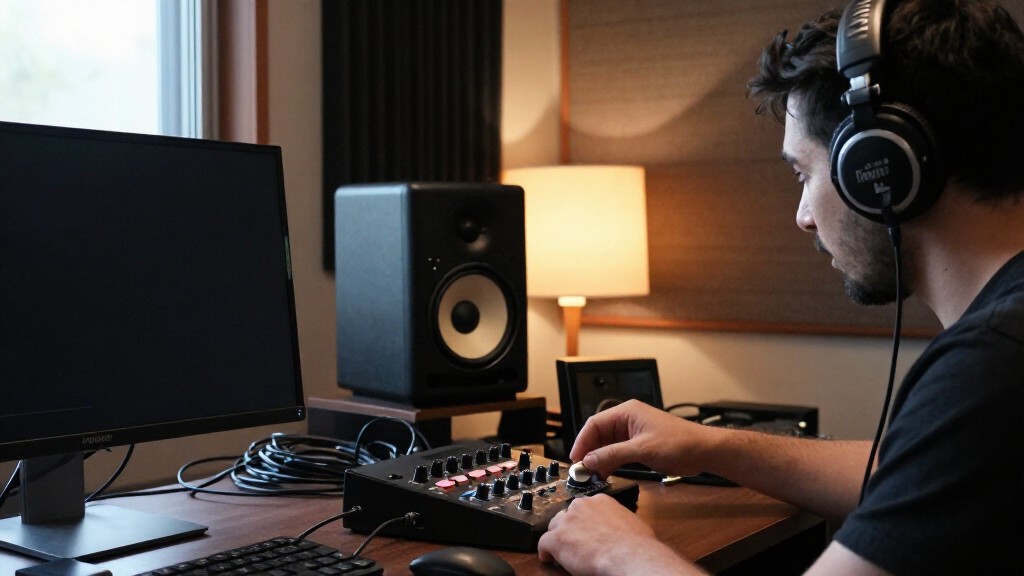
I ranked these studio monitor controllers by how well their control sets match common studio workflows: changing listening level, switching sources or speaker pairs, and adding useful connections without unnecessary complexity. I also weighed ease of use, connection flexibility, desktop practicality, and the role of any built-in USB interface. A feature only counted as an advantage when it solved a clear monitoring or routing need.
The order favors a strong balance of everyday control and connectivity, then separates specialized alternatives by who benefits from them. Passive models rank well for simple, direct monitoring, but sit below multifunction units for buyers who need an interface or communication tools. Larger control centers offer more ways to manage a studio, though they make less sense for compact setups. Because the lineup includes several similarly named Mackie listings, I treat each as a distinct listed option and recommend checking the exact model and included items before buying.
| studio monitor controller | Model | Connectivity |
|---|---|---|
| Mackie Big Knob Studio Monitor | Big Knob Studio | USB |
| Mackie Big Knob Studio+ Monito | Big Knob Studio+ | USB |
| Behringer Studio XL Monitor Co | Studio XL | USB |
| Radial Nuance Select Studio Mo | R800 2026 00 | — |
| Mackie Big Knob Passive 2×2 Mo | Big Knob Passive | — |
| Mackie Big Knob Studio Plus Mo | — | USB |
| StudioMan M04 Passive Monitor | — | — |
| Behringer XENYX CONTROL2USB St | CONTROL2USB | USB |
| Mackie Big Knob Studio Monitor | — | USB |
| Mackie Big Knob Passive Studio | — | Wired, 1/4-inch TRS |
| PreSonus Monitor Station V2 De | — | RCA, TRS, and coaxial |
Factors to Consider When Choosing Studio Monitor Controllers
Choosing a controller starts with your studio’s signal flow, not the number of knobs on the front panel. I’d map out what needs to connect, what you switch during a session, and which tasks you want to control from the desk. These factors help separate a useful control hub from features that add cost and clutter without changing your workflow.
Map Your Sources and Monitor Outputs
Write down every listening source and speaker pair you expect to switch between, including headphones if you want them controlled from the same unit. A common mistake is counting only today’s connections and forgetting a second computer, alternate speakers, or a reference source. Extra routing is useful when you will use it regularly; unused inputs can make a controller harder to set up without improving daily work. Check the exact connection types on the unit and compare them with your interface and speakers. If your setup is fixed and minimal, a simpler controller may be easier to operate than a larger control center. Leave a little room for future additions, but do not choose on hypothetical needs alone.
Decide Whether You Need a USB Interface
A controller with USB audio can combine monitoring control and computer connectivity, which may reduce the number of desktop devices in a compact studio. It is not automatically a replacement for a dedicated interface: compare its input and output needs with your recording workflow before relying on it. If you already own an interface that handles your sessions, paying for another audio path may add little value. Also check how the controller connects to the computer and how its outputs fit your existing signal chain. Buyers often treat USB as a general feature rather than asking what task it will perform. Choose an integrated unit when it solves a real connection or space problem, not simply because it has more functions.
Choose Passive or Active Control Deliberately
Passive controllers appeal to buyers who want direct level adjustment and basic switching without a built-in interface or an array of extra controls. Their simpler role can make them a tidy match for a small, already-equipped studio. Active multifunction models can serve as a broader desk hub, but their added controls only pay off when you use the routing or communication options. Do not assume passive means universally more transparent or active means automatically more capable for your needs; inspect the stated signal path and feature set. Think about what happens if you change your interface or speaker setup later. The right choice is the one that fits your whole chain and leaves the fewest workarounds.
Prioritize Controls You Can Reach During a Session
Volume changes, source selection, speaker switching, mute, and talkback matter most when they are easy to reach without interrupting a session. A long feature list is less useful if the controls you need are awkwardly placed or difficult to identify. Consider whether you regularly work alone, communicate with performers, or compare mixes across multiple speaker pairs. Those habits determine which controls deserve space on the front panel. If you mainly need a reliable master level knob, a large communication-oriented unit may be excessive. If you often change listening modes, fast access can matter more than a smaller footprint.
Match the Controller to Your Desk and Cable Plan
Desktop space and cable routing can decide whether a feature-rich controller is practical. Measure the space available and account for the connectors and cable bends behind the unit, not just its front-panel width. A larger control center may reduce separate boxes but still create a crowded workspace if its connections face into a wall or overlap other gear. Smaller passive models can keep a desk clear, though they may leave interface and communication tasks to other equipment. Check which cables are included, since accessory listings can differ even when product names look similar. Treat the complete setup—not the controller alone—as the footprint you are choosing.
Pay for Features That Replace a Real Workaround
Extra routing, communication controls, and computer connectivity are worth paying for when they replace a separate device or repeated manual steps. Before choosing a higher-feature model, identify the workaround it removes and how often that problem comes up. For a simple two-source, one-pair setup, a basic controller may do the job with less complexity. For a studio with several listening destinations or regular performer communication, additional controls can make sessions smoother. Do not equate a longer spec sheet with better value. Compare the functions you will use against the cost in desk space, setup time, and signal-chain complexity.
Frequently Asked Questions
Should I choose a passive monitor controller or one with a USB interface?
Choose based on whether your current audio interface already covers your recording and playback needs. A passive controller is a more direct fit when you only need convenient listening-level control or basic switching from existing gear. A USB-equipped model may simplify a compact setup if its computer connection and available inputs and outputs match your workflow. It does not automatically replace a full recording interface, so compare the required connections before changing your signal chain. If you do not need the USB function, the extra feature may not justify a more complex unit.
Can one monitor controller replace my audio interface?
Not necessarily. Some controllers add USB audio, but the available inputs, outputs, and recording functions vary by model. List the microphones, instruments, speakers, headphones, and computer connections you use, then check whether the controller supports all of them at once. If you record multiple sources or depend on interface features beyond playback, you may still need a separate interface. A controller is best viewed as a monitoring tool first unless its specifications clearly cover your recording requirements.
How many inputs and speaker outputs should I plan for?
Count the sources you actively switch between and the speaker pairs you use for mix checks, rather than choosing a unit by its maximum connection count. Include any reference playback device or secondary computer that needs to reach your monitors. If you expect a second speaker pair soon, planning for it now can avoid replacing a simpler controller later. On the other hand, unused routing can take up desk space and make operation less straightforward. Verify that the controller’s connector types match the rest of your gear, not just that it offers enough sockets.
Are the Mackie Big Knob Studio, Studio+, and Studio Plus listings interchangeable?
Do not assume they are the same product based on similar names. This roundup includes listings with overlapping Big Knob Studio and Studio+ wording, as well as passive and USB-interface variants, so the exact model designation matters. Check the manufacturer’s model information and the seller’s specified inputs, outputs, USB features, and included accessories. A bundle with cables may still differ from another listing in its actual controller model. Confirm those details against your setup before deciding between them.
When does a larger control-center model make more sense than a compact controller?
A larger model is a better fit when you regularly manage several sources, speaker pairs, or communication tasks from one desktop unit. It can reduce the need to reach for separate devices during a session, which is useful in a busier studio. For a fixed setup with one source and one speaker pair, those extra controls may add clutter without changing your routine. Think through the actions you perform during a typical session and identify which ones you want on the controller itself. If the answer is only volume adjustment, a compact option may serve you better.
Conclusion
Best overall: I’d start with the Mackie Big Knob Studio Monitor Controller and USB Interface for a balanced mix of monitoring control and computer connectivity. Best value: the Mackie Big Knob Passive 2×2 is the clearest fit for buyers who already have an interface and want a straightforward controller rather than another audio device. Best premium-style control center: consider the Behringer Studio XL when your setup benefits from broader desktop routing and control. Best for beginners: a passive model such as the Mackie Big Knob Passive keeps the job focused when the goal is simple listening control. Best for specific needs: choose the Radial Nuance Select for dedicated monitor-control duties, or look to the Behringer CONTROL2USB or PreSonus Monitor Station V2 when their particular control-center features fit your workflow. Check the exact model and connections before purchase, especially across the similarly named Mackie listings.