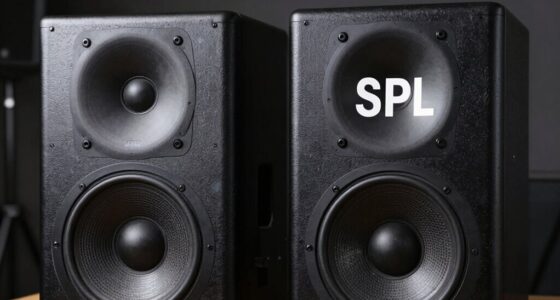
Sealed monitors typically deliver more accurate, tight bass because their airtight design prevents air movement, offering precise control. Ported monitors, on the other hand, produce deeper, louder bass by using a vent to enhance low-end output, but this can sometimes lead to boomy or less accurate sound in certain spaces. The best choice depends on your room and preferred sound; exploring further will reveal which option suits your needs best.
Key Takeaways
- Sealed monitors offer tighter, more controlled bass for greater accuracy, while ported monitors produce deeper, louder lows with less precision.
- Sealed designs reduce room interaction effects, resulting in more consistent bass response across different environments.
- Ported monitors enhance low-end volume and extension but can cause muddiness if room acoustics are untreated.
- Sealed monitors tend to be more forgiving in irregular or reflective spaces, maintaining accuracy better than ported designs.
- For audiophile accuracy, sealed monitors generally provide more precise bass reproduction than ported alternatives.
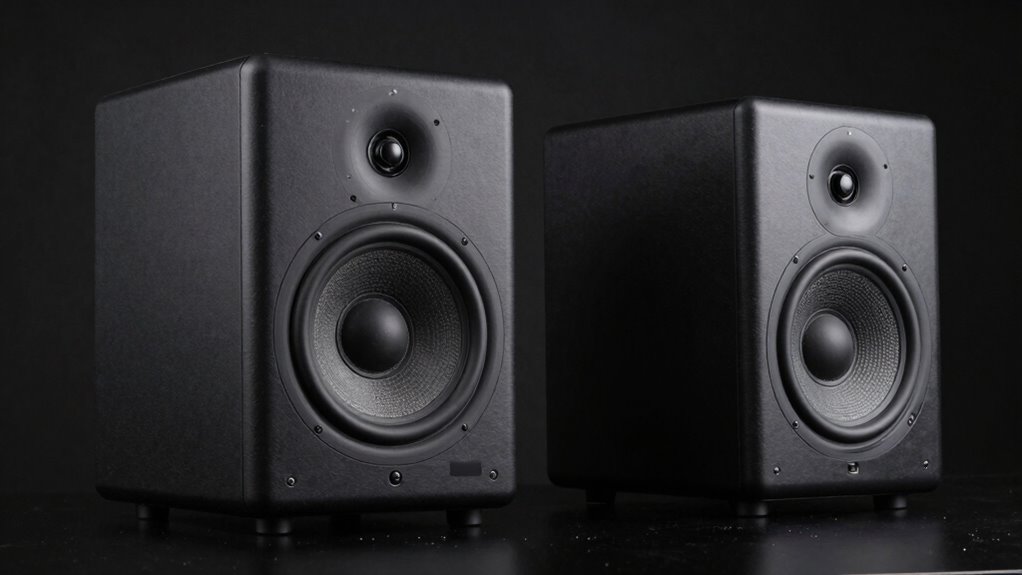
Are sealed and ported monitors truly different in how they deliver sound? The answer lies in understanding how each design interacts with your room acoustics and amplifier compatibility. Sealed monitors, also called closed-back, create a tight, controlled bass response because their airtight enclosures prevent air from moving freely through ports. This design typically results in a more accurate, precise sound, especially in the low frequencies, making them ideal if you want clarity and tight bass. However, their bass response might not be as extended or loud as ported monitors, which use a vent or port to enhance low-frequency output.
Ported monitors, on the other hand, incorporate a vent that allows air to move in and out of the enclosure. This design boosts bass efficiency, producing deeper, more robust low-end sounds without demanding as much power from your amplifier. Since they rely on the port to reinforce bass, their performance can be influenced heavily by your room acoustics. Larger or unevenly treated spaces may cause exaggerated or muddled bass, making ported monitors less predictable in certain environments. Additionally, their design can place more strain on the amplifier, especially if you’re pushing the volume high, because of the increased movement of air within the enclosure. So, amp compatibility becomes a consideration; a powerful enough amplifier can handle the demands of ported monitors more effectively.
Your room acoustics play a significant role in how these monitors perform. Sealed monitors tend to be more forgiving in rooms with reflective surfaces or irregular shapes because their tight bass response reduces the impact of room resonances. Conversely, ported monitors might emphasize certain frequencies, leading to boomy or boisterous bass if your space isn’t well-treated acoustically. If you have a small or untreated room, sealed monitors can provide a cleaner, more accurate sound, while ported monitors might require careful placement and acoustic treatment to avoid muddiness.
In essence, choosing between sealed and ported monitors depends on your listening environment and your amplifier’s capabilities. If you want precision, tight control, and less concern about room effects, sealed monitors are a safer bet. But if you crave deep bass with more volume and have a suitable amplifier to handle their demands, ported monitors can deliver impactful low-end performance. Ultimately, understanding how your room acoustics and amplifier compatibility influence each design will help you select the monitor that best suits your needs for accurate bass reproduction.
Being aware of room acoustics and how they interact with different monitor designs can help you make a more informed choice.
Frequently Asked Questions
How Do Room Acoustics Affect Sealed and Ported Monitor Performance?
Room acoustics considerably impact your sealed and ported monitor performance. Room resonance can cause standing waves, muddying bass response and reducing clarity. Ported monitors are more sensitive to room acoustics, often boosting bass in certain areas but also amplifying resonances. Sealed monitors tend to deliver tighter, more controlled bass, making them more resilient to room variations. Proper room treatment helps guarantee accurate bass response, regardless of monitor type.
Can Sealed or Ported Monitors Be Better for Certain Music Genres?
If you’re choosing monitors for different music genres, sealed monitors excel with genres like acoustic or classical music, offering tight, precise bass suited for smaller room sizes and critical listening. Conversely, ported monitors shine with genres like electronic or hip-hop, delivering louder, more extended bass that fills larger rooms. Your listener preference and room size play key roles; pick sealed for accuracy and control, ported for punch and volume.
What Maintenance Is Required for Sealed Versus Ported Monitors?
You need to regularly check the enclosure sealing and keep the drivers clean to maintain your sealed and ported monitors. Sealed monitors often require less maintenance since their driver durability is protected by the tight enclosure, reducing dust and debris buildup. For ported monitors, ensure the ports stay clear of obstructions to maintain sound quality. Both types benefit from gentle cleaning and periodic inspection to guarantee peak performance and longevity.
Are There Specific Brands Known for Superior Sealed or Ported Designs?
Brands like KEF and Bowers & Wilkins are renowned for their superior sealed monitor designs, emphasizing precision and clarity through innovative engineering. For ported monitors, brands like JBL and Paradigm lead with strong reputation and design innovation, delivering deep bass and efficient performance. Your choice depends on your sound preferences, but these brands are trusted for their quality, durability, and advanced design features that enhance your listening experience.
How Do Sealed and Ported Monitors Impact Power Consumption?
You might think sealed monitors use more power, but actually, they tend to be more energy-efficient because they create a lower amplifier load, meaning your amp doesn’t have to work as hard. Ported monitors can demand more power due to its tuning, increasing energy consumption. So, if you prioritize energy efficiency and want to reduce amplifier strain, sealed monitors are typically the smarter choice for your setup.
Conclusion
Ultimately, choosing between sealed and ported monitors depends on what you value most in your sound. Sealed enclosures give you tighter, more accurate bass, while ported ones deliver more punch and volume. Remember, don’t put all your eggs in one basket—consider your listening environment and personal preference. Whichever you pick, trust your ears; after all, beauty’s in the ear of the beholder. Make a choice that truly rocks your world!