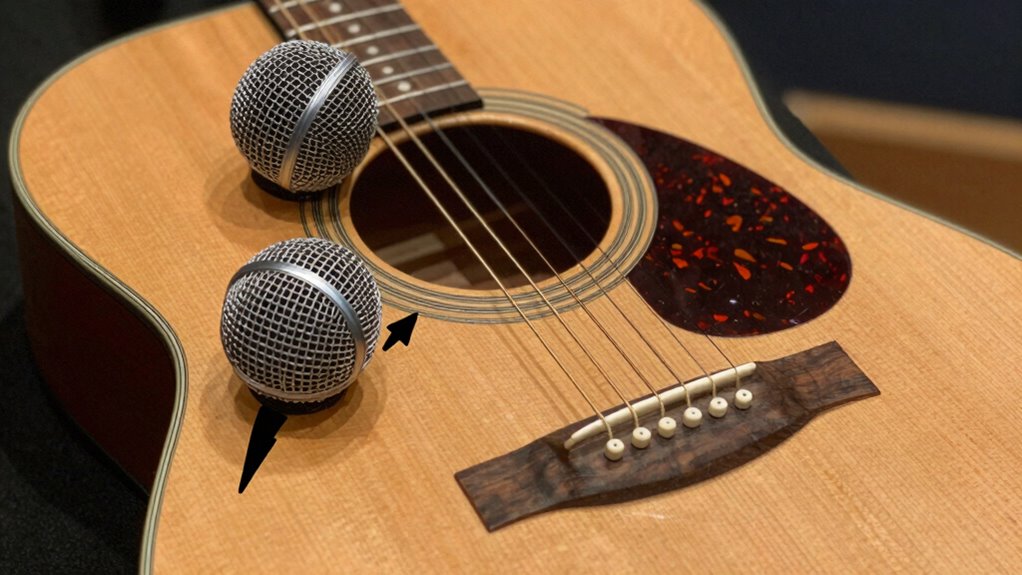
To get a great acoustic guitar sound, try three proven mic positions. First, place a mic around the 12th fret for clarity and detail, capturing the string attack and tone. Next, position another near the soundhole for warmth and resonance. Finally, set a mic farther back to add ambient space and depth. Experiment with these placements to find what works best for your instrument and style—there’s more to discover for your perfect tone.
Key Takeaways
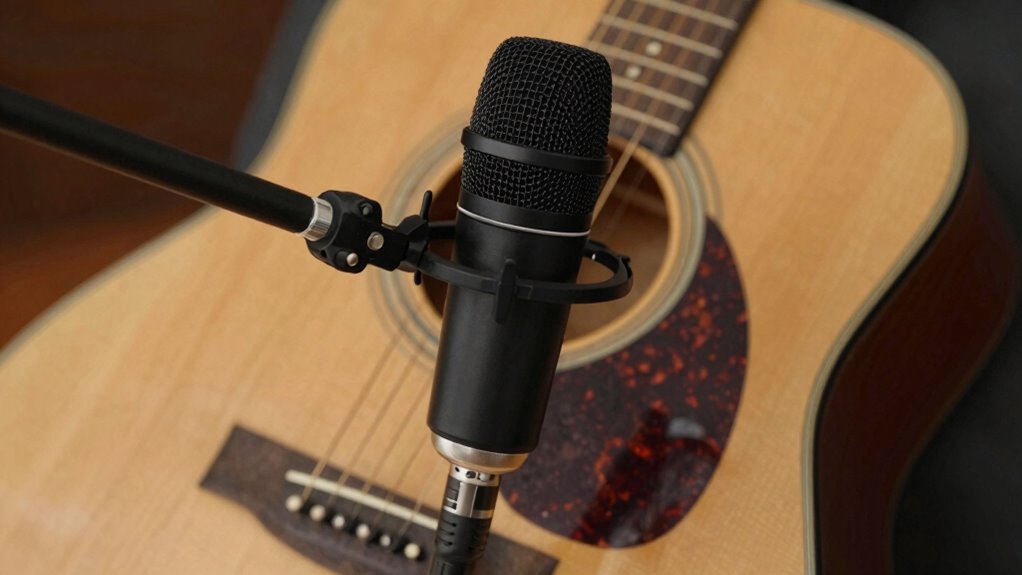
- Position the microphone 6-12 inches from the guitar, aimed at the 12th fret for balanced tone.
- Use one mic near the soundhole for warmth and resonance, and another near the fretboard for clarity.
- Place microphones slightly above the guitar, pointing toward the soundhole for natural, full sound.
- Adjust distance based on playing style: closer for intimacy, farther for spaciousness.
- Experiment with mic angles and positions to optimize tone and suit specific picking techniques.
When it comes to capturing the true sound of an acoustic guitar, proper microphone placement is essential. Your choice of positioning can make or break the clarity, warmth, and character of the recording. Whether you’re working in a professional recording studio or a home setup, understanding how to position your microphone relative to the guitar will help you achieve a natural and balanced tone. One key factor to contemplate is your picking techniques, as they influence the sound’s attack and resonance. For softer strumming or delicate fingerpicking, you’ll want to position the mic closer to the soundhole or the fretboard to capture the intimacy and detail. Conversely, when you’re using more aggressive picking techniques, you might opt for a slightly farther placement to avoid distortion and emphasize the attack.
In a recording studio, you have the advantage of controlled acoustics and high-quality equipment, which allows for more precise mic placement. A popular technique involves placing the microphone about 6 to 12 inches away from the guitar, pointed at the 12th fret or slightly above the soundhole. This position balances the brightness of the strings and the warmth of the body. If you’re aiming for a more ambient sound, you can move the microphone further back, capturing more of the room’s acoustics and giving your recording a spacious feel. For a more direct, intimate sound, positioning the mic closer to the soundhole or near the bridge works well, especially if your picking techniques involve intricate finger work that you want to highlight. Additionally, understanding the impact of microphone technology on your recordings can help you choose the best equipment for your desired sound.
Sometimes, using a stereo setup with two microphones enhances the depth and richness of your recording. One mic can be positioned near the fretboard to emphasize clarity and detail, while the other is placed towards the body to capture warmth and resonance. Blending these signals in the mix can produce a more natural and full-bodied sound. Remember, the key is to experiment with the placement and listen critically to the results. No single position is universally perfect; it depends on your guitar, your style of playing, and the specific sound you want to achieve. With practice and attention to detail, you’ll find the positions that highlight your picking techniques and produce recordings that truly resonate.
Frequently Asked Questions
How Do Ambient Room Acoustics Affect Mic Placement Choices?
Ambient room acoustics profoundly influence your mic placement choices because room reflections can muddy or enhance your sound. You should position the microphone to minimize unwanted reflections, like placing it closer to the guitar or using a directional mic. Experiment with different placements to find a balance that captures the guitar’s tone while avoiding excessive room reflections, ensuring your recording sounds clear and natural.
What Are the Best Mics for Capturing Acoustic Guitar Nuances?
Think of capturing acoustic nuances like tuning a fine instrument—choose the right microphone types and pickup systems. For detailed sound, a condenser mic like the Neumann KM184 excels, while a small-diaphragm dynamic can handle high SPLs. Pickup systems, such as soundhole or undersaddle pickups, also reveal subtle tonal qualities. Combining these tools lets you faithfully record every delicate pluck and whisper of your guitar’s character.
How Can I Minimize Feedback When Miking Acoustic Guitars?
To minimize feedback when miking acoustic guitars, you should focus on feedback reduction and mic positioning techniques. Keep the mic close to the guitar’s sound hole or 12th fret to reduce bleed, and angle it slightly away from monitors or speakers. Use directional mics like cardioids, and position them carefully to avoid reflections. Adjust your monitor and PA levels, and consider using a feedback suppressor for extra safety.
Does Guitar Body Shape Influence Optimal Mic Placement?
Did you know that guitar body shape considerably influences mic positioning? Yes, a larger body like a dreadnought produces more bass, so you’ll want to position your mic closer to the fretboard to capture clarity. Conversely, smaller shapes like parlor guitars require different mic placements to balance tone. You should experiment with mic positioning to optimize guitar tone, tailoring placement based on body shape for the best sound.
What Are Tips for Recording Acoustic Guitar Live Versus Studio Settings?
When recording acoustic guitar live, focus on capturing the natural sound that suits your musical genre by using close mics for detail and ambient mics for space. In studio settings, experiment with mic positions to find the perfect balance, leveraging the controlled environment to enhance tone. Adjust your technique based on whether you’re performing in a lively or quiet performance environment, ensuring clarity and warmth in every take.
Conclusion
Don’t let mic placement hold you back from capturing your guitar’s true tone. By trying these three proven positions, you’ll notice a richer, more balanced sound instantly. Some might worry about complexity or equipment, but these techniques are straightforward and work in most situations. Imagine recording your music with clarity and warmth—no need for fancy gear or endless adjustments. Just place the mic, trust these positions, and enjoy hearing your guitar sound its best.