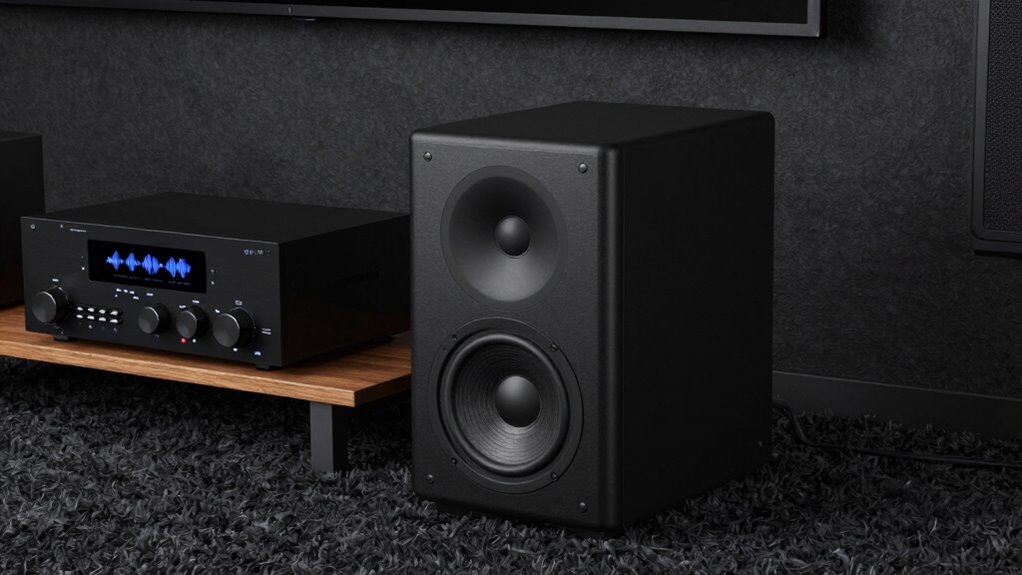

To set up your subwoofer without mud, start by setting the crossover around 80Hz to guarantee smooth transition with your main speakers. Adjust the phase switch to synchronize sound waves—listen for tight, full bass. Position your sub near walls or corners for better reinforcement, then fine-tune using test tones or bass tracks. Small tweaks to these settings make a big difference, and exploring further can help you achieve perfect, clear bass.
Key Takeaways
- Set the crossover frequency around 80Hz to ensure smooth transition and prevent muddiness.
- Adjust the phase switch (0°/180°) while listening to test tones for a tight, full bass blend.
- Position the subwoofer near walls or corners to enhance bass response and fill the room evenly.
- Use calibration tools or test tracks to fine-tune crossover and phase settings for optimal clarity.
- Reassess and refine placement and settings after moving the subwoofer to maintain clean, muddy-free bass.
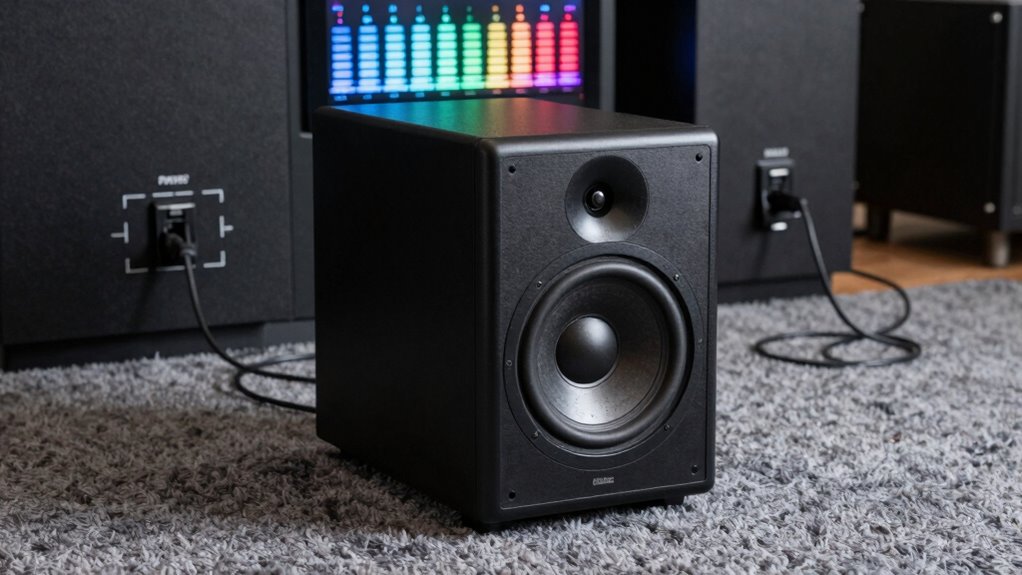
Setting up your subwoofer properly is essential for achieving deep, balanced bass that enhances your overall audio experience. The key to this is correctly configuring the crossover frequency and ensuring proper phase alignment. The crossover frequency is the point where your subwoofer transitions from producing bass to your main speakers handling higher frequencies. If set too high, your sub may interfere with your main speakers, causing muddiness; too low, and the bass might sound thin. To avoid muddiness and guarantee a seamless blend, start by setting the crossover frequency around 80Hz, which is generally ideal for most home theater and stereo setups. From there, you can fine-tune based on your room and preferences. Properly calibrating your system with test tones can help you identify the best settings for your space.
Phase alignment is equally vital because it ensures your subwoofer’s sound waves are synchronized with those of your main speakers. If the phases are misaligned, your bass can sound weak or cancel itself out, creating a hollow or muddy sound. Most subwoofers have a phase switch or control that allows you to toggle between 0° and 180°, or even dial in a specific phase setting. To find the best setting, play a bass-heavy track or test tone and listen carefully. Adjust the phase until the bass sounds tight and full, blending smoothly with your main speakers. You might notice a subtle difference when switching between phase settings, so take your time to find the most coherent sound.
Proper placement of your subwoofer also impacts the effectiveness of your crossover and phase settings. Place your sub in a spot where it can fill the room evenly, ideally near a wall or corner for more bass reinforcement. Once in position, double-check your crossover frequency and phase settings, as moving the sub can change how it interacts with the rest of your system. Use test tones or bass test tracks to evaluate the sound, and make small adjustments until you achieve a deep, clear bass response without muddiness.

Coliao 2pcs 200W Pure Bass Subwoofer Crossover Second-Order Crossover Frequency Distributor Divider 2 Way Speaker Audio Crossover Filter
Pure Bass Subwoofer Crossover Second-Order Crossover Frequency Divider
As an affiliate, we earn on qualifying purchases.
As an affiliate, we earn on qualifying purchases.
Frequently Asked Questions
How Do I Calibrate My Subwoofer Without a Sound Meter?
To calibrate your subwoofer without a sound meter, use calibration techniques like the “hand clap” method or smartphone apps as sound meter alternatives. Play a test tone at your desired volume, then walk around your room listening for even bass levels. Adjust the subwoofer’s volume and crossover settings until the bass feels balanced and consistent throughout the space. Trust your ears and make small tweaks for maximum sound.
Can I Use Multiple Subwoofers Without Causing Phase Issues?
Think of multiple subwoofers as a choir singing in harmony. To avoid phase issues, you need to guarantee their phase alignment is perfect, like tuning instruments before a concert. Adjust each subwoofer’s phase and delay settings so their sound waves blend smoothly, creating a unified bass experience. Proper placement and calibration help these subwoofers work together seamlessly, preventing cancellations and boosting your overall sound clarity.
What’s the Best Way to Prevent Subwoofer Rattling and Vibrations?
To prevent subwoofer rattling and vibrations, start with vibration damping materials like foam or rubber pads under the subwoofer. You should also consider structural reinforcement, such as bracing or mounting the sub securely to a solid surface, to reduce movement. Regularly check for loose screws or connections, and keep the volume at a level that doesn’t overwhelm your space. These steps will help minimize vibrations and rattling effectively.
How Do Room Acoustics Affect Subwoofer Placement Choices?
Think of your room as a performance hall, where acoustics shape the sound experience. Room reflections and sound absorption influence your subwoofer placement by either amplifying or dulling bass. To optimize, position your sub away from reflective surfaces to reduce echo and enhance clarity. Use sound absorption materials strategically to minimize unwanted reflections, creating a balanced environment where your subwoofer’s deep tones resonate clearly without muddiness.
Is It Better to Connect the Subwoofer Directly to the Receiver or Through the Main Speakers?
Connecting your subwoofer directly to the receiver is better for seamless speaker integration. This setup allows the receiver’s bass management to control the sub, ensuring balanced sound and easier adjustments. Using a direct connection minimizes signal loss and helps achieve tighter, more accurate bass. Avoid connecting through main speakers, which can create phase issues and muddy sound. For peak performance, always use the dedicated subwoofer output on your receiver.

Car Subwoofer Speaker Control Cable with Frequency Adjustment, Phase Switch, Power Indicator Light for TS WX110A, TS WX120A
Seamless Compatibility: This wire control is designed for TS WX110A TS WX120A car subwoofers, providing a seamless sound…
As an affiliate, we earn on qualifying purchases.
As an affiliate, we earn on qualifying purchases.
Conclusion
Getting your subwoofer setup right can dramatically improve your sound experience. Proper crossover, phase, and placement make all the difference—ensuring deep, clear bass without muddiness. Did you know that poorly placed subwoofers can reduce sound quality by up to 50%? Taking the time to fine-tune these settings not only enhances your listening but also protects your equipment. Invest a little effort now, and you’ll enjoy richer, more immersive audio every time you press play.

TENINYU 5-Pack RCA Keystone Jack Insert Connector Socket Female Snap in Adapter Port Gold Plated Inline Coupler for Wall Plate Outlet Panel Mount (White)
RCA KEYSTONE INSERT with white center jack joins cables with RCA plugs; Connects equipment with RCA ports like…
As an affiliate, we earn on qualifying purchases.
As an affiliate, we earn on qualifying purchases.
bass test tones for calibration
As an affiliate, we earn on qualifying purchases.
As an affiliate, we earn on qualifying purchases.