Active studio monitors combine amplification and speakers in one cabinet, making them a practical choice for recording, mixing, and desktop audio. My best overall pick is the JBL 305P MkII, which balances nearfield use and room-friendly tuning better than most options here. The PreSonus Eris Studio 8 suits larger spaces and fuller low-frequency needs, while the PreSonus Eris E4.5 is a more manageable fit for compact desks. The main tradeoffs are room size versus bass reach, accuracy versus extra connectivity, and a matched pair versus buying monitors individually. Read on for how all 15 options differ and which compromises make sense for your setup.

Get audio and creator gear delivered free with Prime
- Fast, free delivery on millions of items
- Prime Video, Amazon Music and more included
- Member-only deals all year
Complete the kit



Key Takeaways
- The JBL 305P MkII is the most balanced choice in this group for nearfield work, while the larger JBL 308P MkII and PreSonus Eris Studio 8 call for more space.
- Cabinet size should match the room and listening distance: the 3.5- and 4-inch options suit tighter desks, but they cannot offer the same low-end reach as the 7- and 8-inch models.
- Studio-focused options and Bluetooth-friendly models solve different problems; the Edifier MR3 and Ortizan C7 add convenience, while connection features alone do not make a monitor a better mixing reference.
- Some listings are for one speaker, not a pair, including the PreSonus Eris E7 XT and JBL 308P MkII, so buyers should plan for two matched units for stereo monitoring.
- Lower-cost desktop speakers are not interchangeable with mixing monitors: the Edifier R1280T is bookshelf-oriented, while the M-Audio BX3 and Edifier MR4 are more compact nearfield options.
| (2) JBL 305P MkII 5″ 2-Way Active Powered Studio Reference Monitors Speakers |  | Best Overall | Configuration: Pair of 2-way active monitors | Woofer: 5 inches | Tweeter: 1 inch | VIEW ON AMAZON | See Our Full Breakdown |
| PreSonus Eris Studio 8 8-inch 2-Way Active Studio Monitors with EBM Waveguide |  | Best for Full-Range Home Studios | Configuration: 2-way active monitor | Woofer: 8 inches | Tweeter: 1.25 inches | VIEW ON AMAZON | See Our Full Breakdown |
| PreSonus Eris E4.5 2-Way 4.5-Inch Near Field Studio Monitor (Pair) |  | Best for Beginners | Configuration: Pair of 2-way nearfield monitors | Woofer: 4.5 inches | Amplification: 50 watts total, 25 watts per side | VIEW ON AMAZON | See Our Full Breakdown |
| Edifier MR3 Powered Studio Monitor, Speaker Hi-Res Active Bluetooth Speaker |  | Best Compact Bluetooth Monitor | Configuration: Active 2.0 speaker system | Mid-low drivers: 3.5 inches | Tweeters: 1 inch | VIEW ON AMAZON | See Our Full Breakdown |
| KRK Classic 7 Powered Two-Way Professional Studio Monitor |  | Best for Larger Nearfield Setups | Configuration: 2-way powered monitor | Woofer: 7-inch glass-aramid | Tweeter: 1-inch textile soft dome | VIEW ON AMAZON | See Our Full Breakdown |
| Edifier R1280T Powered Bookshelf Speakers – 2.0 Near Field Studio Monitor |  | Best for Desktop Listening and Everyday Use | Power output: 42 watts RMS | Speaker size: 4 inches | Tweeter diameter: 13 mm | VIEW ON AMAZON | See Our Full Breakdown |
| PreSonus Eris E7 XT 2-Way Active Studio Monitor with EBM Waveguide (Pack of 1) |  | Best for a Wide Listening Sweet Spot | Woofer diameter: 6.55 inches | Tweeter diameter: 1.25 inches | Waveguide coverage: 100° horizontal × 60° vertical | VIEW ON AMAZON | See Our Full Breakdown |
| M-Audio BX3 3.5-Inch Wired Studio Monitors Pair |  | Best Compact Wired Pair | Woofer diameter: 3.5 inches | Tweeter diameter: 1 inch | Power output: 120 W (as listed) | VIEW ON AMAZON | See Our Full Breakdown |
| Ortizan C7 Powered Studio Monitors Pair with Bluetooth 5.3, Black |  | Best for Wireless Desktop Flexibility | Woofer diameter: 3.5 inches | Tweeter diameter: 0.75 inches | Connectivity: Bluetooth 5.3, AUX, RCA, TRS, Type-C | VIEW ON AMAZON | See Our Full Breakdown |
| PreSonus Eris E5 Pair 2-Way 5.25” Near Field Studio Monitors |  | Best Balanced Near-Field Pair | Configuration: 2-way near-field monitor pair | Woofer diameter: 5.25 inches | Power output: 80 watts | VIEW ON AMAZON | See Our Full Breakdown |
| JBL Professional 308P MkII 8-Inch 2-Way Powered Studio Monitor |  | Best for Wide, Bass-Forward Nearfield Mixing | Woofer: 8 inches | Tweeter: 1 inch | Power: 112 watts | VIEW ON AMAZON | See Our Full Breakdown |
| Edifier MR4 Power Studio Monitor Speakers, 4-inch Active Near-Field Speakers | 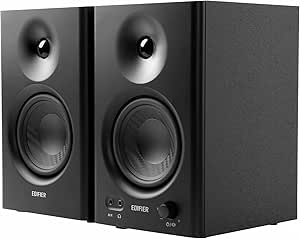 | Best Compact Desktop Pick | Woofer: 4 inches | Tweeter: 1-inch silk dome | Power output: 42 watts | VIEW ON AMAZON | See Our Full Breakdown |
| Yamaha HS5 Powered Studio Monitor, Pair |  | Best for Mix Translation | Units: 2 | Woofer: 5 inches | Tweeter: 1-inch dome | VIEW ON AMAZON | See Our Full Breakdown |
| Edifier MR5 2.0 Studio Monitor Bookshelf Speakers, 110W RMS |  | Best Connectivity and Room Tuning | Power: 110W RMS | Woofer: 5 inches | Tweeter: 1 inch | VIEW ON AMAZON | See Our Full Breakdown |
| Pioneer DJ VM-70 6-inch Active Studio Monitor Speaker |  | Best for DJ and Production Work | Woofer: 6.5 inches | Tweeter: 1 inch | Power output: 100 watts | VIEW ON AMAZON | See Our Full Breakdown |
| active studio monitor | Configuration | Woofer | Tweeter | Inputs |
|---|---|---|---|---|
| (2) JBL 305P MkII 5" 2-Way Act | Pair of 2-way active monitors | 5 inches | 1 inch | Balanced XLR and ¼-inch TRS |
| PreSonus Eris Studio 8 8-inch | 2-way active monitor | 8 inches | 1.25 inches | Balanced XLR, balanced ¼-inch TRS, unbalanced RCA, Bluetooth 5.0 |
| PreSonus Eris E4.5 2-Way 4.5-I | Pair of 2-way nearfield monitors | 4.5 inches | Silk-dome | ¼-inch TRS, RCA, ⅛-inch TRS aux |
| Edifier MR3 Powered Studio Mon | Active 2.0 speaker system | — | — | — |
| KRK Classic 7 Powered Two-Way | 2-way powered monitor | 7-inch glass-aramid | 1-inch textile soft dome | — |
| Edifier R1280T Powered Bookshe | — | — | — | AUX, RCA |
| PreSonus Eris E7 XT 2-Way Acti | 2-way active monitor; pack of 1 | — | — | RCA, TRS, XLR |
| M-Audio BX3 3.5-Inch Wired Stu | Wired monitor pair | — | — | 1/4-inch, 1/8-inch, RCA, AUX |
| Ortizan C7 Powered Studio Moni | Powered monitor pair | — | — | — |
| PreSonus Eris E5 Pair 2-Way 5. | 2-way near-field monitor pair | — | — | Balanced XLR, balanced 1/4-inch, unbalanced RCA |
| JBL Professional 308P MkII 8-I | — | 8 inches | 1 inch | XLR and 1/4-inch TRS |
| Edifier MR4 Power Studio Monit | — | 4 inches | 1-inch silk dome | — |
| Yamaha HS5 Powered Studio Moni | — | 5 inches | 1-inch dome | XLR and TRS |
| Edifier MR5 2.0 Studio Monitor | — | 5 inches | 1 inch | — |
| Pioneer DJ VM-70 6-inch Active | — | 6.5 inches | 1 inch | — |
More Details on Our Top Picks
(2) JBL 305P MkII 5″ 2-Way Active Powered Studio Reference Monitors Speakers
I’d put the JBL 305P MkII first for producers who want a capable nearfield pair without moving up to a larger cabinet. Its Image Control Waveguide is designed to keep stereo placement clear across a wider listening area, which helps when judging panning or sharing a desk. Boundary EQ and HF Trim give you useful ways to adapt the sound to a room, while balanced XLR and TRS inputs suit common studio interfaces. Compared with the smaller PreSonus Eris E4.5, this pair has a larger woofer and more stated output headroom; the Eris is easier to fit on a cramped desk. The JBL’s tradeoff is its limited deep-bass reach relative to an 8-inch monitor, and its room controls still cannot correct poor placement or untreated acoustics.
Pros:- Supplied as a pair, so both channels are covered for stereo monitoring.
- Image Control Waveguide is designed for clear imaging across a broad sweet spot.
- Boundary EQ and HF Trim provide practical adjustment for different placements.
- Balanced XLR and ¼-inch TRS inputs work with common audio interfaces.
Cons:- The 5-inch woofer cannot reproduce the deepest bass as fully as larger monitors such as the PreSonus Eris Studio 8.
- Room controls offer limited compensation for challenging acoustics.
- The pair takes more desk space than the compact PreSonus Eris E4.5.
Best for: Home-studio producers and podcasters who want a matched, desk-friendly pair with balanced inputs and room-tuning controls.
Not ideal for: Beatmakers who need authoritative sub-bass from the monitors alone, or listeners who need very compact speakers for a crowded desk.
- Configuration:Pair of 2-way active monitors
- Woofer:5 inches
- Tweeter:1 inch
- Amplification:Dual 41-watt Class-D amplifiers per monitor
- Inputs:Balanced XLR and ¼-inch TRS
- Room controls:Boundary EQ and HF Trim
- Dimensions:11.7 × 7.3 × 9.1 inches
- Peak SPL:108 dB
Our verdict“Choose the JBL 305P MkII pair for flexible, balanced nearfield monitoring, unless deep bass extension or the smallest possible footprint matters more.”
PreSonus Eris Studio 8 8-inch 2-Way Active Studio Monitors with EBM Waveguide
The PreSonus Eris Studio 8 is the pick here when low-frequency coverage and output take priority over a compact setup. Its 8-inch woofer and stated 35 Hz lower frequency limit give producers more access to bass and kick detail than the 5-inch JBL 305P MkII or 4.5-inch Eris E4.5. A custom-tuned EBM waveguide and acoustic controls help tailor the monitor to its position, while XLR, TRS, RCA, and Bluetooth connections make it adaptable to different sources. That range also means it can serve beyond a conventional interface-based studio. The tradeoff is physical: at nearly 20 pounds and 16.5 inches tall, each cabinet needs real space and stable placement. Bluetooth is convenient for playback, but it does not replace a balanced wired connection for critical work.
Pros:- 8-inch woofer and stated 35 Hz response reach lower than the smaller monitors in this group.
- EBM waveguide is designed to provide broad, controlled stereo imaging.
- XLR, TRS, RCA, and Bluetooth support varied studio and everyday playback sources.
- Acoustic tuning controls help adapt the speakers to placement.
Cons:- Large, heavy cabinets can overwhelm a small desk or compact room.
- The added bass reach does not remove the need for good room placement and acoustic treatment.
- Bluetooth is less appropriate than a balanced wired input for critical monitoring.
Best for: Home-studio producers mixing bass-heavy music who have room for large nearfield monitors and want multiple wired and wireless inputs.
Not ideal for: Desk-based creators with limited space, or anyone who needs lightweight monitors that are easy to move between work areas.
- Configuration:2-way active monitor
- Woofer:8 inches
- Tweeter:1.25 inches
- Power:140 watts
- Frequency response:35 Hz–20 kHz
- Inputs:Balanced XLR, balanced ¼-inch TRS, unbalanced RCA, Bluetooth 5.0
- Dimensions:9.8 × 11.7 × 16.5 inches
- Weight:19.9 pounds
Our verdict“Pick the Eris Studio 8 if you need stronger low-frequency reach and have space for full-size monitors; choose the JBL 305P MkII or Eris E4.5 for a smaller setup.”
PreSonus Eris E4.5 2-Way 4.5-Inch Near Field Studio Monitor (Pair)
The PreSonus Eris E4.5 is a sensible starting point for a first editing or production desk, especially when the speakers will also handle general computer audio. This 4.5-inch pair is smaller than the JBL 305P MkII and the KRK Classic 7, so it is easier to accommodate in a modest workspace. Its TRS, RCA, and ⅛-inch aux inputs simplify connecting an interface alongside everyday devices, and room-tuning controls offer some flexibility as you arrange the speakers. The main compromise is bass: the smaller woofer cannot provide the same low-end weight as the JBL, let alone the 8-inch PreSonus Eris Studio 8. That can make bass-heavy mix decisions less dependable without headphones or a subwoofer. It also needs sensible spacing to form a useful stereo image.
Pros:- Compact 4.5-inch design suits smaller workspaces better than the JBL 305P MkII or KRK Classic 7.
- Pair packaging provides left and right channels for stereo monitoring.
- TRS, RCA, and ⅛-inch aux inputs accommodate studio and consumer audio sources.
- Room-tuning controls allow some adjustment to the listening setup.
Cons:- Limited low-frequency output can obscure bass decisions without headphones or a subwoofer.
- Requires adequate spacing and placement for useful stereo imaging.
- Less headroom and low-end presence than the larger JBL 305P MkII and PreSonus Eris Studio 8.
Best for: New home-studio owners, students, and video editors who need a compact matched pair for nearfield work and everyday desktop audio.
Not ideal for: Bass-focused producers who need to judge sub-bass from speakers, or listeners without enough room to position the pair properly.
- Configuration:Pair of 2-way nearfield monitors
- Woofer:4.5 inches
- Amplification:50 watts total, 25 watts per side
- Inputs:¼-inch TRS, RCA, ⅛-inch TRS aux
- Tweeter:Silk-dome
- Room controls:Room-tuning controls
- Power-saving mode:Auto power-saving after 40 minutes
Our verdict“Choose the Eris E4.5 for a compact first studio pair and general desktop use, but look to the JBL 305P MkII if you need more output and bass presence.”
Edifier MR3 Powered Studio Monitor, Speaker Hi-Res Active Bluetooth Speaker
The Edifier MR3 suits a desktop creator who wants monitor-style connections and easy wireless playback in one compact system. Its balanced TRS input supports a studio source, while RCA and AUX inputs and Bluetooth multipoint make it more convenient for switching among a computer and personal devices than the wired-only JBL 305P MkII. Monitor, Music, and Custom modes, with app-based EQ adjustments, let you choose between a more work-focused presentation and casual listening. The 3.5-inch mid-low drivers keep the cabinets desk-friendly, but they also set a clear limit: this model will not match the bass authority or output of the KRK Classic 7 or PreSonus Eris Studio 8. Treat Bluetooth and the extra listening modes as convenience features, not a substitute for a consistent wired reference when making final mix decisions.
Pros:- Balanced TRS, RCA, and AUX inputs accommodate several wired sources.
- Bluetooth multipoint adds convenient switching for casual playback.
- Monitor, Music, and Custom modes offer distinct listening options.
- App-based EQ gives users a way to tailor the sound.
Cons:- 3.5-inch mid-low drivers provide less bass and headroom than the JBL 305P MkII or KRK Classic 7.
- Bluetooth and selectable sound modes can make playback less consistent for reference mixing.
- The supplied information does not specify a dedicated room-calibration system.
Best for: Desktop musicians, video editors, and guitar players who want compact speakers with balanced inputs, app EQ, and Bluetooth for everyday listening.
Not ideal for: Mixers who need strong low-end extension or high output, or users who want a strictly wired, fixed-reference monitoring setup.
- Configuration:Active 2.0 speaker system
- Mid-low drivers:3.5 inches
- Tweeters:1 inch
- Amplifier output:18 watts × 2 RMS
- Frequency response:52 Hz–40 kHz (Hi-Res Audio specification)
- Inputs and connectivity:Balanced TRS, RCA, AUX, Bluetooth 5.4
- Sound modes:Monitor, Music, and Custom
- Peak SPL:92.5 dB
Our verdict“Choose the MR3 for a space-conscious desktop setup that mixes wired monitoring with Bluetooth convenience, not for bass-heavy work or high-output mixing.”
KRK Classic 7 Powered Two-Way Professional Studio Monitor
The KRK Classic 7 makes the most sense for a producer who wants a 7-inch woofer and hands-on tonal adjustment in a larger nearfield setup. Its 73-watt output and low- and high-frequency controls give more room to shape the speaker response than the compact Edifier MR3, while the 7-inch driver offers more low-end potential than the JBL 305P MkII’s 5-inch woofer. The tradeoff is that the supplied listing describes this as a single monitor, so stereo production requires a second unit. Its listed dimensions are also substantial, making it a poor match for a crowded desktop. There is no Bluetooth, unlike the MR3 or PreSonus Eris Studio 8, and the product data does not provide a frequency-response range to compare its bass extension precisely.
Pros:- 7-inch woofer offers more potential low-frequency output than the JBL 305P MkII or Edifier MR3.
- 73-watt output is suited to a larger nearfield listening setup.
- Low- and high-frequency controls allow tonal adjustment for placement and room conditions.
- Two-way design pairs a glass-aramid woofer with a soft-dome tweeter.
Cons:- Listed as a single monitor, so stereo monitoring requires a second unit.
- Large listed dimensions make it difficult to fit on a small desk.
- No Bluetooth or wireless connectivity is specified.
Best for: Producers with a dedicated desk or control-room space who want a 7-inch active monitor with adjustable low- and high-frequency response.
Not ideal for: Beginners seeking a complete stereo pair in one purchase, small-desk users, or anyone who needs wireless playback.
- Configuration:2-way powered monitor
- Woofer:7-inch glass-aramid
- Tweeter:1-inch textile soft dome
- Power output:73 watts
- Amplifier type:Bi-amped Class A/B
- Room controls:Adjustable low- and high-frequency controls
- Dimensions:18 × 12 × 14 inches
- Weight:8.4 kg
Our verdict“Choose the KRK Classic 7 for a spacious setup that benefits from a larger woofer and tone controls, but account for the need to source a second monitor for stereo.”
Edifier R1280T Powered Bookshelf Speakers – 2.0 Near Field Studio Monitor
The R1280T suits a desk or home office where convenient listening matters as much as checking mixes. Its 42-watt output, 4-inch drivers, and adjustable bass and treble let me tailor playback without adding an external controller; the remote and RCA and AUX inputs also make switching sources straightforward. Compared with the PreSonus Eris E5, this Edifier is oriented more toward casual, flexible playback than studio connections and room adjustment. Its wood finish can blend into a living space, but the bookshelf-style design takes up more room than compact options such as the M-Audio BX3. The stated 80 Hz frequency response also gives less reassurance about deep bass than larger monitors. I’d choose it for general desktop audio, not as my first pick for mix decisions that depend on controlled, neutral monitoring.
Pros:- Bass and treble controls make it easy to adjust playback to a room or preference.
- RCA and AUX inputs support straightforward connections to multiple sources.
- Remote control is convenient for listening from away from the desk.
- Wood-finish enclosure has a home-friendly appearance.
Cons:- Bookshelf-style dimensions can be awkward on a small desktop.
- No balanced XLR or TRS inputs for common studio connections.
- The listed 80 Hz frequency-response figure offers limited detail about low-bass performance.
Best for: Home-office listeners and beginner creators who want powered speakers with simple source switching, tone controls, and a remote.
Not ideal for: Mix engineers who need balanced XLR or TRS connections, detailed acoustic room tuning, or a compact speaker for a crowded desk.
- Power output:42 watts RMS
- Speaker size:4 inches
- Tweeter diameter:13 mm
- Inputs:AUX, RCA
- Frequency response:80 Hz (as listed)
- Enclosure material:Wood
- Impedance:4 ohms
- Signal-to-noise ratio:85 dB
Our verdict“Pick the R1280T for flexible home and desktop listening, but choose the Eris E5 or another studio-focused model when mix accuracy and balanced inputs matter more.”
PreSonus Eris E7 XT 2-Way Active Studio Monitor with EBM Waveguide (Pack of 1)
The Eris E7 XT is the lineup’s single-speaker choice for a larger workspace or collaborative setup: its 6.5-inch woofer and EBM waveguide are designed to provide extended bass and a broad listening area. That wide sweet spot is a practical advantage over the more desk-focused M-Audio BX3, while the acoustic tuning controls give me more ways to adapt the speaker to its placement. Balanced XLR and TRS alongside RCA inputs also suit studio gear better than the Edifier R1280T’s consumer-oriented connections. The tradeoff is scale: this cabinet needs room, and the listing is for one monitor, so a stereo setup requires buying a second. Its larger driver and tuning options make it a more serious monitoring pick, but not the natural choice for a tight desktop or a buyer who only needs a matched pair in one purchase.
Pros:- EBM waveguide is designed for a wide, controlled listening sweet spot.
- Acoustic controls provide options for adapting response to monitor placement.
- 6.5-inch woofer and ported enclosure are designed to deliver deeper bass than compact 3.5-inch monitors.
- XLR, TRS, and RCA inputs support varied studio and consumer sources.
Cons:- Sold as one monitor, so a stereo pair requires a second unit.
- Larger cabinet is a less convenient fit for a crowded desktop.
- More speaker and tuning capability than casual listeners may need.
Best for: Producers building a larger near-field setup who need room-adjustment controls, balanced inputs, and a wider listening area.
Not ideal for: Buyers with limited desk space or anyone expecting a stereo pair from this single-monitor listing.
- Woofer diameter:6.55 inches
- Tweeter diameter:1.25 inches
- Waveguide coverage:100° horizontal × 60° vertical
- Maximum output:Up to 104 dB
- Inputs:RCA, TRS, XLR
- Acoustic controls:Level, HPF, LF Trim, HF Trim, Acoustic Space
- Configuration:2-way active monitor; pack of 1
Our verdict“Choose the E7 XT for a roomy studio where its broad sweet spot and adjustment controls can be used, and check the single-speaker format before planning a stereo setup.”
M-Audio BX3 3.5-Inch Wired Studio Monitors Pair
The BX3 is the most desk-friendly wired pair here, aimed at creators who need small monitors for editing, streaming, or a first home setup. Its 3.5-inch Kevlar woofers and 1-inch silk-dome tweeters keep the package compact, while the range of 1/4-inch, 1/8-inch, RCA, and AUX connections makes it easy to connect computers and other sources. Compared with the Ortizan C7, the BX3 avoids making Bluetooth a central feature and instead keeps the focus on wired desktop use. It also comes as a pair, unlike the single PreSonus Eris E7 XT. The compromise is limited cabinet size: it is less suited to room-filling playback or bass-heavy work than the Eris E5, and its small footprint still needs sensible desk placement. I’d shortlist it for near-field use, not as a substitute for larger monitors in a mixing room.
Pros:- Compact 3.5-inch design fits desktop near-field setups more readily than larger monitors.
- Multiple inputs include 1/4-inch, 1/8-inch, RCA, and AUX.
- Kevlar woofers and silk-dome tweeters support a dedicated monitor-style configuration.
- Sold as a pair for stereo listening.
Cons:- Small woofers are less suited to deep bass and room-filling playback than the PreSonus Eris E5.
- Wired design lacks the Ortizan C7’s Bluetooth convenience.
- Needs clear desk space and careful placement for near-field listening.
Best for: Desktop musicians, streamers, and video editors who want a compact stereo pair with connections for computers and other wired sources.
Not ideal for: Producers who need strong low-frequency extension, high output across a room, or monitors intended for outdoor use.
- Woofer diameter:3.5 inches
- Tweeter diameter:1 inch
- Power output:120 W (as listed)
- Inputs:1/4-inch, 1/8-inch, RCA, AUX
- Woofer material:Kevlar
- Enclosure material:Engineered wood
- Configuration:Wired monitor pair
Our verdict“Choose the BX3 for a compact, wired stereo setup at a desk, but move up to a larger monitor if bass extension or wider-room coverage is a priority.”
Ortizan C7 Powered Studio Monitors Pair with Bluetooth 5.3, Black
The Ortizan C7 stands out for combining compact near-field speakers with Bluetooth 5.3 and wired inputs, making it a flexible choice for a desk shared between production and everyday listening. RCA, AUX, TRS, and USB-C connectivity give it more options than the M-Audio BX3’s wired-focused setup, while the listed built-in 24-bit DAC is intended to support digital audio playback. A 3.5-inch woofer keeps the pair small enough for desktop use, though it also limits how much low-end authority I’d expect compared with the 5.25-inch PreSonus Eris E5. Wireless playback is useful for convenience, but it is not a replacement for a dependable wired monitoring path when making mix decisions. The C7 makes most sense for creators who want one compact system for several sources; buyers focused on straightforward studio monitoring may prefer the BX3 or a larger wired model.
Pros:- Bluetooth 5.3 adds convenient wireless playback alongside wired connections.
- RCA, AUX, TRS, and Type-C inputs support a broad range of desktop sources.
- Compact 3.5-inch woofer format suits near-field desktop placement.
- Built-in 24-bit DAC is listed for digital audio playback.
Cons:- Small woofer is less suited to low-frequency monitoring than the PreSonus Eris E5’s 5.25-inch driver.
- Bluetooth convenience does not replace a wired connection for consistent production monitoring.
- Requires corded power and is not waterproof.
Best for: Desktop creators who alternate between wired production sources and wireless playback from phones or tablets.
Not ideal for: Mixers who prioritize larger-driver bass, a strictly wired workflow, or speakers for outdoor and water-exposed use.
- Woofer diameter:3.5 inches
- Tweeter diameter:0.75 inches
- Connectivity:Bluetooth 5.3, AUX, RCA, TRS, Type-C
- Bluetooth range:18 meters
- Power source:Corded electric
- Additional feature:Built-in 24-bit DAC
- Configuration:Powered monitor pair
Our verdict“Pick the C7 if wireless listening and broad desktop connectivity matter alongside studio-style use, but choose a larger wired monitor for more demanding mix work.”
PreSonus Eris E5 Pair 2-Way 5.25” Near Field Studio Monitors
The Eris E5 is the most straightforward step up from compact desktop monitors in this group: its 5.25-inch woven-composite woofers give it a larger platform for near-field mixing than the M-Audio BX3 or Ortizan C7. The pair format is convenient for building a stereo setup, and balanced XLR and 1/4-inch inputs alongside RCA suit both studio interfaces and consumer sources. Its acoustic tuning controls are another advantage over the Edifier R1280T, whose bass and treble adjustments are simpler tone controls rather than a broader studio-placement approach. The larger cabinet and need for AC power make the E5 less appealing on a very crowded desk, and buyers wanting wireless playback should look at the Ortizan instead. It is a capable middle ground for a home studio, though the listing provides limited detail about the exact tuning-control settings.
Pros:- 5.25-inch woven-composite woofers offer a larger driver platform than the BX3 and C7.
- Balanced XLR and 1/4-inch inputs work with common studio interfaces.
- RCA input adds compatibility with unbalanced sources.
- Acoustic tuning controls support adjustment for the listening setup.
Cons:- Cabinet size can be inconvenient on a compact desk.
- Requires power outlets for active operation.
- Lacks the Ortizan C7’s Bluetooth playback option.
Best for: Home-studio producers who want a matched near-field pair, balanced interface connections, and more low-frequency capacity than compact desktop monitors.
Not ideal for: Users with very little desk space or listeners who need Bluetooth and remote-based everyday control.
- Configuration:2-way near-field monitor pair
- Woofer diameter:5.25 inches
- Power output:80 watts
- Inputs:Balanced XLR, balanced 1/4-inch, unbalanced RCA
- Dimensions:7.7 × 7 × 10.2 inches
- Weight:11.6 pounds
- Protection:RF interference, output current limiting, over-temperature, transient, and subsonic protection
Our verdict“Choose the Eris E5 pair for a conventional home-studio setup with balanced connections and larger drivers, unless your desk is too small or wireless playback is a priority.”
JBL Professional 308P MkII 8-Inch 2-Way Powered Studio Monitor
The JBL 308P MkII suits producers who want an 8-inch monitor’s fuller low end without stepping up to the PreSonus Eris Studio 8. Its wide sweet spot can make it easier to judge stereo placement when you move around a desk, while the Boundary EQ offers a way to adjust for nearby walls or surfaces. XLR and 1/4-inch TRS inputs also fit common studio interfaces and mixers. The tradeoff is size: its larger woofer needs more room and careful placement than the Yamaha HS5 or JBL 305P MkII, and its bass may be harder to judge accurately in a small, untreated room. I’d also factor in that this listing is one monitor, not a pair, so stereo setup requires buying two separately.
Pros:- 8-inch woofer provides more low-frequency reach than the Yamaha HS5’s 5-inch design.
- Wide sweet spot supports listening from more than one position.
- Boundary EQ helps adapt response when monitor placement is close to room boundaries.
- XLR and 1/4-inch TRS inputs suit common balanced studio connections.
Cons:- Sold individually, so a stereo setup requires purchasing two units.
- Large cabinet and stronger bass response can be a poor fit for small rooms.
- Placement and EQ adjustments may be needed to get a reliable sound in a given room.
Best for: Home and project-studio producers with enough space for 8-inch monitors who want broader listening coverage and more low-frequency reach.
Not ideal for: Desktop mixers in small or untreated rooms, or buyers who want a ready-to-use stereo pair in one purchase.
- Woofer:8 inches
- Tweeter:1 inch
- Power:112 watts
- Inputs:XLR and 1/4-inch TRS
- Input sensitivity:+4 dBu / -10 dBV
- Boundary EQ:Yes
- Low-frequency port:Slip Stream
Our verdict“Choose the JBL 308P MkII if you have room for an 8-inch monitor and want broad coverage and deeper bass, but skip it for a compact desktop setup.”
Edifier MR4 Power Studio Monitor Speakers, 4-inch Active Near-Field Speakers
The Edifier MR4 is the lineup’s desk-friendly option: its 4-inch woofer keeps the speakers compact, while the wood enclosure and multiple inputs make them practical for a creator’s computer, interface, and other sources. Compared with the Yamaha HS5, the MR4 takes up less space and offers more everyday connection flexibility, but its 42-watt output and smaller drivers leave less room for loud playback or bass-heavy mixing. The listed connections include RCA, auxiliary, TRS, and Bluetooth, so it can bridge casual listening and basic production more readily than a strictly studio-focused monitor. I’d treat that versatility as a convenience, not a substitute for a larger monitor’s low-frequency extension. Choose these for close-range work; skip them if you need to judge deep bass with confidence.
Pros:- Compact 4-inch design fits desktop and small-room setups.
- RCA, auxiliary, TRS, and Bluetooth connections accommodate multiple sources.
- Wood enclosure suits a permanent desktop setup.
- User-friendly controls provide sound-mode and frequency adjustments.
Cons:- 42-watt output and small drivers limit loudness and bass authority compared with the Yamaha HS5 or JBL 308P MkII.
- The supplied frequency-response information gives only a 20 kHz figure, not a complete range.
- Listed dimensions are incomplete, making exact desk-fit planning harder.
Best for: Bedroom producers, students, and desktop creators who need compact nearfield speakers for basic editing, music work, and everyday listening.
Not ideal for: Mixers working on bass-heavy material, or anyone needing high playback levels and stronger low-frequency extension.
- Woofer:4 inches
- Tweeter:1-inch silk dome
- Power output:42 watts
- Connectivity:RCA, auxiliary, TRS, Bluetooth
- Enclosure:Wood
- Color:Black
- Warranty:2 years
Our verdict“Pick the MR4 for compact desktop production and flexible connections, but choose a larger monitor if low-end decisions are central to your work.”
Yamaha HS5 Powered Studio Monitor, Pair
The Yamaha HS5 pair is the most straightforward choice here for stereo mixing when the priority is hearing a relatively unembellished presentation rather than adding bass weight. Its bi-amplified design and stated 54 Hz–30 kHz response give producers a defined reference for balancing mids and highs, while balanced XLR and TRS inputs connect neatly to studio gear. Compared with the Edifier MR4, the HS5 is a more focused mixing tool and comes as a pair, but it takes up more space and offers fewer convenience-oriented connection options. Its 5-inch woofer also cannot reproduce the deepest bass as confidently as the JBL 308P MkII or Edifier MR5. I’d pair it with good placement and, for bass-critical work, a larger system or separate subwoofer.
Pros:- Sold as a pair for a ready stereo-monitor setup.
- Bi-amplified design and stated 54 Hz–30 kHz response support detailed mixing.
- Balanced XLR and TRS inputs connect to common studio equipment.
- 5-inch format is more manageable than the JBL 308P MkII’s 8-inch cabinet.
Cons:- Limited low-frequency reach compared with the JBL 308P MkII and Edifier MR5.
- Requires deliberate placement and an external power source.
- Fewer casual-listening connection options than the Edifier MR4.
Best for: Home-studio musicians and mixers who want a matched pair of reference monitors for nearfield work and have a room suited to careful placement.
Not ideal for: Producers who need substantial sub-bass from the monitors alone, or desktop listeners seeking Bluetooth and casual-source flexibility.
- Units:2
- Woofer:5 inches
- Tweeter:1-inch dome
- Power output:70 watts
- Frequency response:54 Hz–30 kHz
- Power system:Bi-amplified
- Inputs:XLR and TRS
- Weight:5.3 kg
Our verdict“Choose the HS5 pair for a focused, balanced nearfield reference, but look to a larger monitor or subwoofer if deep bass is a priority.”
Edifier MR5 2.0 Studio Monitor Bookshelf Speakers, 110W RMS
The Edifier MR5 brings together a 5-inch woofer, a 3-way active crossover, room-tuning controls, and an unusually broad set of connections for a home-studio monitor. XLR and TRS support studio sources, while RCA, AUX, and Bluetooth 6.0 make switching to other playback devices straightforward. Its stated 46 Hz–40 kHz range reaches lower than the Yamaha HS5’s listed 54 Hz floor, giving it a more flexible role for both production and listening. That versatility comes with a different emphasis: the HS5 is the more clearly specified mixing reference, while the MR5 prioritizes tuning options and source convenience. It is still a nearfield speaker, not a room-filling system, and its cabinet needs adequate space for setup and adjustment.
Pros:- Room-tuning controls allow sound adjustments for different placements.
- XLR, TRS, RCA, AUX, and Bluetooth 6.0 support varied studio and listening sources.
- 110W RMS output and a 5-inch woofer offer more headroom than the Edifier MR4.
- Stated 46 Hz–40 kHz response extends below the Yamaha HS5’s listed low end.
Cons:- Nearfield design is best suited to listening close to the speakers, not across a large room.
- Room controls and placement require space and some setup decisions.
- Not water resistant, so it is unsuitable for outdoor use.
Best for: Home producers who want room-tuning options, balanced studio inputs, and wireless or auxiliary playback in one monitor system.
Not ideal for: Buyers who need outdoor speakers, a distant-listening system, or a strictly studio-only design with fewer consumer features.
- Power:110W RMS
- Woofer:5 inches
- Tweeter:1 inch
- Frequency response:46 Hz–40 kHz
- Crossover:3-way active
- Connectivity:Bluetooth 6.0, XLR, TRS, RCA, AUX
- Cabinet material:MDF
- Dimensions:11 × 6.3 × 10.4 inches
Our verdict“Pick the MR5 if you want one nearfield system for studio sources and flexible home listening, but favor the HS5 for a simpler mixing-focused setup.”
Pioneer DJ VM-70 6-inch Active Studio Monitor Speaker
The Pioneer DJ VM-70 is aimed at producers and DJs who want more low-end presence than a compact monitor provides, without moving to an 8-inch model like the JBL 308P MkII. Its 6.5-inch woofer, Class D amplification, and DSP tuning give it a practical mix of output and placement flexibility for a home studio or DJ setup. Compared with the Yamaha HS5, the VM-70’s larger driver is better suited to fuller playback, while the HS5 is the more clearly specified choice for restrained, reference-style mixing. One limitation in the supplied data is connectivity: it lists auxiliary and Bluetooth, but does not identify the professional inputs described in the product copy, so buyers should verify connection details before matching it with an interface. The single-speaker listing also means a stereo setup needs two.
Pros:- 6.5-inch woofer offers fuller low-end potential than the Yamaha HS5’s 5-inch driver.
- DSP tuning supports adjustments for different placement conditions.
- Class D amplification is suited to a monitor designed for regular studio and DJ use.
- Tabletop mounting fits desk-based and DJ-booth arrangements.
Cons:- Listed connectivity specifies auxiliary and Bluetooth but does not confirm XLR or TRS inputs.
- Sold as an individual speaker, so a stereo setup requires two units.
- Supplied frequency-response specification is incomplete, listing only 36 kHz.
Best for: DJs and home producers seeking a larger nearfield monitor with DSP tuning for playback and production at a desk or tabletop.
Not ideal for: Buyers who need confirmed balanced studio inputs from the listed specifications, or who want a stereo pair in one purchase.
- Woofer:6.5 inches
- Tweeter:1 inch
- Power output:100 watts
- Amplifier type:Class D
- Listed connectivity:Auxiliary, Bluetooth
- Mounting type:Tabletop
- Enclosure material:Aluminum
- Warranty:1 year
Our verdict“Choose the VM-70 for DJ-oriented playback and a fuller nearfield presentation, but confirm its input options and account for buying two speakers for stereo.”

How We Picked
I compared these active studio monitors by how well their size, intended use, and feature set fit real recording and desktop setups. The main criteria were nearfield suitability, driver size and likely room demands, available tuning or placement controls, connection flexibility, and practical setup details such as whether a listing describes one speaker or a pair. I also separated monitors intended for reference listening from powered bookshelf models whose convenience may matter more than studio-focused adjustment.
The order gives priority to balanced studio use and versatility, then weighs value, room fit, and specialized strengths. That puts the JBL 305P MkII ahead as the broadest recommendation, while larger monitors rank higher for buyers who can use their added scale and lower-frequency reach. Compact and connectivity-rich models remain useful picks, but they rank lower for buyers who need a reliable mixing reference. Product specifications and intended uses inform these comparisons; I do not present them as hands-on listening tests.
Factors to Consider When Choosing Active Studio Monitors
Choosing a monitor is less about selecting the largest driver or the longest feature list and more about matching the speaker to your room and work. These broader factors can help you avoid paying for capabilities you cannot use—or choosing a convenient speaker that does not suit your mixing goals.
Match Driver Size to Your Room and Listening Distance
A larger woofer can support stronger low-frequency playback, but that does not make it the right choice for every room. In a small untreated space, bass can collect unevenly and make kick drums or bass lines seem louder in some positions than others. Compact models such as 3.5- and 4-inch monitors are easier to place on a crowded desk, though their limited low-end output may make bass decisions harder. Mid-sized speakers often suit nearfield listening at a desk, while 7- and 8-inch models need enough space and distance to blend naturally. Avoid choosing by woofer diameter alone; room dimensions, placement, and listening level all affect what you hear.
Treat Room Acoustics as Part of the Monitor Choice
Monitors reproduce both the recording and the room, so reflective walls, bare desks, and corners can distort your judgment. Before buying larger speakers, think about whether you can position them away from walls and create a reasonably symmetrical listening area. Rear-panel boundary controls can help manage placement compromises, but they cannot correct a room with strong echoes or severe bass buildup. A modest monitor in a sensible position may give more dependable results than a bigger one pushed against a wall. If acoustic treatment is not practical, prioritize placement flexibility and listen from a consistent position. This is a common reason buyers misread a monitor as having a tonal problem when the room is the larger factor.
Separate Mixing Accuracy From Everyday Convenience
Bluetooth, front-panel controls, and multiple inputs can make powered speakers easier to use for music, video, or quick device changes. Those conveniences are separate from the question of whether a speaker gives a useful reference for mixing. If your priority is production, choose for dependable tonal judgment, stereo placement, and suitable room controls before choosing wireless features. If the speakers will also serve a general desktop role, Bluetooth or a simple analog input may justify a less studio-focused design. Do not assume that a product labeled a studio monitor is equally suited to every kind of audio work. Be clear about whether convenience or mix translation matters more in your daily setup.
Check Whether the Listing Includes One Monitor or a Pair
Stereo monitoring requires two speakers, but some studio monitors are sold individually while others are listed as pairs. That difference affects the real setup cost and can delay a project if you order only one unit. Read the product name and package details carefully, especially for professional models commonly sold per speaker. When buying a second unit separately, confirm that it is the same model and revision so the left and right channels match. Also plan for stands, isolation pads, and suitable cables; these can affect placement and desk vibration even though they are not part of the monitor itself. A clear inventory check prevents a single-speaker listing from being mistaken for a complete stereo system.
Choose Connections for Your Actual Signal Chain
Start with the outputs on your audio interface, mixer, computer, or other source. Balanced connections can help reduce noise on longer cable runs, while unbalanced inputs may be adequate for a short desktop connection. Bluetooth can be handy for casual playback, but it is not a substitute for a dependable wired path when recording or making detailed mix decisions. Check how many sources you need to connect and whether you want to switch between them without unplugging cables. Buyers sometimes focus on connection count without checking connector type, then discover their existing cables do not fit. A simple signal-chain sketch before purchase can prevent unnecessary adapters and extra noise.
Budget for the Whole Listening Setup, Not Just the Speakers
Monitors perform best when both speakers sit at ear height, form a balanced triangle with the listener, and have stable support. On a desk, isolation pads or stands can reduce vibration and make positioning easier. A subwoofer may extend bass, but adding one without suitable placement and level matching can create less reliable low-frequency judgments. Spend first on a workable position and room setup rather than assuming a higher-tier speaker will solve every problem. If you are new to production, a compact pair and a familiar reference playlist can be more useful than oversized monitors in a poorly arranged room. Paying more makes sense when the room, listening distance, and workflow let you benefit from the extra capability.
Frequently Asked Questions
Should I buy the JBL 305P MkII or an 8-inch monitor?
Choose the JBL 305P MkII if you work close to the speakers, have limited room, or want a broadly useful nearfield option. The JBL 308P MkII and PreSonus Eris Studio 8 make more sense when you have space to place larger cabinets and need greater low-frequency reach. A bigger woofer does not guarantee more accurate bass in a small or untreated room. Consider listening distance and placement before stepping up in size. Also check whether the model is sold individually or as a pair.
Are Bluetooth active studio monitors suitable for mixing?
Bluetooth can be useful for casual playback and convenient device switching, but it should not be the only connection you rely on for production. For mixing, use a stable wired connection from an audio interface or other appropriate source. Models such as the Edifier MR3 and Ortizan C7 pair connectivity convenience with a desktop-friendly format, but buyers should still decide whether their priority is everyday playback or studio reference work. Wireless features do not by themselves indicate how suitable a speaker is for judging a mix. Check the wired inputs and their compatibility with your equipment before choosing.
Do I need to buy two monitors if a listing says ‘sold individually’?
Yes, a normal stereo setup needs two monitors, so a listing marked sold individually describes one speaker rather than a pair. This matters for models such as the JBL 308P MkII and PreSonus Eris E7 XT in this roundup. Confirm the package contents before ordering and account for the second matching unit in your plan. A single monitor can still suit mono checks or a temporary setup, but it will not provide stereo placement cues. If you buy the speakers separately, match the model and revision.
Can I use bookshelf speakers like the Edifier R1280T instead of studio monitors?
You can use the Edifier R1280T for general desktop listening, but it is not the same kind of choice as a monitor designed for production reference. Bookshelf speakers may prioritize everyday playback and easy source connections, while studio monitors are selected to help users judge recording and mix balance. That distinction matters when you want decisions to translate to other systems. If production is occasional and convenience is your main goal, the R1280T may fit your use. If mixing is the priority, compare it with more studio-focused options such as the JBL 305P MkII or PreSonus Eris E5.
Is a compact monitor enough for a first home studio?
A compact pair can be enough for a first setup if you work at a desk, listen at a nearfield distance, and accept that very low bass may be harder to judge. Options such as the PreSonus Eris E4.5, Edifier MR4, and M-Audio BX3 suit tighter spaces better than large cabinets. Use reference tracks and check bass-heavy mixes on other playback systems while you learn how your room and monitors behave. A small speaker does not remove the need for sensible placement or room awareness. Move to a larger model when your room and work genuinely call for more low-frequency output.
Conclusion
For the broadest fit, I recommend the JBL 305P MkII as best overall: it sits between the smallest desktop options and larger monitors that need more room. The best value for a compact production desk is the PreSonus Eris E4.5, while the best beginner-friendly starting point is also a compact pair such as the Eris E4.5, provided you account for its limited bass reach. For a larger room and more low-end scale, consider the PreSonus Eris Studio 8 or JBL 308P MkII; these are the premium-size choices here, not automatic upgrades for every setup. Choose the Edifier MR3 or Ortizan C7 when Bluetooth and flexible desktop use matter, and the Edifier R1280T when general bookshelf playback takes priority over studio reference. Match the speaker to your room, confirm whether the package contains one unit or two, and let your actual workflow settle the choice.
Halloween Picks

10-Foot Halloween Inflatable Double-Headed Dragon Archway

Star Wars Yoda and R2-D2 Inflatable Halloween Decor, 6 ft with LEDs, Indoor/Outdoor

MGparty 14.5 ft Halloween Inflatable Walk-In Pumpkin House with LED Lights
As an affiliate, we earn on qualifying purchases.