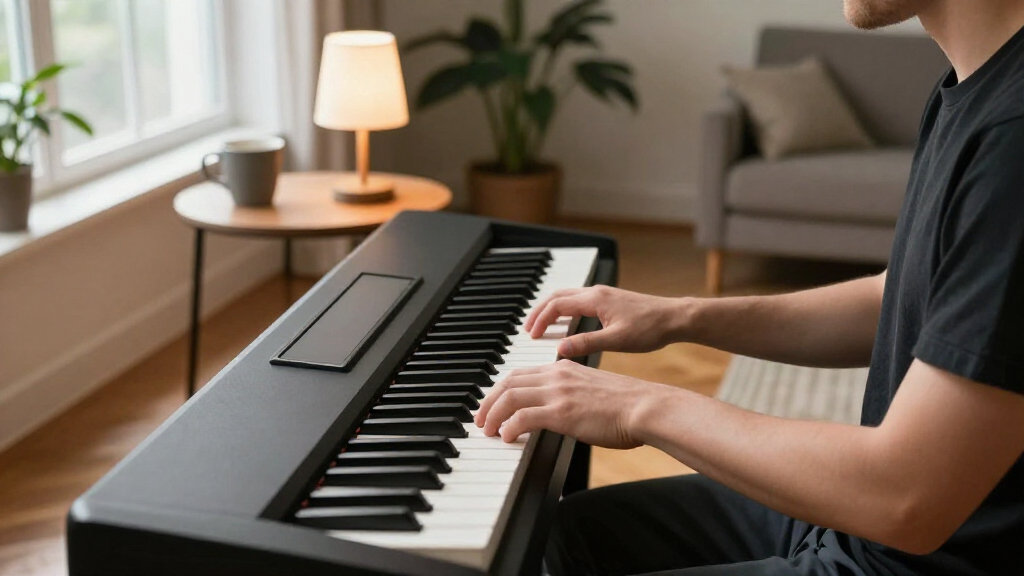

For most home players, I’d start with the Yamaha P-145BT for a straightforward weighted-key setup, then compare it with the Casio PX-870 for a more furniture-style piano and the Yamaha DGX-670B for broader sounds and practice features. The main tradeoffs are realistic key action versus a lighter, easier-to-play feel, compact portability versus a permanent home setup, and focused piano practice versus extra sounds and functions. Bundled stands and pedals can simplify setup, but they don’t always match the feel or build of a more established instrument. This guide compares all 15 options by how well they fit common home-practice needs. Read on for the full breakdown and help choosing the right piano for your space, skill level, and routine.

Get audio and creator gear delivered free with Prime
- Fast, free delivery on millions of items
- Prime Video, Amazon Music and more included
- Member-only deals all year
Complete the kit


Key Takeaways
- Weighted action is the clearest dividing line. Yamaha, Casio, Alesis, and several furniture-style models offer weighted or graded hammer-action keys; the Veitob, UISCOM semi-weighted, KUMENG, Vediya, and Zilvok options trade some piano-like resistance for a lighter touch.
- The Yamaha P-145BT and P71 favor focused practice. Their portable, simpler designs suit players who want a familiar piano layout without the broader accompaniment and sound options of the DGX-670B.
- The DGX-670B stands apart for versatility. Its wider range of sounds and functions can support more than piano drills, but those extras may be unnecessary for someone who mainly wants a direct piano practice instrument.
- Furniture-style picks make different space and setup tradeoffs. The Casio PX-870, AKLOT LS02Pro, and desk-style UISCOM are aimed at a more permanent home arrangement, while portable models leave room to choose a separate stand and bench.
- Accessory bundles need a closer look than their item count suggests. Stands and pedals can make a beginner setup easier, but buyers should weigh key action and the actual pedal configuration more heavily than a long list of included extras.
| AODSK B-83 88-Key Weighted Digital Piano with Speakers, Stand, and Triple Pedals |  | Best Home Setup with Triple Pedals | Keys: 88 weighted keys | Polyphony: 128 notes | Timbres: 128 | VIEW LATEST PRICE | See Our Full Breakdown |
| Veitob 88-Key Digital Piano with Semi-Weighted Keys and Beginner Accessory Kit |  | Best Beginner Bundle | Keys: 88 semi-weighted keys | Timbres: 1,000 | Rhythms: 1,000 | VIEW LATEST PRICE | See Our Full Breakdown |
| Alesis Recital Home 88-Key Digital Piano with Graded Hammer-Action, Black |  | Best for Structured Piano Lessons | Keys and action: 88 weighted keys with graded hammer-action | Touch response: Adjustable sensitivity | Built-in sounds: 25 | VIEW LATEST PRICE | See Our Full Breakdown |
| Yamaha DGX-670B 88-Key Weighted Digital Piano, Black |  | Best for Accompaniment and Creative Practice | Keys: 88 weighted hammer-action keys | Instrument voices: 630 | Accompaniment styles: 263 | VIEW LATEST PRICE | See Our Full Breakdown |
| Yamaha P71 88-Key Weighted Action Digital Piano |  | Best Compact Weighted Piano | Keys: 88 weighted, touch-sensitive keys | Key action: Hammer action | Voices: 10 | VIEW LATEST PRICE | See Our Full Breakdown |
| Yamaha P-145BT 88-Key Digital Piano |  | Best for a More Piano-Like Home Practice Feel | Keys: 88 weighted, touch-sensitive keys | Key action: Graded Hammer Compact | Connectivity: Bluetooth | VIEW LATEST PRICE | See Our Full Breakdown |
| UISCOM 88-Key Semi-Weighted Digital Piano with Wooden Stand |  | Best Complete Starter Setup | Keys: 88 | Key type: Semi-weighted | Tones: 600 | VIEW LATEST PRICE | See Our Full Breakdown |
| KUMENG 88-Key Semi-Weighted Digital Piano with Stand |  | Best for Home Practice with Music Software | Keys: 88 full-size semi-weighted keys | Tones: 800 | Polyphony: 128 notes | VIEW LATEST PRICE | See Our Full Breakdown |
| Vediya 88-Key Semi-Weighted Digital Piano Keyboard with Stand |  | Best for Structured Practice Features | Keys: 88 | Key action: Semi-weighted | Tones: 600 | VIEW LATEST PRICE | See Our Full Breakdown |
| Zilvok 88-Key Digital Piano with Semi-Weighted Keys and Beginner Accessory Kit |  | Best for Beginners Who Want Lots of Built-In Variety | Keys: 88 | Key type: Semi-weighted | Tones: 1,000 | VIEW LATEST PRICE | See Our Full Breakdown |
| UISCOM 88 Key Weighted Home Digital Piano, Wooden Desk Keyboard, Triple-Pedal |  | Best for a Furniture-Style Practice Setup | Keys: 88 weighted keys | Key action: Progressive hammer action | Tones: 8 | VIEW LATEST PRICE | See Our Full Breakdown |
| Casio PX-870 Privia Digital Piano Bundle, Black |  | Best for a Full-Featured Home Practice Station | Keys: 88 scaled, weighted hammer-action keys | Key texture: Simulated ebony and ivory | Instrument tones: 19 | VIEW LATEST PRICE | See Our Full Breakdown |
| AKLOT LS02Pro 88-Key Weighted Upright Digital Piano with Sliding Lid |  | Best for Quiet Practice with a Home Console Feel | Keyboard: 88-key graded hammer action with velocity sensitivity | Piano voices: 4 | Speakers: Dual 25-watt stereo speakers | VIEW LATEST PRICE | See Our Full Breakdown |
| Alesis Recital Pro MKII 88-Key Weighted Digital Piano |  | Best for Flexible, Space-Conscious Practice | Keys: 88 | Key action: Weighted hammer action with adjustable touch response | Built-in sounds: 25 | VIEW LATEST PRICE | See Our Full Breakdown |
| Eastar EUP-100 88-Key Weighted Digital Piano with Three-Pedal System |  | Best for Feature-Rich Beginner Practice | Keys: 88 | Keyboard action: Weighted hammer action | Voices: 13 | VIEW LATEST PRICE | See Our Full Breakdown |
| digital pianos for home practice | Keys | Connectivity |
|---|---|---|
| AODSK B-83 88-Key Weighted Dig | 88 weighted keys | USB MIDI; 6.35 mm jack |
| Veitob 88-Key Digital Piano wi | 88 semi-weighted keys | Bluetooth, USB, and USB-MIDI |
| Alesis Recital Home 88-Key Dig | — | USB-B, 1/4-inch stereo output, 1/8-inch stereo auxiliary input, and headphone outputs |
| Yamaha DGX-670B 88-Key Weighte | 88 weighted hammer-action keys | USB, 3.5 mm jack, and Bluetooth |
| Yamaha P71 88-Key Weighted Act | 88 weighted, touch-sensitive keys | USB and auxiliary |
| Yamaha P-145BT 88-Key Digital | 88 weighted, touch-sensitive keys | Bluetooth |
| UISCOM 88-Key Semi-Weighted Di | 88 | Bluetooth audio, USB-MIDI |
| KUMENG 88-Key Semi-Weighted Di | 88 full-size semi-weighted keys | USB/MIDI |
| Vediya 88-Key Semi-Weighted Di | 88 | USB-MIDI |
| Zilvok 88-Key Digital Piano wi | 88 | Bluetooth, USB, USB-MIDI |
| UISCOM 88 Key Weighted Home Di | 88 weighted keys | USB; MIDI control; dual headphone jacks |
| Casio PX-870 Privia Digital Pi | 88 scaled, weighted hammer-action keys | — |
| AKLOT LS02Pro 88-Key Weighted | — | — |
| Alesis Recital Pro MKII 88-Key | 88 | USB-MIDI, USB-Audio, 1/4-inch sustain pedal input, 1/4-inch Aux output, 1/8-inch Aux input, and 1/8-inch headphone output |
| Eastar EUP-100 88-Key Weighted | 88 | USB, wireless, MIDI IN/OUT |
More Details on Our Top Picks
AODSK B-83 88-Key Weighted Digital Piano with Speakers, Stand, and Triple Pedals
The AODSK B-83 is a practical fit for a dedicated practice corner: its 88 weighted keys, wooden case, stand, and three-pedal unit arrive as one piano-style setup. That makes it more complete for classical exercises than the lighter Yamaha P71, which includes a sustain pedal but not a stand or full pedal set. The B-83 also offers two headphone connections, so a teacher and student can listen together without filling the room with sound, plus recording and teaching modes for structured practice. Its 128 tones and demonstration songs add variety, though they are not the main reason to choose it. The tradeoff is substantial: at 71.2 pounds and nearly 54 inches wide, it is better left in place, and the supplied warranty wording is incomplete.
Pros:- Full-size weighted keys support piano-style practice.
- Stand and three pedals provide a more complete home setup.
- Two headphone connections allow quiet practice with a teacher or duet partner.
- Recording, playback, teaching, and split modes support varied practice routines.
Cons:- Its 71.2-pound weight and large footprint make repositioning difficult.
- Warranty details in the provided product information are incomplete.
Best for: Home learners who want weighted keys, a stand, and soft, sustain, and sostenuto pedals in one stationary setup.
Not ideal for: Players who need a portable keyboard or have limited floor space; its 71.2-pound body is bulky to move.
- Keys:88 weighted keys
- Polyphony:128 notes
- Timbres:128
- Demonstration songs:88
- Pedals:Soft, sustain, and sostenuto
- Connectivity:USB MIDI; 6.35 mm jack
- Headphone support:Up to two headphones
- Dimensions and weight:53.94 × 29.13 × 13.78 inches; 71.2 lbs
Our verdict“Choose the AODSK B-83 if you want a substantial, pedal-equipped home piano and do not need to move it often.”
Veitob 88-Key Digital Piano with Semi-Weighted Keys and Beginner Accessory Kit
The Veitob is aimed at beginners who want a keyboard, accessories, and plenty of built-in variety from the start. Its 88 semi-weighted keys provide a more substantial feel than an unweighted portable keyboard, while the included stand, case, headphones, sustain pedal, and music rest reduce the need to assemble a setup piece by piece. Compared with the Yamaha P71, it offers far more sounds and rhythms, plus Bluetooth and USB-MIDI for connecting to devices or music software. That breadth can make practice more engaging, but it does not replace the feel of fully weighted hammer-action keys found on the P71 or Alesis Recital Home. The large collection of rhythms and tones may also distract a learner focused on piano technique. Choose it for an all-in-one starter package, not for the most piano-like action.
Pros:- Includes a stand, carrying case, headphones, sustain pedal, and music rest.
- 88 semi-weighted keys offer more resistance than unweighted portable keys.
- Bluetooth, USB, and USB-MIDI support connections to external devices.
- Large selection of tones, rhythms, and demo songs provides practice variety.
Cons:- Semi-weighted action does not match the hammer-action feel of the Yamaha P71 or Alesis Recital Home.
- The extensive sound and rhythm selection may be unnecessary for learners concentrating on piano fundamentals.
Best for: New learners who want a full-size keyboard, basic practice accessories, and device connectivity in a single package.
Not ideal for: Students prioritizing acoustic-piano-like key resistance or a simple, focused instrument with few extra functions.
- Keys:88 semi-weighted keys
- Timbres:1,000
- Rhythms:1,000
- Demo songs:150
- Connectivity:Bluetooth, USB, and USB-MIDI
- Included components:Stand, carrying case, headphones, sustain pedal, power supply, key stickers, and music rest
- Color:Black
- Skill level:All
Our verdict“Pick the Veitob if included accessories and creative variety matter more to you than fully weighted keys.”
Alesis Recital Home 88-Key Digital Piano with Graded Hammer-Action, Black
For home learners building technique, the Alesis Recital Home combines graded hammer-action keys with adjustable touch sensitivity, allowing players to tailor how strongly a key must be played to produce a response. Its included wooden stand and three-pedal unit make it a more lesson-oriented setup than the portable Yamaha P71, which has a simpler sustain pedal arrangement. The Alesis also provides 25 sounds, layer and split modes, USB, audio connections, and headphone outputs, giving learners useful options for silent practice and recording. Lesson-software trials can help get a study routine started, but access is limited-time rather than a lasting included resource. The key tradeoff is mobility: at 19 kg, it is not an easy instrument to shift between rooms. It makes more sense as a settled practice station than as a portable piano.
Pros:- Graded hammer-action keys and adjustable touch sensitivity support expressive practice.
- Wooden stand and three-pedal unit create a lesson-ready home setup.
- USB, audio, and headphone connections accommodate practice and recording.
- Layer and split modes add flexibility beyond basic piano practice.
Cons:- At 19 kg, it is cumbersome to move frequently.
- Skoove and Melodics access is offered as limited-time trials.
Best for: Students who want weighted action, a three-pedal setup, adjustable touch response, and lesson-friendly home connectivity.
Not ideal for: Players who need a lightweight keyboard to carry between rooms or expect lesson software to remain included indefinitely.
- Keys and action:88 weighted keys with graded hammer-action
- Touch response:Adjustable sensitivity
- Built-in sounds:25
- Built-in speakers:20 W
- Pedals:Three-pedal unit
- Connectivity:USB-B, 1/4-inch stereo output, 1/8-inch stereo auxiliary input, and headphone outputs
- Dimensions:11.52 × 51.6 × 29.88 inches
- Weight:19 kg
- Included lesson software:Skoove and Melodics trials
Our verdict“Choose the Alesis Recital Home for a stationary, lesson-focused setup with weighted keys and three pedals.”
Yamaha DGX-670B 88-Key Weighted Digital Piano, Black
The Yamaha DGX-670B suits players who want home practice to include more than solo piano exercises. Its weighted hammer action is heavier in the low register and lighter in the high register, while CFX stereo sampling supplies a concert-grand voice. The broader appeal is its 630 instrument voices and 263 accompaniment styles: these let a player practice with different sounds or a backing arrangement, something the more focused Yamaha P71 does not provide. A built-in score display and microphone input with vocal effects also support varied learning and home performance. That range brings a more involved instrument and setup, though; the furniture stand is sold separately, and the 67.7-pound piano is not a lightweight option. Pick it for accompaniment and creative features rather than a minimal, piano-only practice station.
Pros:- Weighted hammer action is heavier in the low register and lighter in the high register.
- CFX stereo sampling provides a concert-grand sound.
- 630 voices and 263 accompaniment styles support varied practice and arranging.
- Score display and microphone input add learning and performance options.
Cons:- Furniture stand is sold separately.
- At 67.7 pounds, the piano is cumbersome to move.
- The optional UD-WL01 adapter is needed for the wireless connection described in the product information.
Best for: Home players who want weighted piano practice alongside accompaniment styles, multiple instrument sounds, and microphone features.
Not ideal for: Buyers seeking a straightforward, compact piano setup or a package that includes a furniture stand.
- Keys:88 weighted hammer-action keys
- Instrument voices:630
- Accompaniment styles:263
- Piano sampling:CFX stereo sampling
- Connectivity:USB, 3.5 mm jack, and Bluetooth
- Microphone input:Yes, with vocal effects
- Weight:67.7 lbs
- Stand:Sold separately
- Included accessories:Sustain foot switch and music rest
Our verdict“Choose the DGX-670B if accompaniment and sound variety matter as much as practicing piano repertoire.”
Yamaha P71 88-Key Weighted Action Digital Piano
The Yamaha P71 is the most straightforward choice here for players who want a weighted 88-key keyboard without a bulky cabinet or a long list of features. At 25 pounds and about six inches high, it is far easier to place or move than the AODSK B-83 and Yamaha DGX-670B, both of which offer more built-in equipment and weigh substantially more. The P71 keeps practice essentials: touch-sensitive hammer action, built-in speakers, a sustain pedal, headphone output, and USB connectivity. Its 10 voices and dual voice layering are enough for basic variety, but not comparable to the DGX-670B’s extensive voices and accompaniment styles. It also lacks a stand and full three-pedal unit, so players wanting a furniture-style piano setup should look to the Alesis Recital Home or AODSK instead.
Pros:- Weighted hammer-action keys provide a piano-oriented playing feel.
- At 25 pounds, it is easier to move than the AODSK B-83 and Yamaha DGX-670B.
- Built-in speakers, headphone output, and included sustain pedal cover basic home practice.
- USB connectivity supports use with music software.
Cons:- The 10-voice selection is limited compared with the Yamaha DGX-670B.
- A stand and three-pedal unit are not included.
- The full-size keyboard still requires a suitable surface or space for placement.
Best for: Learners who need a relatively light, full-size weighted keyboard for a small home practice space or occasional relocation.
Not ideal for: Players who want a built-in stand, three pedals, extensive accompaniment features, or a large selection of sounds.
- Keys:88 weighted, touch-sensitive keys
- Key action:Hammer action
- Voices:10
- Special features:Built-in speakers, Duo Mode, and dual voice layering
- Connectivity:USB and auxiliary
- Headphone jack:3.5 mm
- Dimensions:52.25 × 11.5 × 6 inches
- Weight:25 lbs
- Included components:Sustain pedal and power supply
Our verdict“Choose the P71 if weighted keys and a manageable footprint matter more than a built-in stand or broad feature set.”
Yamaha P-145BT 88-Key Digital Piano
The P-145BT is the clearest fit here for players who want their daily practice to feel closer to playing an acoustic piano. Its 88 weighted, touch-sensitive keys and Graded Hammer Compact action offer a more piano-oriented touch than the semi-weighted UISCOM URS25, KUMENG KU-3506, Vediya, or Zilvok. That difference matters when building finger control, though the compact action may not feel identical to a full acoustic mechanism.
Bluetooth audio lets you play along with streamed music, while built-in speakers keep ordinary practice simple. At 24.5 pounds, it is easier to move around the home than a furniture-style setup, but it still needs corded power and its included sustain switch is a simpler arrangement than the triple-pedal bundle supplied with the UISCOM. I’d choose this for piano-focused practice, not for the biggest collection of sounds or bundled accessories.
Pros:- 88 weighted, touch-sensitive keys with Graded Hammer Compact action
- Bluetooth audio supports playing along with streamed music
- Built-in speakers allow practice without separate amplification
- Compact 24.5-pound design and included music rest, sustain foot switch, and AC adapter
Cons:- Requires corded electric power
- Included sustain control is a foot switch rather than a triple-pedal setup
- Offers fewer built-in sound and rhythm options than the semi-weighted bundle models
Best for: Learners and returning pianists who prioritize weighted-key practice, built-in speakers, and a compact instrument for a home room.
Not ideal for: Buyers seeking a bundled stand and triple-pedal unit, extensive rhythms and tones, or a keyboard that can be played without mains power.
- Keys:88 weighted, touch-sensitive keys
- Key action:Graded Hammer Compact
- Connectivity:Bluetooth
- Speakers:Built-in
- Headphone jack:6.35 mm
- Weight:24.5 pounds
- Dimensions:10.55 x 52.21 x 5.08 inches
- Included components:Music rest, sustain foot switch, AC adapter
Our verdict“Choose the P-145BT if weighted-key feel matters more to your home practice than a large sound library or a furniture-style accessory bundle.”
UISCOM 88-Key Semi-Weighted Digital Piano with Wooden Stand
The UISCOM URS25 is aimed at beginners who want a ready-to-use home station rather than a keyboard alone. Its wooden stand, triple pedal, headphones, and music stand cover several setup needs in one package; by contrast, the Yamaha P-145BT has weighted action but includes a simpler sustain foot switch. That makes the UISCOM easier to outfit from the start, especially for someone setting aside a fixed practice space.
Its 600 tones, 800 rhythms, demo songs, metronome, and recording features give new players plenty to explore between lessons. Bluetooth audio and USB-MIDI also broaden its use with streamed music and compatible devices. The main compromise is the semi-weighted keyboard: it will not provide the same resistance or piano-oriented finger training as the Yamaha’s weighted action. I’d favor this as an accessible, feature-rich starter kit, not as the pick for developing a more acoustic-like touch.
Pros:- Includes wooden stand, triple pedal, headphones, and music stand
- Bluetooth audio and USB-MIDI connectivity
- Metronome, recording, demo songs, and extensive tone and rhythm choices
- Full 88-key range for practicing across the keyboard
Cons:- Semi-weighted keys feel lighter than the weighted action on the Yamaha P-145BT
- Large assortment of tones and rhythms may be less useful to players focused on piano practice
- Product data does not specify dimensions or weight for planning a home setup
Best for: First-time learners who want a stand, triple pedal, headphones, and multiple guided practice and accompaniment features in one setup.
Not ideal for: Pianists focused on weighted-key technique or buyers who would rather have a simpler instrument with a more piano-like action.
- Keys:88
- Key type:Semi-weighted
- Tones:600
- Rhythms:800
- Demo songs:80
- Connectivity:Bluetooth audio, USB-MIDI
- Headphone jack:3.5 mm
- Included components:Wooden stand, triple pedal, music stand, headphones, music clips, piano cover, key stickers
Our verdict“Pick the URS25 if you want a bundled beginner practice station and can accept lighter semi-weighted keys.”
KUMENG 88-Key Semi-Weighted Digital Piano with Stand
The KUMENG KU-3506 is the most directly suited of these semi-weighted options to a learner who wants to connect a keyboard to a computer and practice with music software. Its USB/MIDI connection is listed as compatible with Windows, macOS, and Linux, with GarageBand and Ableton Live named as supported software. That gives it a more explicit software-oriented case than the Vediya, whose supplied details highlight practice functions but do not name supported programs.
The 128-note polyphony and 800 tones provide room for layered sounds and longer passages, while the included stand, sheet music stand, and pedal make it a practical home setup. The tradeoff is touch: its full-size keys are semi-weighted, unlike the weighted Yamaha P-145BT, so it is less compelling for players focused on piano-style resistance. I’d choose it for connected practice and feature variety, not for the most authentic key feel.
Pros:- USB/MIDI supports connection to devices and listed music software
- 128-note polyphony supports layered sounds and sustained passages
- Includes piano stand, sheet music stand, pedal, and power adapter
- 800 tones and split-keyboard and recording features add practice options
Cons:- Semi-weighted keys do not match the piano-oriented resistance of the Yamaha P-145BT
- USB/MIDI is listed, but Bluetooth audio is not
- Corded electric power limits placement away from an outlet
Best for: Home learners who plan to use a computer, tablet, or compatible music software alongside built-in practice and sound features.
Not ideal for: Players who want weighted action for piano technique, or buyers seeking Bluetooth audio connectivity.
- Keys:88 full-size semi-weighted keys
- Tones:800
- Polyphony:128 notes
- Connectivity:USB/MIDI
- Headphone jack:3.5 mm
- Power source:Corded electric
- Dimensions:12.2 x 53 x 6.5 inches
- Included accessories:Piano stand, sheet music stand, pedal, power adapter
- Supported systems and software:Windows, macOS, Linux; GarageBand and Ableton Live
Our verdict“Choose the KU-3506 if computer-connected practice and broad sound options matter more than weighted-key feel.”
Vediya 88-Key Semi-Weighted Digital Piano Keyboard with Stand
The Vediya puts the focus on practical routines: a metronome, recording and playback, split mode, layered sounds, and transpose give a learner several ways to work through material at home. Its feature set is close to the KUMENG KU-3506, but the supplied Vediya details emphasize practice functions and a generous accessory bundle rather than polyphony or named music-software compatibility. That makes it a better match for someone who wants to practice directly on the keyboard without building a computer-centered setup.
A four-leg stand, sustain pedal, music stand, and cover help establish a dedicated space, while USB-MIDI provides a route to compatible devices. The limitation shared with the KUMENG and UISCOM is its semi-weighted action, which is lighter than the Yamaha P-145BT’s weighted keys. The listed dimensions also make it worth measuring the intended spot before choosing it. I’d shortlist it for feature-led practice, not piano-action training.
Pros:- Metronome and recording/playback support routine practice
- Split mode, layered sounds, and transpose add flexible practice options
- Includes four-leg stand, sustain pedal, music stand, cover, and other accessories
- USB-MIDI supports connection to compatible external devices
Cons:- Semi-weighted keys have a lighter touch than the Yamaha P-145BT’s weighted action
- Bluetooth audio is not listed
- Its 57-inch listed length may require careful space planning
Best for: Beginners who want built-in timing, recording, and split or layered modes with a stand and basic practice accessories included.
Not ideal for: Players seeking weighted keys, Bluetooth audio, or a compact instrument with clearly specified portability.
- Keys:88
- Key action:Semi-weighted
- Tones:600
- Rhythms:800
- Demo songs:80
- Connectivity:USB-MIDI
- Functions:Metronome, split mode, layered sounds, transpose, recording and playback
- Included accessories:Four-leg stand, sustain pedal, music stand, cover, key stickers, music clips, manual
- Dimensions:57 x 5.25 x 15.75 inches
Our verdict“The Vediya suits learners who value onboard practice tools and a bundled stand more than weighted-key response or Bluetooth audio.”
Zilvok 88-Key Digital Piano with Semi-Weighted Keys and Beginner Accessory Kit
The Zilvok 801 is the most feature-packed choice here for a beginner who likes experimenting with accompaniment and sounds during home practice. Its 1,000 tones, 1,000 rhythms, and 150 demo songs exceed the listed libraries on the UISCOM URS25 and Vediya, giving a new player more material to explore. Recording and playback, a dual-keyboard function, Bluetooth, and USB-MIDI add ways to practice or connect beyond playing a piano sound by itself.
The bundle includes a stand, sustain pedal, carrying case, headphones, music rest, and key stickers, so it covers more setup needs than the KUMENG package. That breadth comes with a clear compromise: the semi-weighted keys are less suitable for developing the resistance expected from a piano, especially compared with the weighted Yamaha P-145BT. The supplied data also omits dimensions and weight, making fit and portability harder to judge. I’d pick it for variety, not touch realism.
Pros:- Large selection of tones, rhythms, and demo songs
- Bluetooth, USB, and USB-MIDI connectivity
- Includes stand, carrying case, headphones, sustain pedal, and music rest
- Recording/playback and dual-keyboard function provide practice flexibility
Cons:- Semi-weighted keys do not provide the feel of the Yamaha P-145BT’s weighted action
- Dimensions and weight are not specified in the supplied product data
- Extensive rhythms and sounds may distract buyers seeking a straightforward piano-practice instrument
Best for: New players who want an all-in-one starter bundle, many accompaniment options, and Bluetooth or USB connections for home practice.
Not ideal for: Learners prioritizing weighted action, or buyers who need confirmed dimensions and weight before planning a tight space.
- Keys:88
- Key type:Semi-weighted
- Tones:1,000
- Rhythms:1,000
- Demo songs:150
- Connectivity:Bluetooth, USB, USB-MIDI
- Special features:Built-in speaker, recording and playback, dual keyboard function
- Included components:Sustain pedal, power supply, stand, carrying case, headphones, key stickers, music rest
- Skill level:Beginner
Our verdict“Choose the Zilvok 801 if variety and a broad beginner bundle are your priorities, but look elsewhere for weighted-key practice.”
UISCOM 88 Key Weighted Home Digital Piano, Wooden Desk Keyboard, Triple-Pedal
The UISCOM is a strong fit for home practice when the piano should also function as a piece of furniture: its wooden desk-style cabinet is designed to transform between a desk and vanity, and it includes a triple-pedal unit. Its 88 weighted keys and progressive hammer-action design target players who want a more piano-like touch than the semi-weighted alternatives in this roundup. The USB MP3 player, dual headphone jacks, recording, and MIDI support give households useful ways to practice quietly or connect to music software. Compared with the Casio PX-870, though, the UISCOM lists just eight tones and does not specify speaker wattage or polyphony, while the Casio documents a larger sound set and a 40-watt speaker system. Its flexible furniture design is appealing, but buyers should expect fewer confirmed sound and audio details.
Pros:- 88 weighted keys with progressive hammer-action design
- Triple pedals add sustain, sostenuto, and soft-pedal control
- Dual headphone jacks support quiet practice for two people
- USB playback, recording, and MIDI provide useful practice and computer connections
Cons:- Eight listed tones offer less variety than the Casio PX-870’s 19
- Speaker wattage and polyphony are not specified in the provided details
- The large furniture-style cabinet is less suitable for buyers who need a portable instrument
Best for: Home learners who want weighted keys, three pedals, and a convertible furniture-style cabinet in a shared room
Not ideal for: Players who prioritize a documented, broad sound library or clearly specified speaker performance; the product details list only eight tones and omit speaker wattage
- Keys:88 weighted keys
- Key action:Progressive hammer action
- Tones:8
- Demo songs:40
- Pedals:Triple pedal: sustain, sostenuto, and soft
- Connectivity:USB; MIDI control; dual headphone jacks
- Practice features:Recording and playback; dual-tone mode; reverb and chorus
- Power:Corded electric
Our verdict“Choose the UISCOM if a convertible furniture design and triple pedals matter more than a large documented sound library or portable setup.”
Casio PX-870 Privia Digital Piano Bundle, Black
For a home practice setup centered on expressive playing and built-in learning tools, the Casio PX-870 is the most complete console option in this group. Its 88 textured hammer-action keys and 256-note polyphony give learners room to work on layered passages without quickly running out of notes, while the four-speaker, 40-watt system is a substantial step up from the Alesis Recital Pro MKII’s 20-watt speakers. The two-track MIDI recorder, duet mode, and 60 built-in songs also make regular practice more structured. The included bench, headphones, and learning materials help create a ready-to-use station, though not every buyer will want the entire bundle. Compared with the more furniture-flexible UISCOM, the PX-870 offers more listed tones and stronger documented audio, but it is a dedicated console rather than a convertible desk.
Pros:- Textured, weighted hammer-action keys support expressive piano practice
- 40-watt four-speaker system provides stronger documented output than the Alesis Recital Pro MKII
- 256-note polyphony and 19 tones support layered playing and varied practice
- Bench, headphones, and learning materials make the bundle practice-ready
Cons:- Console format takes more dedicated space than the portable Alesis Recital Pro MKII
- Some included accessories and learning materials may go unused
- The 19-tone selection is smaller than the 25 sounds listed for the Alesis Recital Pro MKII
Best for: Committed home learners or lesson-taking students who want a console piano, robust built-in speakers, and practice tools in one setup
Not ideal for: Buyers with limited floor space, those who need a portable keyboard, or anyone who would not use the bundled bench and learning materials
- Keys:88 scaled, weighted hammer-action keys
- Key texture:Simulated ebony and ivory
- Instrument tones:19
- Polyphony:256 notes
- Speakers:Four speakers; 40 watts
- Recorder:Two-track MIDI recorder
- Music library:60 built-in songs; space for 10 additional songs
- Included accessories:Furniture bench, headphones, instructional book, online lessons, instructional DVD, and polishing cloth
Our verdict“Pick the PX-870 if you want a dedicated home console with strong built-in sound and practice features, and have room for its full setup.”
AKLOT LS02Pro 88-Key Weighted Upright Digital Piano with Sliding Lid
The AKLOT LS02Pro is suited to players who want an upright-style instrument that feels settled in a home practice space but still accommodates quiet sessions. Its graded hammer-action keys and triple pedal provide a more piano-focused setup than the portable Alesis Recital Pro MKII, and the sliding lid helps protect the keys between sessions. Headphone support, recording and playback, and an adjustable soft light strip are practical touches for evening practice or reviewing a passage without disturbing others. The dual 25-watt speakers offer more listed power than the Alesis’s 20-watt system. The tradeoff is a limited four-voice sound selection, compared with 25 sounds on the Alesis, and assembly is required. This is a console-minded choice, not the flexible option for players who move their instrument around.
Pros:- Graded hammer-action keys provide an acoustic-style touch
- Triple pedal and sliding lid suit a permanent home practice station
- Dual 25-watt speakers have more listed power than the Alesis Recital Pro MKII
- Recording, playback, headphones, and adjustable lighting support varied practice routines
Cons:- Only four piano voices are listed
- Assembly is required before use
- Upright cabinet format is less convenient to relocate than the portable Alesis Recital Pro MKII
Best for: Home players who want an upright-style cabinet, triple pedals, headphones for quiet sessions, and a lighted practice area
Not ideal for: Musicians seeking many instrument sounds or a keyboard they can easily move; it lists four piano voices and requires assembly
- Keyboard:88-key graded hammer action with velocity sensitivity
- Piano voices:4
- Speakers:Dual 25-watt stereo speakers
- Pedal:Triple pedal
- Key cover:Sliding piano lid
- Lighting:12V 2A soft light strip with adjustable brightness
- Practice features:Recording and playback
- Included accessories:Headphones and lesson book
Our verdict“Choose the LS02Pro for an upright-style home setup with triple pedals and quiet-practice support, not for a wide range of sounds or easy portability.”
Alesis Recital Pro MKII 88-Key Weighted Digital Piano
The Alesis Recital Pro MKII is the most flexible pick here for a learner who needs a full 88-key weighted instrument without committing to a console cabinet. At 10.5 kg, it is far easier to reposition than the 25 kg Eastar EUP-100, and its adjustable touch response lets players adapt the keys to their developing technique. The 25 sounds, Lesson Mode, metronome, and USB-MIDI and USB-Audio connections support practice at the instrument and with compatible computer software. Its 20-watt speakers are practical for a home room, though they are less powerful on paper than the Casio PX-870’s 40-watt four-speaker system or the AKLOT’s dual 25-watt speakers. It also lacks a built-in triple-pedal console setup, and battery operation requires six AA batteries sold separately.
Pros:- Adjustable weighted hammer-action response can suit different playing preferences
- 25 sounds, Lesson Mode, and metronome support varied practice
- USB-MIDI and USB-Audio provide useful computer connections
- At 10.5 kg, it is considerably easier to reposition than the 25 kg Eastar EUP-100
Cons:- 20-watt speakers have less listed power than the Casio PX-870 and AKLOT LS02Pro
- A sustain pedal is included, but no triple-pedal system is listed
- Six AA batteries for mobile use are sold separately
Best for: Beginners or apartment players who want weighted keys and learning tools in a keyboard they can reposition or connect to a computer
Not ideal for: Buyers seeking a furniture-style console, a built-in triple-pedal system, or the stronger speaker output listed for the Casio PX-870
- Keys:88
- Key action:Weighted hammer action with adjustable touch response
- Built-in sounds:25
- Speakers:20 watts
- Metronome:5–320 BPM
- Connectivity:USB-MIDI, USB-Audio, 1/4-inch sustain pedal input, 1/4-inch Aux output, 1/8-inch Aux input, and 1/8-inch headphone output
- Power:Included AC adapter or six AA batteries, sold separately
- Weight and dimensions:10.5 kg; 12.2 × 50.47 × 5 inches
- Included accessories:Music rest, sustain pedal, power adapter, and learning subscriptions
Our verdict“Choose the Recital Pro MKII if you want weighted-key practice with learning and computer features in a relatively easy-to-reposition format.”
Eastar EUP-100 88-Key Weighted Digital Piano with Three-Pedal System
The Eastar EUP-100 gives beginners more structured ways to explore music than the simpler sound-focused options in this group. Alongside 88 weighted hammer-action keys, it offers 13 voices, 128 rhythms, 31 built-in songs, and recording, so practice can include accompaniment and playback rather than only repeating pieces. Its USB, MIDI IN/OUT, and wireless connectivity add options for working with compatible devices. Compared with the portable Alesis Recital Pro MKII, the Eastar includes a three-pedal system, headphones, and a protective cover, but that fuller home setup comes with a real mobility cost: the EUP-100 weighs 25 kg, and assembly is required. Its rhythm selection is useful for experimentation, though learners who mainly want piano practice may prefer the Casio PX-870’s more clearly specified speaker system and 256-note polyphony.
Pros:- 88 weighted hammer-action keys support piano-style technique
- 128 rhythms, 31 songs, and 13 voices offer varied practice material
- Recording, USB, MIDI IN/OUT, and wireless connectivity broaden practice options
- Includes a three-pedal system, headphones, and protective cover
Cons:- At 25 kg, it is difficult to move compared with the Alesis Recital Pro MKII
- Assembly is required, with two people recommended
- Speaker output and polyphony are not specified in the provided details
Best for: Beginners who want weighted keys, built-in rhythms and songs, and a three-pedal home setup with bundled headphones
Not ideal for: Players who need to move their piano often or want detailed speaker and polyphony specifications; assembly and its 25 kg weight limit flexibility
- Keys:88
- Keyboard action:Weighted hammer action
- Voices:13
- Rhythms:128
- Built-in songs:31
- Connectivity:USB, wireless, MIDI IN/OUT
- Weight and dimensions:25 kg; 11.42 × 53.35 × 31.02 inches
- Included accessories:Protective cover, headphones, three-pedal system, and piano stickers
Our verdict“Pick the Eastar if a beginner wants rhythms, built-in songs, and bundled pedals for a home setup and does not need a lightweight instrument.”
How We Picked
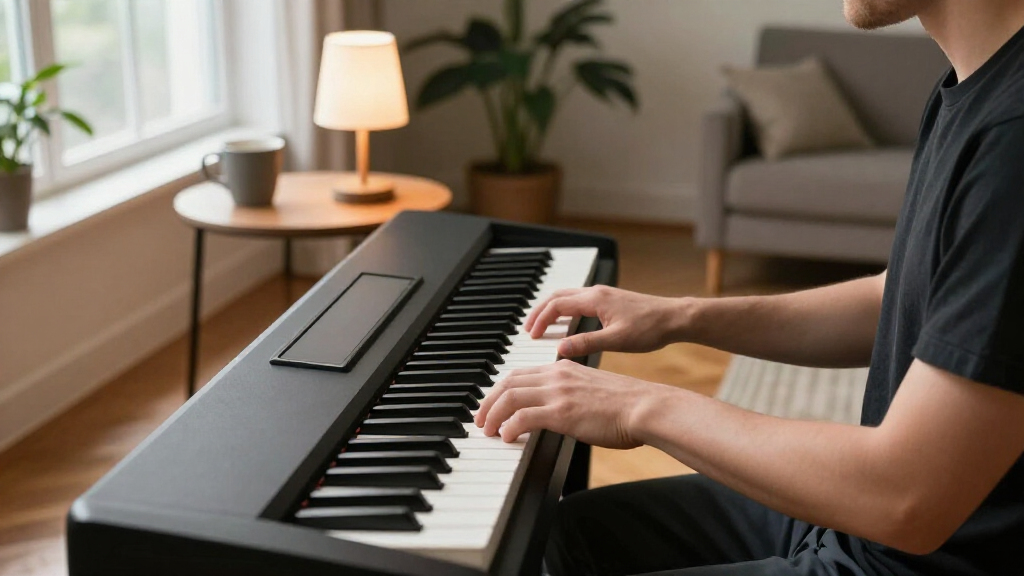
I ranked these digital pianos for home practice around the parts that shape daily use: key action, full 88-key range, built-in speakers, pedal and stand setup, sound and practice functions, and how well the design suits a dedicated or shared room. I gave more weight to a convincing piano-style touch and a useful home setup than to accessory count alone, since key feel and comfortable positioning matter each time someone sits down to practice.
The ranking reflects distinct buyer needs rather than treating every feature as equally valuable. A focused weighted-key model can outrank a more feature-rich keyboard for someone who wants piano practice without extra menus, while an all-in-one furniture-style option can be a better fit for a permanent setup. Semi-weighted models remain relevant for beginners or tighter budgets, but I place them lower for players building piano technique. I also account for tradeoffs: larger cabinets take more space, while portable instruments may need separate furniture and pedals.
Factors to Consider When Choosing Digital Pianos For Home Practice
Product features only tell part of the story. I’d match a piano to the room, the player’s practice goals, and how long the instrument is likely to serve them before choosing based on included accessories or extra sounds.
Choose Key Action for the Skills You Want to Build
For a player learning classical, jazz, or other piano repertoire, weighted or graded hammer action is usually a better practice foundation because it more closely reflects the resistance and response of an acoustic piano. Semi-weighted keys can feel lighter and may be comfortable for casual playing, but they offer less of that resistance practice. A common mistake is buying a semi-weighted model because it includes a stand and then expecting it to feel like a traditional piano. If the player is unsure, prioritize touch over a large sound library: key action affects every exercise, while extra sounds may see little use. A lighter action can still be the right call for a casual player, a shared instrument, or someone who values ease of playing over technique transfer.
Decide Whether the Piano Will Stay in One Place
A portable digital piano offers flexibility for a shared room, storage, or occasional moves, but it often needs a separate stand, bench, and pedal setup. Furniture-style models take up a more defined footprint and are less convenient to relocate, yet they can make a home practice corner feel ready to use. Measure the space with the player seated, not just the instrument’s width: a bench needs room to slide back, and a stand may affect where cables can run. Buyers often underestimate the value of a stable playing position, especially when a keyboard stand wobbles or puts the keys at an awkward height. Choose a cabinet-style instrument when the piano has a dedicated spot; choose a portable body when flexibility matters more than a built-in appearance.
Check the Pedal Setup Before Counting It as an Included Extra
Pedals affect both expression and technique, so an included pedal should be judged by its function and placement, not simply by whether the box lists one. A sustain pedal is enough for many early lessons, while a three-pedal arrangement is more relevant for repertoire that uses soft and sostenuto pedals. Some bundles include a pedal unit that is part of a specific stand, while portable models may rely on a separate pedal placed on the floor. Confirm compatibility and whether the setup can remain stable during practice. Paying more for a built-in pedal assembly can make sense for a permanent home instrument; a player who is still learning may be better served by allocating space and budget to a suitable bench first.
Treat Extra Sounds and Practice Functions as a Specific Need
More voices, rhythms, recording options, and accompaniment features can make practice varied, but they also add controls and choices. The DGX-670B’s broader feature set is more compelling for players who want to explore styles beyond solo piano, while a simpler model may make daily practice feel more direct. Before paying for extras, ask how the instrument will be used during an ordinary week: scales, lesson assignments, songwriting, or playing along with backing parts each point to different needs. A common buying mistake is assuming more features automatically improve practice. If the goal is steady piano technique, reliable keys, clear sound, and a comfortable setup deserve priority over functions that may remain unused.
Plan for Quiet Practice and the Room’s Sound
Built-in speakers make it easy to start playing without extra equipment, but their sound still depends on the room and the instrument’s speaker design. Headphone compatibility can matter just as much in an apartment or a household with different schedules; check the connection type and whether the player can reach it comfortably. If the piano will sit in a small room, maximum volume is less important than clear sound at a moderate level. Headphones also make repeated drills less disruptive, though long sessions call for a comfortable fit and sensible listening levels. Don’t assume that a larger cabinet alone guarantees a better practice experience; the way the piano sounds at the volume you’ll actually use is what matters.
Compare the Whole Setup, Not Just the Keyboard
A piano that arrives with a stand and pedals may be easier to put into service, but the player may still need a bench, headphones, or a more secure pedal solution. Check what is included and whether each item suits the player’s height and room. A bench that cannot be adjusted can make a child’s playing position uncomfortable, while a stand that shifts can distract during repeated passages. Portable models let buyers select these pieces separately, which offers control but creates more setup decisions. I’d compare the cost and effort of a complete, usable practice station rather than choosing by the longest bundle list.
Frequently Asked Questions
Should I choose semi-weighted keys or weighted keys for a beginner?
If the beginner expects to study piano seriously, I’d favor weighted keys because they provide resistance that supports developing finger control and prepares the player for acoustic instruments. Semi-weighted keys may suit casual playing or a player who finds heavier keys uncomfortable, but they are a compromise for piano technique. The bundled stand and accessories on models such as the Veitob, KUMENG, Vediya, and Zilvok can make a first setup simpler, but they don’t change the feel of the keys. If possible, choose based on the player’s long-term goal rather than only the easiest setup on day one.
Is a portable digital piano a poor choice for a permanent home practice space?
No. A portable model can work well at home, especially when space is shared or the instrument may need to move. The tradeoff is that the stand, bench, and pedal may need to be selected separately, so the full setup can take more planning than a furniture-style piano. A cabinet model such as the Casio PX-870 or AKLOT LS02Pro is more suited to a dedicated spot, while portable options such as the Yamaha P-145BT or P71 leave more flexibility. Choose based on room layout and setup stability, not on the label “portable” alone.
Do I need three pedals for home practice?
Most new players can begin with a sustain pedal, which is the pedal used most often in early lessons and common repertoire. A three-pedal setup becomes more useful as the player advances and encounters music that calls for soft or sostenuto pedal technique. If you are choosing a permanent home instrument, a three-pedal unit can save a later upgrade and keep the setup tidy. For a beginner with limited space, it may be more sensible to prioritize weighted keys, a stable bench, and a comfortable playing position first. Check whether the pedal unit is included and compatible with the piano rather than assuming every pedal bundle offers the same arrangement.
When is the Yamaha DGX-670B a better choice than a simpler Yamaha piano?
The DGX-670B makes more sense if practice includes exploring different instrument sounds, accompaniment, or broader musical activities alongside piano study. A simpler option such as the P-145BT or P71 may be easier to approach when the main goal is playing piano with fewer functions competing for attention. Extra features are useful only when they match the player’s routine; they do not replace a comfortable touch or regular practice. Consider who will use the instrument and whether those added functions will be part of lessons, family playing, or creative work. If the player mainly wants straightforward piano practice, a more focused model may be the clearer fit.
What should I prioritize if the piano is for a child who may outgrow it?
Start with a full 88-key range and a playing position that can be adjusted to the child’s height, since an unsuitable bench or stand can make practice uncomfortable. If the child is taking lessons and likely to continue, weighted keys are a stronger foundation than choosing a model mainly for its accessory bundle. A portable piano can be easier to reposition as the room changes, while a furniture-style instrument offers a more permanent setup. Avoid paying extra for advanced features unless the child will use them; put the focus on key feel, stable support, and headphone access for household practice. If commitment is uncertain, a simpler setup may limit the initial investment in space and accessories without sacrificing the full keyboard range.
Conclusion
For the best overall balance of focused practice and a manageable home setup, I’d begin with the Yamaha P-145BT. The best value for a permanent home arrangement depends on whether the buyer prioritizes a fuller feature set or a bundled setup: compare the Alesis Recital Pro MKII and the weighted UISCOM desk-style model against the included stand and pedal needs. For a best premium-style home fit, the Casio PX-870 is the stronger choice for buyers who want a furniture-style instrument, while the DGX-670B suits players who want more sounds and functions. For beginners, I’d favor weighted keys such as those on the Yamaha P71 or Alesis Recital Home over a semi-weighted bundle if technique is the goal. For specific needs, choose the AKLOT LS02Pro or Eastar EUP-100 when a more permanent, pedal-oriented setup appeals, and look to the Veitob, KUMENG, Vediya, or Zilvok when a lighter-touch beginner package better matches casual use. The right pick is the one whose key action, setup, and features support the practice routine the player will actually keep.
Halloween Picks

10.5 ft Lighted Pumpkin and Ghost Halloween Inflatable Archway

3 ft. Halloween Groundbreaker Skeleton for Outdoor Decoration

10 ft Halloween Inflatable Archway – Pumpkin, Skeleton & Candy Yard Décor
As an affiliate, we earn on qualifying purchases.