
TL;DR

Get audio and creator gear delivered free with Prime
- Fast, free delivery on millions of items
- Prime Video, Amazon Music and more included
- Member-only deals all year
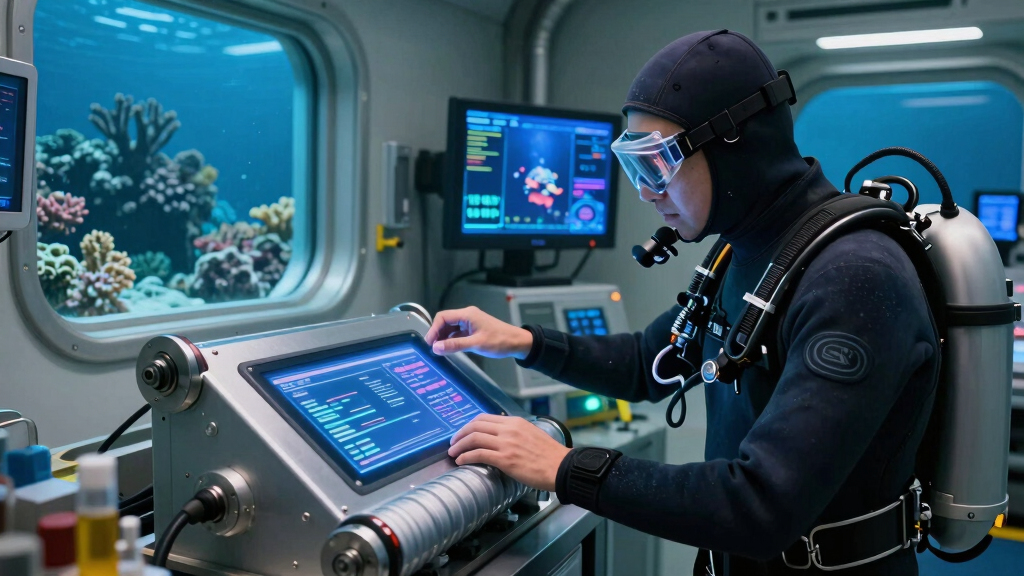
FABLE/175 has published Abyssal Station, an experimental website that turns scrolling into a simulated 3,800-meter ocean descent. Its creators say a shared depth engine controls color, lighting, pressure data and animated sea life, though performance and accessibility claims have not been independently verified.
FABLE/175 has published Abyssal Station, a single-page web experience that converts scrolling into a simulated 3,800-meter ocean descent. The exhibition says the site was produced through an AI-led design and development pipeline, with a shared depth engine controlling its visuals, data displays and animated creatures—a model that may interest designers testing AI-built interactive storytelling.
The experience places a fixed depth meter beside the page and calculates a virtual water depth from the visitor’s scroll position. According to the project description, that measurement drives background color, light intensity and pressure readings while also changing interface states throughout the descent. The palette moves from surface teal toward near-black water, with cyan and cold-blue light used for bioluminescent details.
A canvas animation system supplies different creatures for each ocean zone. The published brief calls for particle-based fish near the surface, pulsing jellyfish in the twilight zone, an anglerfish and marine snow at greater depth, and ghostly amphipods near the trench. Reaching the bottom activates a restrained finale in which the station lights switch on.
The creators say the site uses plain HTML, CSS and JavaScript, without frameworks, external requests or image assets. CSS and SVG provide texture and interface elements, while JavaScript interpolation links multiple effects to a single scroll anchor. The brief also specifies self-hosted fonts, keyboard support and reduced-motion behavior, alongside animation-loop pausing when the browser tab is hidden.
One Depth Value Drives Everything
The project’s main technical idea is that one calculated depth value governs many systems instead of assigning unrelated animations to separate sections. That approach can make scroll-driven scenes feel physically connected: light fades as pressure rises, particles drift as creatures change, and the interface reports the same simulated location represented by the artwork.
For web designers, Abyssal Station also presents a test of AI-assisted production beyond static pages. FABLE/175 describes all 175 exhibition sites as built end-to-end by AI. If the implementation matches the published brief, this room shows how an AI coding workflow can coordinate responsive layout, animation and accessibility requirements within a self-contained page.
interactive ocean exploration VR experience
As an affiliate, we earn on qualifying purchases.
As an affiliate, we earn on qualifying purchases.
Room Six in an AI Exhibition
Abyssal Station is Room 6 of 175 in FABLE/175, an exhibition intended to present fundamentally different AI-built websites. The source identifies Claude Fable 5 as the art director behind the original brief and says the room was executed through the FABLE/175 pipeline.
That pipeline is described as having three production passes: an initial build and self-critique, an outside critique intended to identify at least 10 problems, and a final art-direction pass. The supplied material says screenshots were reviewed at 390, 834 and 1,440 pixels wide, although those review records were not included with the source.
“The page is a descent.”
— The Abyssal Station art-direction brief
Testing Evidence Is Still Limited
Several details remain unverified outside the publisher’s account. The source does not provide source code, frame-rate measurements or accessibility audit results, so claims about holding 60 frames per second, meeting contrast targets and working without horizontal overflow cannot be independently confirmed from the material alone. It is also unclear how much code was generated by AI, how much human editing followed, or what criteria were used for final approval. The project’s launch date and browser-support range were not stated.
Live Use Will Test the Build
The immediate next step is public use of the live room, which can reveal how the depth engine performs across browsers, screen sizes and lower-powered devices. Publication of code, test results or detailed build notes would allow closer evaluation of the performance and accessibility claims. FABLE/175 is also continuing its room-by-room documentation, giving readers further examples against which to compare Abyssal Station’s methods.
Key Questions
What is Abyssal Station?
It is Room 6 in the FABLE/175 exhibition, presented as a deep-sea research-station website in which scrolling simulates a 3,800-meter descent.
How does the scrolling system work?
The project description says a master scroll anchor converts page position into virtual depth. That value controls lighting, color, pressure data and animation states.
Where does AI fit into the project?
FABLE/175 says the room was produced through an AI-led build, critique and art-direction pipeline. The source does not disclose the exact division between machine-generated work and human revision.
Does the site use photographs or external libraries?
According to the published brief, it uses no image assets, frameworks, CDNs or external requests. Its visuals are described as code-based CSS, SVG and canvas graphics.
Are its accessibility and performance claims confirmed?
They are requirements stated by the creators, not independently documented findings. No audit report or benchmark data accompanied the source material provided.
Source: Thorsten Meyer AI
Fall Picks
fall essentials
As an affiliate, we earn on qualifying purchases.