To understand XY, ORTF, and AB stereo miking, consider how they affect phase and width. XY uses two cardioids stacked vertically at 90-135°, offering excellent phase coherence and focused imaging. ORTF places cardioids at 110° with 17cm spacing, creating a natural stereo spread similar to human ears. AB employs two omnidirectionals spaced 17-30cm apart, producing a spacious sound but potentially introducing phase issues. Exploring these methods helps you choose the ideal setup for natural, clear stereo recordings.
Key Takeaways
- XY uses two cardioid mics at 90-135° close together for excellent phase coherence and a focused stereo image.
- ORTF employs two cardioid mics at 110° with 17cm spacing, creating a natural stereo spread similar to human ears.
- AB setup involves two omnidirectional mics spaced 17-30cm apart, producing wider stereo images with potential phase issues at larger distances.
- XY minimizes phase problems due to capsule proximity, while ORTF offers a more spacious sound with careful alignment.
- AB provides greater stereo width but can introduce phase cancellation if microphones are spaced too far apart.
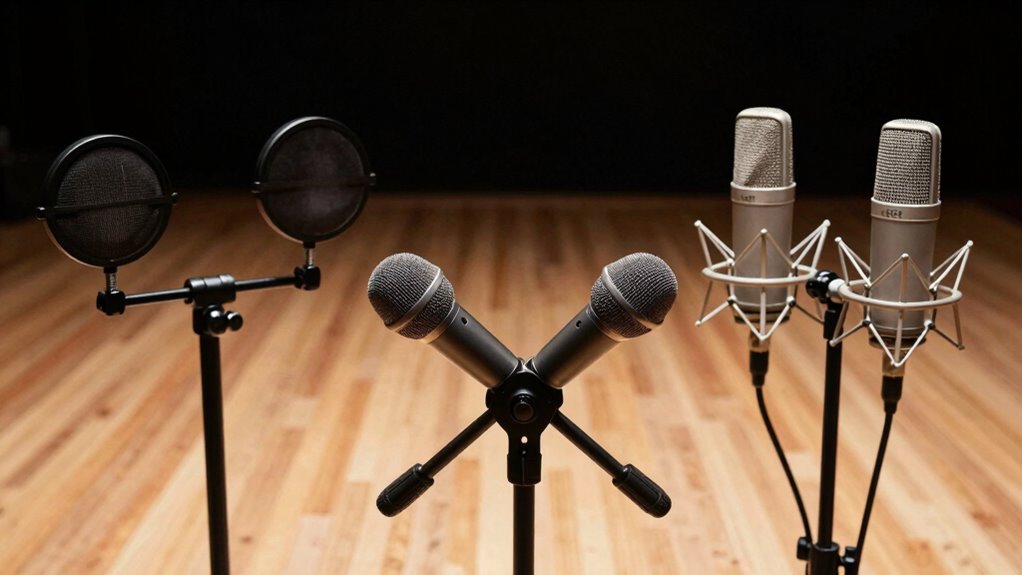
Stereo miking is an essential technique for capturing a natural and immersive sound image. When you’re setting up your microphones, paying attention to phase coherence is crucial. Phase coherence ensures that the signals from each microphone combine correctly, avoiding issues like phase cancellation that can thin out the sound or create unnatural imaging. To achieve this, you need to carefully consider microphone placement, aligning the microphones so their signals arrive at the recording device in sync. Proper placement minimizes phase issues, giving you a clearer, more accurate stereo image.
Ensuring phase coherence in mic placement creates a clearer, more natural stereo image.
In the XY technique, you position two cardioid microphones at a 90 to 135-degree angle, with their capsules close together, often almost touching. This setup offers excellent phase coherence because the microphones are so close that their signals are almost identical in phase, which results in a tight, focused stereo image. Your goal here is to keep the capsules aligned vertically and maintain consistent microphone placement relative to the sound source. This tight arrangement reduces phase discrepancies, making XY ideal for capturing detailed, well-defined recordings with minimal phase issues.
With the ORTF setup, you place two cardioid microphones at a 110-degree angle, about 17 centimeters apart. This configuration aims to mimic human ear spacing, creating a natural stereo spread. To maintain phase coherence, you need to be precise with your microphone placement, ensuring they are equidistant from the sound source and angled correctly. Small deviations can introduce phase differences, leading to comb filtering or a less coherent stereo image. Properly aligning the microphones in ORTF helps preserve phase integrity, which is vital for maintaining a realistic and spacious sound.
The AB method involves placing two omnidirectional microphones a fixed distance apart—often between 17 and 30 centimeters. Since omnidirectional mics pick up sound equally from all directions, phase coherence is less of a concern compared to directional mics. However, microphone placement still matters because the spacing influences the stereo width. If you set the microphones too far apart, you risk introducing phase differences that can affect mono compatibility and cause phase cancellation. Conversely, placing them too close reduces the stereo width, making the sound less spacious. Finding the right balance in microphone placement ensures that your stereo image is both wide and phase-coherent, preserving the integrity of the recorded sound. Additionally, understanding how phase coherence impacts overall sound quality can help you make more informed choices during setup.
Frequently Asked Questions
Can I Combine XY, ORTF, and AB Techniques in One Recording?
Yes, you can definitely combine XY, ORTF, and AB techniques in one recording. This technique blending allows you to utilize the strengths of each miking strategy, capturing a richer and more immersive stereo image. Just guarantee proper placement to avoid phase issues. Experiment with different distances and angles to balance the sound. Multi miking strategies like this give you more control and flexibility during mixing, resulting in a more dynamic and natural stereo field.
Which Stereo Miking Technique Works Best for Outdoor Recordings?
Imagine capturing a lively outdoor scene like a painter capturing sunlight—your best bet is AB miking. It offers wide stereo separation, ideal for ambient noise and natural soundscapes. Use wind protection to prevent noise from rustling leaves or gusts, ensuring clarity. XY and ORTF can work too, but AB’s spaciousness makes it perfect for outdoor recordings, allowing you to preserve the environment’s full richness and emotion.
How Do Room Acoustics Affect Each Stereo Miking Method?
Room acoustics considerably impact each stereo miking method by influencing room reflections and microphone proximity. In XY, close mic placement minimizes room reflections, giving a focused sound. ORTF, with wider spacing, captures more room ambiance but can be affected by reflections, creating a spacious feel. AB, with its spaced capsules, picks up more room reflections, making it ideal for capturing the natural ambiance of a space.
Are There Specific Microphones Better Suited for Each Technique?
Yes, certain microphones suit each technique better based on their polar patterns and your recording environment. For XY, cardioid microphones work well, minimizing room noise. ORTF benefits from cardioid or hypercardioid microphones to capture spaciousness, while AB often uses omnidirectional mics to pick up a wide stereo image. Consider your room acoustics and choose microphones with polar patterns that complement your space to get the best stereo image.
How Does Microphone Placement Impact Stereo Image Width?
Think of your microphone placement as painting a vivid landscape. When you position your mics carefully, you maintain phase coherence, which preserves clarity and prevents comb filtering. Wider placements, like AB, create a broader stereo image and more image depth, immersing listeners in the scene. Closer placements narrow the image, focusing on detail. Your choices directly shape the emotional depth and realism in your stereo image, making your recordings more engaging.
Conclusion
Think of each stereo miking technique as a different way to paint your soundscape. XY captures the core colors, blending them into a focused portrait. ORTF spreads the palette wider, adding depth and warmth. AB creates a broad canvas, immersing you in a spacious scene. Choose the technique that best expresses your musical story, and let your microphone be the brush that brings your sound to life—making your music a vivid masterpiece you’ll always remember.