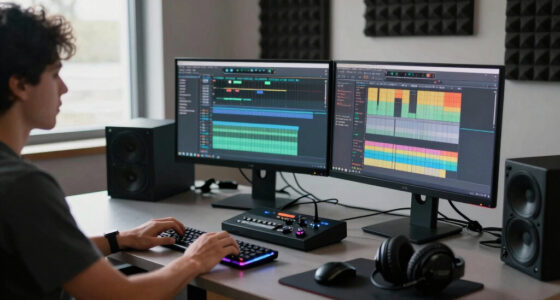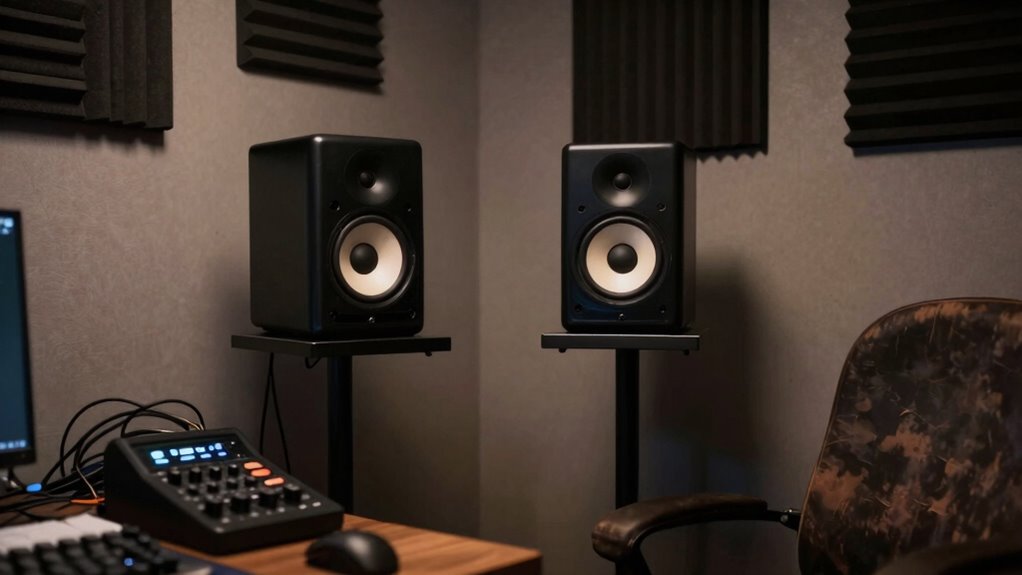

Even expensive studio monitors can’t deliver accurate sound if your small room isn’t properly treated and set up. Room size greatly impacts how monitors perform, causing reflections, standing waves, and bass buildup that distort sound. Without acoustic treatment and careful placement, high-end speakers won’t reveal their true potential. By focusing on your room’s acoustics and positioning, you’ll reveal better clarity. Keep exploring to discover how proper environment makes all the difference in your sound quality.

Get audio and creator gear delivered free with Prime
- Fast, free delivery on millions of items
- Prime Video, Amazon Music and more included
- Member-only deals all year
Key Takeaways
- Expensive monitors alone cannot compensate for poor room acoustics in small spaces.
- Proper acoustic treatment is more crucial than monitor price for accurate sound in small rooms.
- Monitor placement and room setup significantly influence monitor performance, regardless of cost.
- Small rooms require careful acoustic management to reveal true monitor quality.
- Investing in room treatment often yields better results than upgrading to high-end monitors in small spaces.
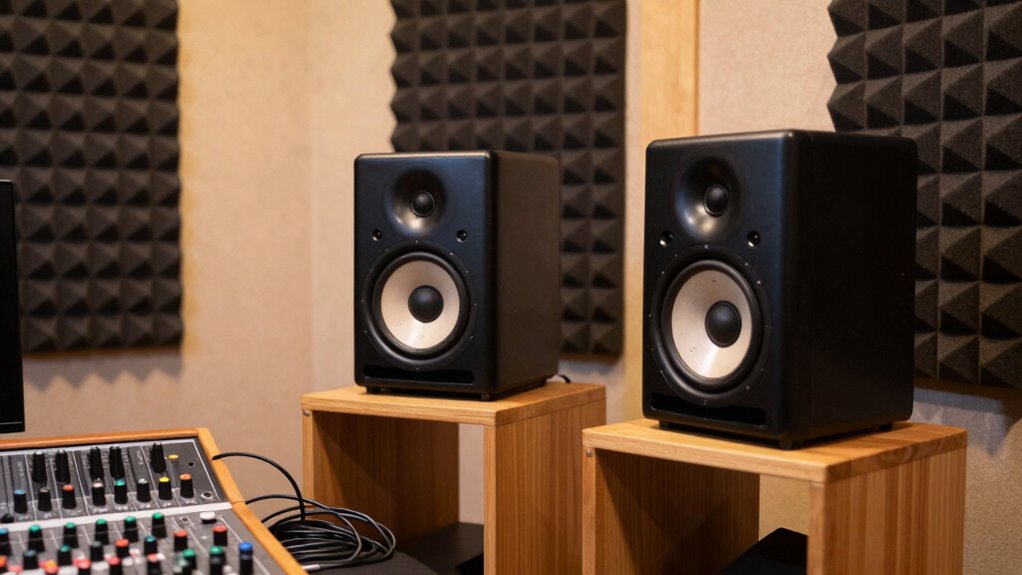
When working in a small room, choosing the right studio monitors is essential to achieving accurate sound without overwhelming your space. Many folks assume that expensive monitors automatically deliver superior audio, but that’s not always the case, especially in small rooms. Your room’s size and acoustics play a significant role in how monitors perform, which is why proper acoustic treatment and speaker placement are just as important as the monitors themselves. If you ignore these factors, even high-end speakers can produce muddled or inaccurate sound.
Acoustic treatment helps control reflections, standing waves, and bass buildup that are common in small spaces. Instead of relying solely on expensive monitors to compensate for poor room acoustics, you should invest in bass traps, diffusers, and acoustic panels. These components help create a flatter, more balanced listening environment, allowing your monitors to reveal the true character of your audio. Without proper treatment, even the most expensive speakers can sound off, making it harder to make accurate mixing decisions. Additionally, understanding the monitor design can help you optimize their placement and performance in your specific environment.
Acoustic treatment ensures balanced sound, making even modest monitors reveal true audio quality in small spaces.
Speaker placement is another critical factor that can’t be overlooked. In small rooms, placing your monitors too close to walls or corners can create exaggerated bass and early reflections, which distort what you hear. Instead, position your monitors at ear level, forming an equilateral triangle with your listening position. Keep some distance from the walls—about 2 to 3 feet—if possible, to minimize boundary interference. Experiment with angling and positioning to find the sweet spot where the sound feels natural and balanced. Small adjustments can drastically improve clarity and stereo imaging.
While expensive studio monitors might seem like a shortcut to better sound, they won’t solve issues caused by poor room acoustics or bad placement. Many professionals find that high-quality but reasonably priced monitors paired with proper acoustic treatment and careful placement outperform costly speakers in untreated rooms. It’s also important to consider room acoustics as a vital aspect that influences monitor performance and sound clarity. Additionally, understanding how different monitor designs impact sound dispersion can help you choose the best option for your space. Remember that the listening environment can significantly impact your perception of audio quality, regardless of monitor price. It’s tempting to chase after the biggest, most expensive monitors, but in a small room, your focus should be on creating a controlled environment. This way, you leverage the true potential of your monitors, regardless of their price.
Ultimately, investing in acoustic treatment and paying attention to speaker placement will make your small-room studio more accurate and enjoyable to work in. The goal isn’t just having big, expensive monitors—it’s about making sure what you hear accurately reflects your mix. When you combine good acoustics with smart placement, even modest monitors can deliver professional results. So, don’t underestimate the power of room design; it’s the acoustic environment for making your small space sound just right.
studio monitor acoustic treatment kit
As an affiliate, we earn on qualifying purchases.
As an affiliate, we earn on qualifying purchases.
Frequently Asked Questions
How Do Room Acoustics Affect Monitor Performance?
Room acoustics considerably impact monitor performance because they influence sound clarity and accuracy. When you add room treatment and acoustic panels, you reduce reflections, echoes, and standing waves, allowing your monitors to deliver a more truthful sound. Properly treated rooms help you hear subtle details, making mixing and mastering easier. So, investing in room treatment and acoustic panels guarantees your monitors perform at their best, giving you a more precise listening environment.
Can Budget Monitors Replace Expensive Studio Monitors?
Budget monitors can sometimes replace expensive studio monitors if you focus on proper studio placement and sound isolation. You need to position your monitors correctly and minimize room reflections for ideal sound quality. While they might not match the precision of high-end models, good studio placement and sound isolation can help you get the best possible performance from budget monitors, making them a viable option for many recording environments.
What Is the Ideal Listening Position?
Think of your listening spot as the heart of a well-tuned instrument. You should position yourself so that your ears are at the same height as the speaker drivers, forming an equilateral triangle with the monitors. Use room treatment to minimize reflections, and adjust speaker placement for even sound. This setup guarantees accurate listening, helping you catch every detail without distortion, and makes mixing much more reliable.
How Do I Prevent Sound Reflections in a Small Room?
To prevent sound reflections in a small room, you should focus on acoustic treatment and soundproofing techniques. Use bass traps and diffusers in corners to absorb and scatter reflections, and add acoustic panels at reflective surfaces like walls and ceilings. Rugs, curtains, and furniture also help reduce echo. These measures improve sound clarity, making your monitoring environment more accurate and preventing reflections from muddying your mixes.
Are There Specific Monitor Brands Best for Small Rooms?
You should look for monitors designed for small rooms, like Adam Audio or Focal, which provide accurate sound at close distances. Proper monitor placement is essential—you want them at ear level and equidistant from your listening position. Regular studio calibration also helps, ensuring your monitors deliver true sound. These steps optimize your setup, making even smaller monitors perform well, giving you clearer mixes without needing the largest, most expensive models.
Conclusion
In a small room, your studio monitors are like a lighthouse in fog—vital for guiding your mixes to clarity. While expensive monitors promise precision, they’re not a magic fix. Instead, focus on room treatment, proper placement, and your ears. Think of your monitors as the paintbrush, but your skills and environment are the canvas. Master those, and you’ll turn your modest space into a studio that sings, regardless of price tags.
Halloween Picks
halloween
As an affiliate, we earn on qualifying purchases.