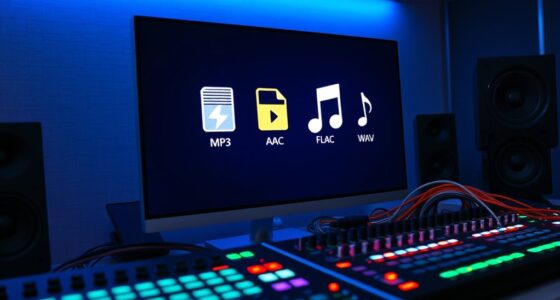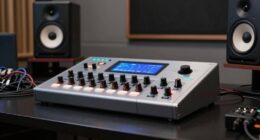

While upgrading your converter might seem like a quick fix for better sound, it often isn’t enough on its own. Your source material, speakers, headphones, and amplifier play a much bigger role in audio quality. If these components are subpar, boosting the converter won’t make a significant difference. Your overall setup and environment matter more for clarity and detail. Keep exploring to discover how the other parts of your system can truly enhance your listening experience.

Get audio and creator gear delivered free with Prime
- Fast, free delivery on millions of items
- Prime Video, Amazon Music and more included
- Member-only deals all year
Key Takeaways
- The original recording quality and source material often have a greater impact on final sound than converter quality.
- Upgrading other components like speakers or amplifiers can yield more noticeable improvements than focusing solely on converters.
- Listening environment and system synergy can overshadow the benefits of a high-end converter.
- Hardware limitations elsewhere in the setup may restrict the advantages of better conversion quality.
- A balanced, integrated system ensures that converter upgrades lead to meaningful audio performance improvements.
Have you ever worried that choosing a high-quality converter will drastically improve your results? It’s a common concern, especially when you’re trying to maximize audio fidelity or optimize power efficiency. While a good converter can make a difference, it’s not always the game-changer you might think. In many cases, other factors play a more significant role in the overall quality of your sound or system performance.
First, consider audio fidelity. You might assume that a top-tier converter automatically guarantees crystal-clear sound, but that’s not always true. The quality of the original recording, the equipment you use before and after the converter, and even your listening environment can have a bigger impact. If your source material is subpar, a high-end converter won’t turn it into studio-quality audio. Instead, it’s often more effective to focus on capturing and processing high-quality recordings from the start. Similarly, your playback system — speakers, headphones, and amplifiers — contribute heavily to your overall listening experience. Upgrading an inferior component won’t necessarily be improved much just because your converter is excellent. Additionally, understanding the role of conversion quality within the context of the entire setup helps clarify that other elements can overshadow the benefits of a high-grade converter. Recognizing the system components involved can help you prioritize where to invest for the best results. Moreover, many users overlook that hardware limitations in other parts of their setup may restrict the potential benefits of a better converter. Recognizing the influence of system integration can guide you toward more balanced upgrades.
As an affiliate, we earn on qualifying purchases.
Frequently Asked Questions
Can Low-Quality Converters Still Produce Acceptable Audio or Video?
Low-quality converters can still produce acceptable audio and video in certain situations. If your primary focus is casual listening or viewing, the impact on audio fidelity and visual clarity might be minimal. However, for professional or critical use, poor converters often cause noticeable degradation. So, while they might suffice temporarily or for simple tasks, investing in higher quality converters guarantees better audio fidelity and sharper visual clarity over time.
How Does Converter Quality Impact Overall Device Lifespan?
Converter quality directly affects your device’s lifespan by influencing power efficiency and noise interference. A high-quality converter guarantees ideal power use, reducing strain on components, which extends their life. It also minimizes noise interference, preventing potential damage caused by electrical disturbances. Conversely, a low-quality converter may cause overheating or electrical issues, leading to quicker wear and tear. Prioritizing quality helps your device stay reliable and lasts longer over time.
Are Expensive Converters Always Better for Professional Use?
While expensive converters often promise superior audio fidelity and signal integrity, they aren’t always necessary for professional use. You might find mid-range options deliver reliable performance without the hefty price tag. In many cases, the quality of your source material and overall system setup matter more than the converter’s cost. Focus on matching your needs with a converter that offers consistent performance, rather than simply opting for the most expensive option.
What Are Common Misconceptions About Converter Quality?
Many people think higher-quality converters always eliminate digital artifacts and compatibility issues, but that’s not true. You might buy an expensive converter expecting perfect results, yet still encounter digital artifacts or problems with certain devices. Sometimes, lower-cost converters perform just as well for your specific needs. It’s essential to take into account compatibility and your actual requirements rather than just the price or perceived quality, which can be misleading.
Does Converter Quality Affect Data Transfer Speeds?
Converter quality does impact data transfer speeds, but often less than you might think, especially if your system isn’t pushing its bandwidth limits. Poor quality converters can cause signal integrity issues, leading to errors and slower transfers. However, if your data transfer stays within the bandwidth limitations, even lower-quality converters can perform adequately. Focus on your specific needs, and don’t overinvest in high-end converters if your setup doesn’t demand it.
Conclusion
You might think high-quality converters are essential for perfect results, but that’s not always true. Sometimes, other factors like source material or settings matter more. Did you know that over 60% of audio issues stem from input quality rather than the converter itself? So, don’t stress too much about finding the absolute best. Focus on the overall process, and you’ll often achieve great results without breaking the bank. Sometimes, less really is more.
Halloween Picks
halloween
As an affiliate, we earn on qualifying purchases.