

Using the scale degree shortcut helps you understand music more intuitively by focusing on each note or chord’s relation to the root. Instead of memorizing pitches, you identify their position within the scale—like tonic, dominant, or submediant—which reveals their function. This approach speeds up analysis, aids in composing, and improves improvisation. If you keep exploring, you’ll discover even more ways this method simplifies complex music and enhances your skills.

Get audio and creator gear delivered free with Prime
- Fast, free delivery on millions of items
- Prime Video, Amazon Music and more included
- Member-only deals all year
Key Takeaways
- Focus on each note or chord’s relation to the scale root rather than memorizing individual pitches.
- Label chords and notes by their scale degrees (e.g., I, V) to quickly identify their harmonic function.
- Recognize tension and stability patterns based on their position relative to the tonic.
- Use scale degrees to streamline analysis, composition, and improvisation processes.
- Simplify complex harmonic and melodic ideas into an easily understandable, intuitive framework.
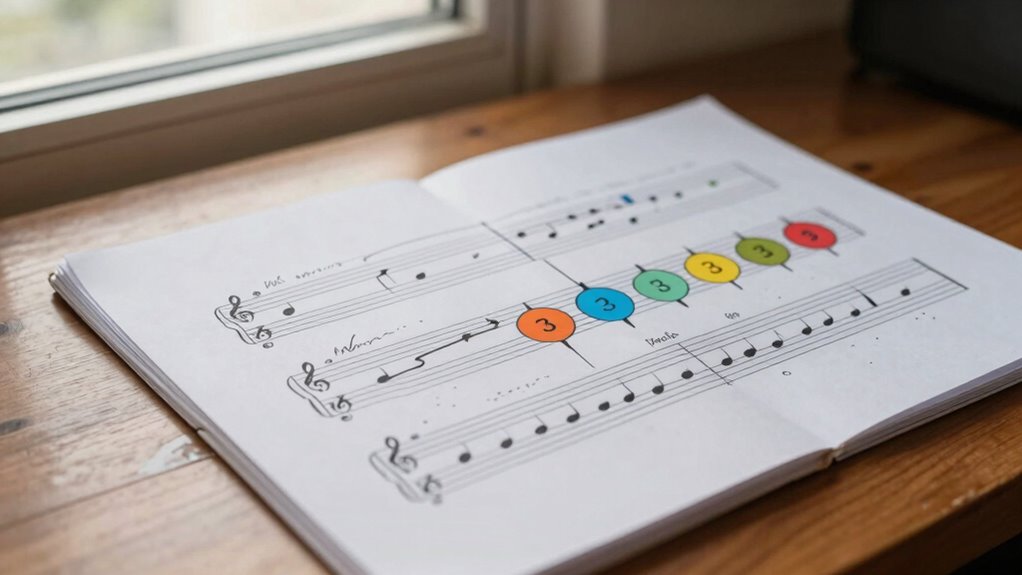
Have you ever struggled to quickly identify scale degrees in a piece of music? If so, you’re not alone. Recognizing these degrees—like tonic, dominant, or submediant—can feel tricky at first, especially when you’re trying to analyze a complex chord progression or understand the melodic harmony. But there’s a shortcut that can make your musical thinking much faster and more intuitive: the scale degree shortcut. This simple trick helps you connect chords and melodies more directly to their position within a scale, streamlining the process of understanding and creating music.
The key idea behind the shortcut is to think of each note or chord in relation to the scale’s root, rather than trying to memorize every scale degree in isolation. When you see a chord progression, for example, instead of labeling each chord as “D minor” or “G major,” you think about where those chords sit within the scale. The tonic, or the first degree, is the foundation, and other chords are built around it. Recognizing that the V chord is the fifth degree, or the dominant, makes it easier to predict the next move in a progression. This approach gives you an immediate sense of the musical tension and release, because you understand how each chord functions within the harmonic context. Understanding scale functions can deepen your grasp of harmonic progressions and improve your musical intuition. Additionally, this perspective aligns with music theory fundamentals, enhancing both your analytical skills and creative expression.
Think of each chord relative to the scale root to understand its function and predict musical movement more intuitively.
Applying this shortcut to melodic harmony is just as effective. When you analyze a melody, instead of trying to memorize every note, you identify the notes relative to the tonic. This helps you see patterns, such as which notes act as stable tones (the tonic or subdominant) and which create tension (the dominant or leading tone). The more you practice, the more natural it becomes to associate each note with its scale degree, speeding up your ability to analyze and compose. It also makes improvisation easier because you can quickly identify which scale degrees to emphasize or resolve.
In essence, this scale degree shortcut transforms a complex web of notes and chords into a clear map. It’s a mental tool that ties together chord progression and melodic harmony, making your musical decisions more confident and precise. Instead of getting bogged down in every note or chord, you develop a quick, intuitive understanding of how everything fits within the scale. With practice, you’ll find that this shortcut not only simplifies analysis but also enhances your creativity, allowing you to craft more compelling music with less effort.
As an affiliate, we earn on qualifying purchases.
Frequently Asked Questions
How Does the Scale Degree Shortcut Differ Across Musical Genres?
You’ll find the scale degree shortcut varies across genres, affecting chord progressions and improvisation techniques. In jazz, it’s more flexible, allowing complex progressions and spontaneous improvisation. In pop, it’s straightforward, emphasizing catchy progressions. Classical music uses precise scale degrees for harmony, while blues often bend notes, emphasizing emotional expression. Understanding these differences helps you adapt your improvisation skills and chord choices, making your playing more authentic across styles.
Can Beginners Easily Learn and Apply This Shortcut?
Absolutely, beginners can grasp and grow with this helpful shortcut. With consistent practice techniques, you’ll slowly simplify complex music theory, making melodies more manageable. Start small, practicing scales and identifying degrees regularly. The more you practice, the more natural it becomes to recognize patterns and apply the shortcut effortlessly. Remember, patience and persistence pave the path, turning initial confusion into confident composition. Keep practicing—progress is just a step away!
Are There Any Common Mistakes When Using the Scale Degree Shortcut?
Yes, there are common mistakes when using the scale degree shortcut in chord progressions and melodic harmony. You might accidentally misidentify scale degrees, leading to awkward shifts or dissonance. Sometimes, you rely too heavily on the shortcut and overlook the overall musical context, making your melody or harmony sound forced. To avoid these errors, double-check your scale degrees and make sure they fit naturally within your chord progression and melodic flow.
Does This Shortcut Work With All Types of Scales?
This shortcut isn’t a magic wand for all scales, but it does work surprisingly well across many. You’ll find it helpful in managing scale complexity and adapting to genre variation, though some scales—like whole tone or augmented—may not fit perfectly. It’s a versatile tool that simplifies writing, but don’t expect it to handle every unique scale with flawless ease. Use it as a guide, not a rulebook.
How Does This Shortcut Improve Songwriting Efficiency?
This shortcut improves your songwriting efficiency by simplifying music theory concepts, making creative composition faster and more intuitive. Instead of memorizing complex scales, you quickly identify scale degrees and their relationships, saving time. It helps you experiment with melodies and harmonies effortlessly, boosting your confidence. By streamlining your process, you spend more time focusing on your artistic ideas, making your compositions more spontaneous and inspired.
Conclusion
By mastering this scale degree shortcut, you’ll find writing melodies becomes faster and more intuitive. Some might think it’s just a quick trick, but it’s actually a powerful tool that streamlines your creative process. Don’t let the complexity hold you back—embrace this shortcut, and watch your compositions flow effortlessly. Once you get the hang of it, you’ll wonder how you ever composed without it. Give it a try and see your music improve instantly!
Halloween Picks
halloween
As an affiliate, we earn on qualifying purchases.