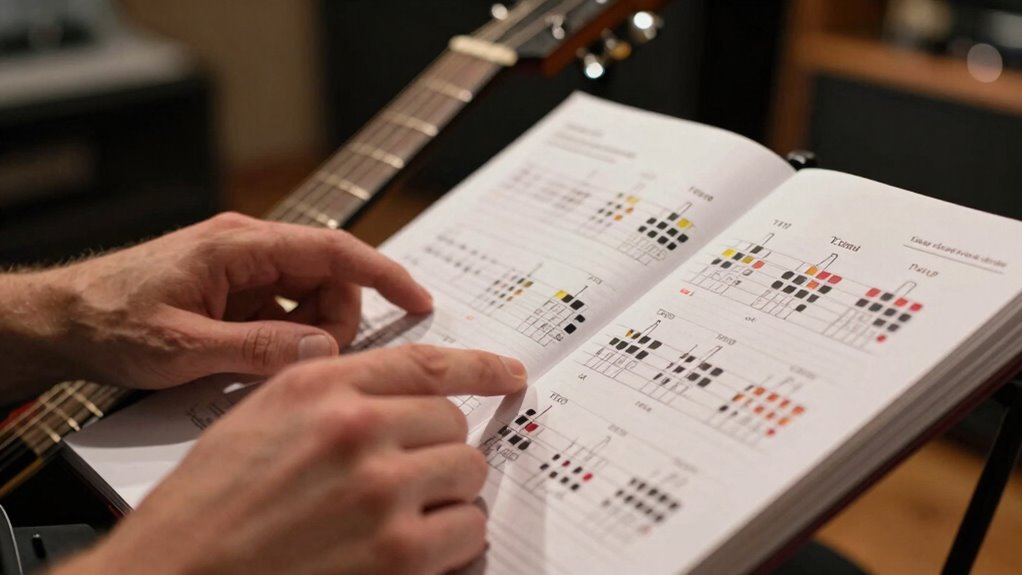

To read chord charts faster during sessions, focus on building your music theory knowledge and recognize common progressions and shapes quickly. Practice with a metronome and simulate real scenarios to improve your timing and muscle memory. Develop your ear to identify chords by sound, which speeds up recognition. Break charts into smaller sections and internalize shifts for smooth flow. Keep refining these skills, and you’ll discover more techniques to boost your confidence and efficiency even further.

Get audio and creator gear delivered free with Prime
- Fast, free delivery on millions of items
- Prime Video, Amazon Music and more included
- Member-only deals all year
Key Takeaways
- Memorize common chord shapes and progressions to recognize patterns instantly during sessions.
- Use a metronome to simulate real-time playing and develop quick, accurate reading under tempo.
- Break complex charts into smaller sections, focusing on one part at a time for faster comprehension.
- Develop your ear to identify chords by sound, reducing reliance solely on visual cues.
- Internalize chord transitions and muscle memory to improve speed and confidence in reading charts.
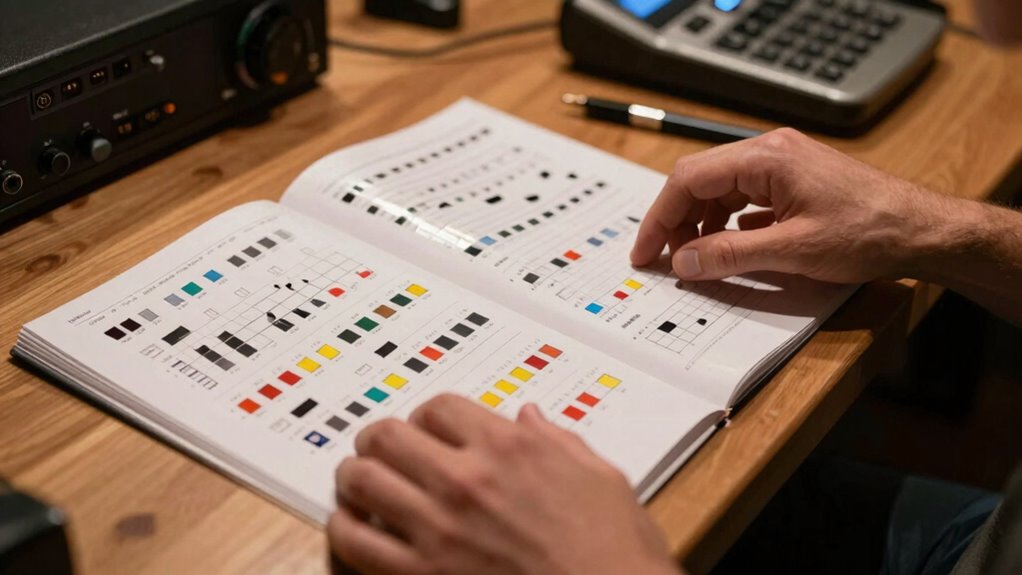
During sessions, being able to read chord charts quickly can keep the music flowing smoothly and prevent delays. When you’re in the middle of a jam or recording, every second counts, and the faster you can interpret a chord chart, the more confident and relaxed you’ll feel. To improve this skill, understanding basic music theory is essential. Knowing how chords are constructed, their relationships, and common progressions helps you recognize patterns faster. For example, if you see a G major chord, understanding its makeup allows you to anticipate the next chord or recognize similar chords quickly, saving precious time. Incorporate simple music theory concepts into your practice routines, like memorizing common chord shapes, scale degrees, and key signatures. This foundational knowledge acts as a mental shortcut during sessions, making it easier to decipher unfamiliar charts on the spot. Additionally, recognizing chord relationships can help you quickly predict upcoming chords and navigate progressions more efficiently. Practicing with an awareness of musical context can further enhance your ability to see how chords function within different progressions. Developing a good sense of musical ear can also aid in identifying chords by sound, speeding up your reading process. Building your musical vocabulary through regular listening and analysis can deepen your understanding and improve recognition speed. Practice techniques play a crucial role in sharpening your ability to read chord charts swiftly. One effective method is to simulate real session scenarios—set up practice sessions where you read through charts at a moderate tempo, gradually increasing speed as you become more comfortable. Use a metronome to keep your timing tight and challenge yourself to keep pace. Flashcards can also be useful; write down chords or progressions and quiz yourself regularly to build quick recognition skills. Another technique is to break down complex charts into manageable sections. Instead of trying to read an entire chart at once, focus on small parts, internalize them, and then connect to the next segment. Over time, this reduces the cognitive load, making the process more instinctive. Consistent practice with a focus on muscle memory can markedly improve your reading speed. Spend time familiarizing yourself with common chord shapes and transitions, so your fingers move smoothly without conscious thought. As you become more adept, your ability to scan a chart and immediately identify the chords will improve naturally. Keep in mind that speed shouldn’t sacrifice accuracy—strive for a balance where you can read quickly without making mistakes. By integrating music theory into your routine and employing targeted practice techniques, you’ll find yourself reading chord charts faster, confidently following along during sessions, and ultimately becoming a more versatile musician.
Popular right now

Bose QuietComfort Headphones (2nd Gen), Wireless Noise-Cancelling Over-Ear Headphones, Black

Breville Bambino Espresso Machine, Brushed Stainless Steel (BES450BSS)

KitchenAid Artisan Series 5-Quart Tilt-Head Stand Mixer, Dried Rose (KSM150PS)
As an affiliate, we earn on qualifying purchases.
Frequently Asked Questions
How Can I Memorize Chord Shapes Quickly?
To memorize chord shapes quickly, use visual pattern recognition and effective memorization techniques. Focus on recognizing common finger patterns and shapes across different chords, which speeds up recall. Practice regularly by playing the chords in various keys and contexts, and break down complex shapes into simpler segments. Repetition combined with visual cues helps your brain connect patterns, making it easier to memorize shapes faster and recall them effortlessly during sessions.
What Are Common Mistakes When Reading Chord Charts?
You might often mistake chord shapes or miss cues because you overlook visual pattern recognition, which hampers quick comprehension. Rushing can also cause you to ignore rhythmic interpretation, leading to mistakes. A common error is not scanning the chart fully before playing, causing hesitation. To avoid these, take a moment to recognize recurring visual patterns and interpret rhythms accurately. This sharpens your reading skills, making session shifts smoother and more confident.
How Do I Adapt to Different Chart Formats?
To adapt to different chart formats, focus on recognizing alternative notation styles and visual cues. You’ll want to identify symbols, abbreviations, and layout differences quickly. Practice with various charts to become familiar with their unique cues, like color codes or specific symbols. By staying observant and flexible, you’ll efficiently interpret diverse formats, making your session smoother and helping you stay in sync with the band.
What Exercises Improve Sight-Reading Skills?
Think of sight-reading exercises as your musical workout; they sharpen your skills like a blade. Practice daily with simple chord progressions, focusing on your hand position and rhythm patterns. Use metronomes to develop timing, and gradually increase complexity. Play along with recordings, and challenge yourself to identify chords quickly. These exercises build muscle memory and help you read chord charts faster, making sessions smoother and more confident.
How Can I Read Chord Charts Silently?
You can read chord charts silently by practicing silent visualization techniques. Close your eyes and picture the chart in your mind, focusing on the chord shapes and progressions. Incorporate silent practice regularly to build familiarity without needing to look at the chart physically. This method enhances your ability to quickly interpret charts during sessions, helping you stay focused and efficient. Over time, you’ll read charts faster and more intuitively without vocalizing or looking directly at them.
Conclusion
Mastering chord charts is like sharpening your saw—you’ll cut through progressions more smoothly and confidently. With practice, you’ll read charts faster than ever, turning each session into a seamless jam. Think of it as tuning your instrument; the more you do it, the more in sync you become with the music. Soon, reading charts will feel as natural as breathing, freeing you to focus on the groove and making music that truly moves.