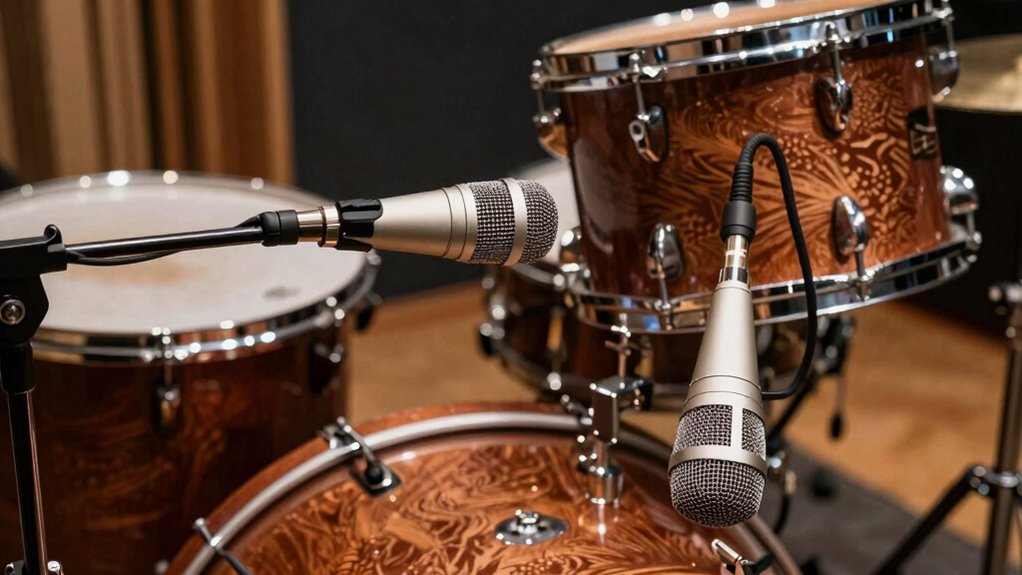

To get punch or boom from your kick drum, position your mic accordingly. For punch, place it just outside or near the beater head to capture attack and transient detail. For a booming sound, move the mic inside toward the resonant head or shell to emphasize low-end resonance. Combining inside and outside placements gives versatile control over both qualities. Experiment with different positions while tuning your drum—if you keep adjusting, you’ll discover how to craft the perfect kick sound.
Key Takeaways
- For punch, place the mic just outside the beater head to capture attack and transient detail.
- To emphasize boom, position the mic further inside near the resonant head or shell for low-end resonance.
- Use dynamic cardioid mics for focused pickup and reducing leakage from other drums.
- Combining inside and outside mics allows flexible blending for balanced punch and boom.
- Adjust mic placement iteratively while listening critically to achieve desired attack or resonance.
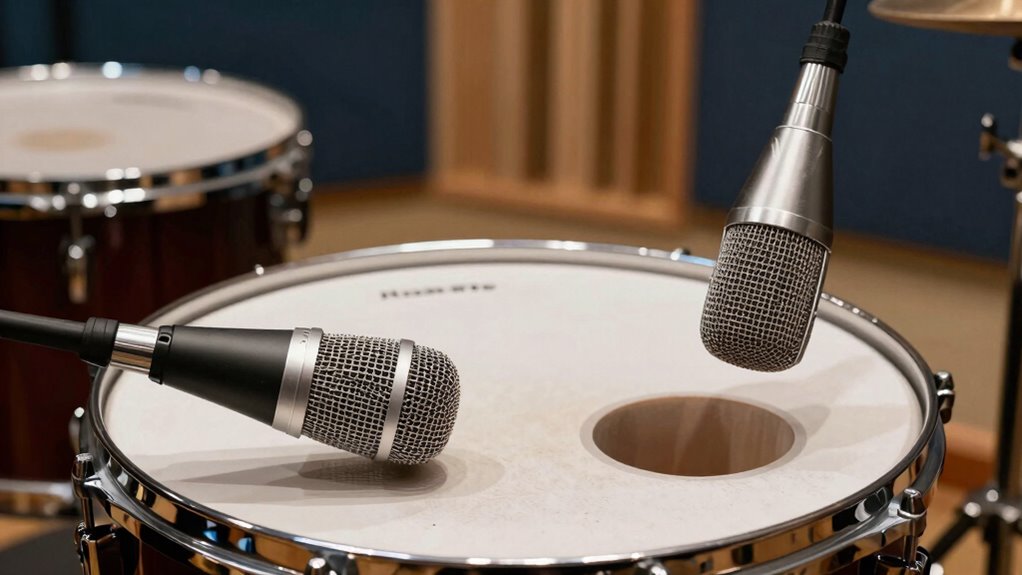
Choosing the right mic placement for your kick drum is essential to capturing its full power and punch. When you’re working on achieving that perfect sound, it all starts with understanding how mic techniques combined with proper drum tuning can make a huge difference. The way you position your microphone can emphasize the punchy attack or bring out the booming low end, depending on your desired outcome. To get there, focus on how your drum tuning influences resonance and how your mic placement will interact with those frequencies.
Start by considering your drum tuning. A well-tuned kick drum produces a balanced sound that allows your mic placement options to shine. If your drum is tuned high, with a tighter resonance, you might want to position your mic closer to the beater head or the drum’s shell to capture that attack and clarity. Conversely, if your drum is tuned low and has a more resonant, boomy quality, placing the mic further inside or toward the center of the drum can emphasize the low-end boom. Adjusting your drum tuning first gives you a better foundation, ensuring that your mic techniques yield the best possible sound.
When it comes to mic techniques, your goal is to find a sweet spot that captures the desired punch or boom without unwanted noise or muddiness. For punch, you typically want to place the mic just outside the beater head, aiming to catch the initial attack of the hit. This positioning emphasizes the transient and makes the kick punch through the mix. Using a dynamic microphone with a focused pickup pattern, like a cardioid, helps isolate the attack and reduces leakage from other drums. To capture more boom, you can move the mic further inside the drum, pointing toward the resonant head or the shell, which accentuates the low frequencies and creates a fuller sound. Experimentation is key here—small adjustments can considerably alter the balance between punch and boom.
Another effective technique involves using an inside mic and an outside mic simultaneously, blending them during mixing to achieve a customized sound. The inside mic captures the fundamental boom, while the outside mic emphasizes attack and attack transient details. This approach allows you to sculpt your kick drum sound precisely, depending on the musical context. Remember, the placement isn’t static; it’s a dynamic process that benefits from your careful listening and tweaking.
Additionally, understanding frequency response and how different mic placements can accentuate or diminish specific frequencies will help you tailor your sound more effectively. Ultimately, mastering your mic techniques in tandem with proper drum tuning unlocks a wide sonic palette. Whether you’re after a tight, punchy kick or a deep, resonant boom, understanding how to position your microphone relative to your tuned drum is crucial. Keep experimenting with different placements, listen critically, and you’ll find the perfect balance that makes your kick drum stand out with clarity and impact.
Frequently Asked Questions
How Does Room Acoustics Affect Kick Drum Mic Placement?
You should consider room acoustics because room echo can color your kick drum sound, making mic placement tricky. If your room has a lot of echo, you might want to increase microphone distance to reduce reflections. Conversely, in a dead room, closer mic placement captures more punch. Adjusting mic distance based on room acoustics helps you achieve a clear, balanced kick sound without unwanted reverberation.
What Are the Best Mic Options for Different Genres?
You know what they say, “the right tool makes all the difference.” For genres, choose dynamic microphones like the Shure Beta 52 for punchy rock or metal, condenser mics for detailed jazz or acoustic, and specialized drum mics for genres like electronic or pop. Use genre-specific techniques, such as close miking for tight sounds or distant miking for a roomier feel, to capture the vibe perfectly.
How Can I Minimize Bleed From Other Drums?
To minimize bleed from other drums, focus on proper mic technique and phase cancellation. Position your kick mic close and slightly off-axis to reduce spill, and use directional mics to isolate the kick. Keep an eye on phase alignment; if signals cancel out, adjust mic placement or flip polarity. Combining these approaches guarantees cleaner kick sound while cutting down on unwanted bleed from other drums.
What Are Common Mistakes to Avoid in Placement?
Did you know that improper mic placement causes over 30% of phase cancellations? To avoid common mistakes, make sure you position your mic correctly, paying attention to polar patterns—cardioid or hypercardioid—so you capture the kick’s punch without phase issues. Avoid placing the mic too close or too far, which can lead to bleed and phase cancellation, and always listen carefully to optimize the sound and prevent unwanted audio artifacts.
How Does Mic Placement Influence Overall Drum Mix?
Your mic placement directly impacts the drum mix by affecting phase cancellation and stereo imaging. Proper placement minimizes phase issues, ensuring a clear, punchy sound. It also enhances stereo imaging, giving your kick drum space and presence in the mix. If misplaced, you’ll likely experience phase cancellation, making the kick sound weak or hollow. Focus on positioning your mic to capture the desired punch or boom without compromising clarity or stereo balance.
Conclusion
Now that you know the secrets behind punch versus boom mic placements, you’re basically a kick drum whisperer. With the right choice, your recordings will hit harder than a meteor crashing into a mountain—nothing will stand in the way of that perfect, thunderous sound. So go ahead, experiment boldly, and unleash the raw power of your kick drum. Your mixes will shake worlds—literally! Now, go make some sonic earthquakes!