
Two headphones dominate the conversation when people ask for “wireless studio headphones”: Sony’s WH-1000XM5 and Apple’s AirPods Max. Neither is a true studio monitor — both are consumer wireless headphones with Bluetooth at their core — but both are frequently bought by producers, mixers, podcasters and video editors who want one premium pair that handles critical listening, tracking reference checks and long days at the desk without cables. That is the real decision here: you are choosing the best available compromise between analytical sound quality, wearing comfort over long sessions, and platform integration.

Get audio and creator gear delivered free with Prime
- Fast, free delivery on millions of items
- Prime Video, Amazon Music and more included
- Member-only deals all year

OneOdio Studio Max 2 Wireless DJ Headphones with 9ms Low Latency and LDAC
- ✔ Latency: 9ms (2.4G RapidWill+ 3.0)
- ✔ Codecs: LDAC Hi-Res
- ✔ Drivers: 45mm high-flux

Audio-Technica ATH-M20xBT Wireless Over-Ear Headphones, Black
- ✔ Brand: Audio-Technica
- ✔ Model: ATH-M20xBT
- ✔ Driver Size: 40mm rare earth magnet, CCAW voice coil
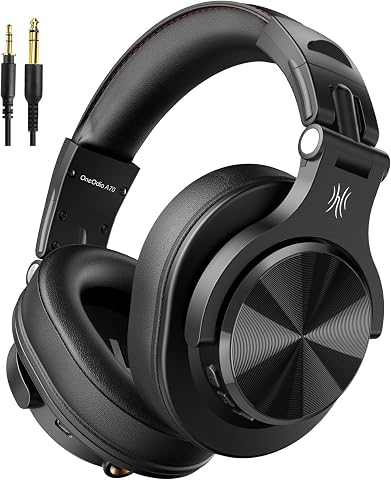
OneOdio A70 Bluetooth Over-Ear Headphones, Hi-Res Wired DJ Studio – Black
- ✔ Model: A70
- ✔ Connection: Bluetooth + wired (3.5mm and 6.35mm)
- ✔ Battery Life: Up to 72 hours (wireless mode)
The main difference is straightforward. The AirPods Max are the more revealing, more neutral-sounding headphone with a fuller, more controlled low end and better spatial processing, and they integrate tightly with Apple hardware. The WH-1000XM5 are cheaper, lighter on features per dollar but stronger on endurance — they cancel noise better, run roughly ten hours longer per charge, and support high-resolution Bluetooth codecs that Apple does not. If your work happens inside the Apple ecosystem and sound fidelity is the priority, the Max justify themselves. If you work across devices, want all-day battery, or simply want most of the performance for considerably less money, the Sony is the smarter buy.
At a Glance
| Criteria | Sony WH-1000XM5 | Apple AirPods Max | Winner |
|---|---|---|---|
| Sound accuracy for critical listening | Warm, consumer-tuned; EQ adjustable via app | More neutral and detailed out of the box | |
| Noise cancelling | Class-leading, among the best available | Excellent but a step behind Sony | |
| Battery life | 30 hours with ANC on | 20 hours with ANC on | |
| Comfort over long sessions | 250 g, plush earpads, excellent | 385 g, mesh canopy, heavy but balanced | |
| Codec and connectivity | LDAC and AAC, multipoint for two devices | AAC only, no LDAC or aptX, no multipoint | |
| Ecosystem and software | Works fully with Android and iOS | Deep Apple integration, spatial audio, seamless switching | |
| Wired studio use | 3.5 mm wired option, usable without battery | USB-C audio out, no 3.5 mm port | |
| Price-to-performance | Lower price with most features intact | Premium price paid for build and tuning |
OneOdio Studio Max 2 Wireless DJ Headphones with 9ms Low Latency and LDAC
The OneOdio Studio Max 2 earns our top spot because it solves the problem that keeps most producers wired in the first place: latency. Its 9ms ultra-low latency over 2.4G wireless means the sound arriving at your ears stays effectively in sync with what’s happening on screen or on the decks — the difference between a usable wireless workflow and a frustrating one. Compared with the A70, which offers no comparable low-latency mode, the Studio Max 2 is simply the safer tool for DJ monitoring, video editing, and gaming.Audio quality also leans professional here. The 45mm high-flux drivers paired with LDAC Hi-Res support and a 20Hz–40kHz frequency response give it the widest bandwidth of the three, translating to more audible detail in the top end where the A70’s tuning runs out of air. Battery life is the other headline: 120 hours per charge, with fast charging that delivers roughly nine hours of playback from a five-minute top-up. That’s nearly double the A70’s already generous endurance, and it means charging anxiety essentially disappears from your week.The tradeoffs are real, though. This is a large, serious over-ear headphone with 180° swiveling earcups — built for the booth and the desk, not the commute — and its premium feature set sits at a higher price point than the other two picks. Compared with the ATH-M20xBT, it also lacks Audio-Technica’s long-established studio pedigree, so tuners of habit may want to audition both. But if your priority is a wireless headphone that behaves like studio equipment, this is the most complete package here.
Pros:
- 9ms ultra-low latency over 2.4G wireless makes real-time monitoring practical
- Hi-Res LDAC audio with 45mm drivers and 20Hz–40kHz response for detailed listening
- Exceptional 120-hour battery life with 9-hour fast-charge playback in 5 minutes
- Triple connectivity: 2.4G, Bluetooth 6.0, and wired via dual 3.5mm/6.35mm jacks
Cons:
- Premium feature set comes at a higher price than the other picks
- Large over-ear design is bulky for casual, portable everyday use
Best for: DJs, video editors, and producers who need near-zero wireless latency and long untethered sessions
Not ideal for: Buyers on a tight budget or those wanting a compact everyday headphone for casual listening
Bottom line: The most complete wireless studio package here — low latency, Hi-Res audio, and unmatched battery life for professionals who work untethered.
“The most complete wireless studio package here — low latency, Hi-Res audio, and unmatched battery life for professionals who work untethered.”
Audio-Technica ATH-M20xBT Wireless Over-Ear Headphones, Black
The Audio-Technica ATH-M20xBT takes a different path to wireless studio credibility: instead of chasing specs, it brings the tuning of a long-respected wired studio line into a Bluetooth form factor. Its 40mm drivers use rare earth magnets and copper-clad aluminum wire voice coils, and the result is a noticeably more even, mid-forward presentation than either OneOdio option. If your work depends on hearing vocals, guitars, and midrange detail honestly — mixing, podcast production, vocal tracking — this is the most trustworthy tuning of the three.Its second strength is isolation. The circumaural design contours fully around the ears and passively blocks room noise far better than looser-fitting consumer headphones, which matters when you’re monitoring in an untreated space. Compared with the Studio Max 2, which offers more features but a more consumer-flavored low end, the ATH-M20xBT is the headphone we’d trust for judgment calls about a mix. Compared with the A70, it’s more refined in the mids but less generous with accessories and battery claims.The notable weakness is transparency around battery life and charging: no runtime figures are provided, which is an unusual omission for wireless headphones and a genuine concern if you plan long untethered sessions. The collapsible design helps with portability, but this remains a full-size over-ear headphone. Our advice: if sound integrity outranks feature lists for you, this is the pick — just plan to keep a charging routine since you can’t budget your sessions around a stated runtime.
Pros:
- Trusted studio-line tuning with excellent mid-range definition
- Strong passive sound isolation from the circumaural design
- High-quality 40mm drivers with rare earth magnets
- Collapsible design for easier storage and transport
Cons:
- No stated battery life or charging details — hard to plan long wireless sessions
- Lacks the low-latency wireless mode of the Studio Max 2
- Fewer bundled accessories than the OneOdio options
Best for: Mixing engineers, podcasters, and vocal-focused producers who prioritize honest midrange and isolation over feature counts
Not ideal for: Buyers who need guaranteed all-day battery life or low-latency monitoring for DJ and video work
Bottom line: The most honest-sounding option here, best for listeners who value studio-accurate mids and isolation more than spec-sheet battery claims.
“The most honest-sounding option here, best for listeners who value studio-accurate mids and isolation more than spec-sheet battery claims.”
OneOdio A70 Bluetooth Over-Ear Headphones, Hi-Res Wired DJ Studio – Black
The OneOdio A70 is the pragmatic choice in this lineup: it doesn’t match the Studio Max 2’s latency specs or the ATH-M20xBT’s tuning pedigree, but it delivers a genuinely useful dual-mode design at an accessible price. The core idea is simple and smart — wired mode via included 3.5mm and 6.35mm cables means the headphone literally never runs out of power. Plug into your interface or mixer with the 6.35mm jack and battery life becomes irrelevant, which is exactly the kind of insurance budget-conscious studio users need.Wirelessly, the A70 covers the essentials well. Up to 72 hours of playtime comfortably outlasts most consumer headphones at this level, and the 40mm neodymium drivers deliver a hi-res-leaning sound with punchy bass that suits tracking, DJ practice, and casual reference listening. The memory cotton and protein leather cushions keep long sessions comfortable, and a foldable, rotatable build makes it easy to toss in a bag. A standout extra is the audio sharing feature, which lets multiple people listen simultaneously — handy for collaborative sessions where neither the Studio Max 2 nor the ATH-M20xBT offers an equivalent.Where it falls behind is precision. The bass-forward tuning is less neutral than the ATH-M20xBT, so we’d hesitate before making final mix decisions on it, and there’s no low-latency wireless mode for timing-critical DJ work like the Studio Max 2 provides. Wired mode also means carrying the included cables, and the over-ear build is bulky for everyday portable use. Still, as a flexible do-everything studio companion that won’t strain your budget, it’s the easiest recommendation here for beginners and multi-purpose users.
Pros:
- Dual wired/wireless design with both 3.5mm and 6.35mm cables means it never runs out of power
- Up to 72 hours of wireless battery life
- Comfortable memory cotton and protein leather cushions for long sessions
- Audio sharing lets multiple people listen at once — great for collaborative sessions
Cons:
- Bass-forward tuning is less neutral than the ATH-M20xBT for critical mixing
- No low-latency wireless mode for DJ monitoring or video work
- Wired mode requires carrying the included cables, and the over-ear build is bulky
Best for: Beginners, home studio owners, and DJs who want maximum flexibility and battery life without a premium price
Not ideal for: Engineers needing neutral tuning for final mixes, or anyone requiring low-latency wireless monitoring
Bottom line: The best-value entry point into wireless studio listening — flexible, long-running, and comfortable, so long as you don’t need neutral mixing accuracy.
“The best-value entry point into wireless studio listening — flexible, long-running, and comfortable, so long as you don’t need neutral mixing accuracy.”
As an Amazon Associate we earn from qualifying purchases.
Key Differences
The biggest practical difference for studio-adjacent work is tuning. The AirPods Max come out of the box closer to a reference presentation: tighter, better-extended bass, more restrained treble, and an overall balance that makes it easier to judge mix decisions like low-end level and reverb tail. The WH-1000XM5 ship with a warmer, more bass-forward consumer signature that flatters music but colors judgment. Sony partially compensates with a full parametric-style EQ in its app, and a careful EQ preset can close much of the gap — but you are correcting toward neutrality rather than starting from it. For pure listening enjoyment the Sony tuning is arguably more pleasant; for evaluating a mix, the Max have the edge.
The second difference shapes your whole workflow: battery and connectivity. The Sony runs about 30 hours with noise cancelling active versus roughly 20 for the Max, and it pairs with two devices simultaneously — so you can stay connected to your computer and phone at once, a small feature that matters enormously in a working setup. The Max support only AAC, have no multipoint, and their smart case provides minimal protection while offering no power off function, meaning battery drains in standby. On the other hand, inside the Apple ecosystem the Max do things Sony cannot: automatic device switching, head-tracked spatial audio, and lossless-class wireless audio with Apple devices that use the right setup. Choose based on where your work lives.
Detailed Comparison
Sound accuracy for critical listening (Apple AirPods Max wins — major)
Neither headphone replaces a wired studio monitor, but the gap between them is real. The AirPods Max present a cleaner, more analytical picture: bass is deep but disciplined, midrange is more transparent, and micro-detail like vocal sibilance or reverb decay is easier to hear. The WH-1000XM5 sound fuller and more engaging but with a bass lift and slightly smoothed-over top end that can hide problems in a mix — or trick you into under-mixing low end. Sony’s app EQ lets you flatten the response considerably, and for many listeners the corrected XM5 is close enough. Still, if judging audio is the job rather than enjoying it, the Max are the more honest tool.
Noise cancelling (Sony WH-1000XM5 wins — moderate)
Sony’s noise cancelling is widely regarded as the best in the consumer category, and the XM5 edge out the Max here, particularly against low-frequency drone like HVAC hum, server fans or street noise. The Max are excellent in their own right and subjectively some listeners prefer their ANC character in midrange noise. For a studio-adjacent use case — blocking room noise while you concentrate on editing or mixing — the difference is noticeable but not dramatic. Both will let you work in a noisy environment; Sony simply does it slightly better while using less battery to do so.
Battery life (Sony WH-1000XM5 wins — major)
This is a decisive gap for long working days. The WH-1000XM5 deliver roughly 30 hours with ANC on; the AirPods Max deliver around 20. Worse, the Max have no true power-off switch — they rest in a low-power state, and the famously minimal Smart Case is what triggers it. Leave them out of the case overnight and you lose meaningful charge. For someone whose headphones are on and off the head for ten hours a day, the Sony’s endurance and quick-charge behavior (minutes of charging for hours of playback) are a genuine quality-of-life advantage.
Comfort over long sessions (Sony WH-1000XM5 wins — moderate)
Both are comfortable, but differently. The XM5 weigh about 250 grams with plush earpads and gentle clamping — among the most comfortable wireless headphones made. The Max weigh roughly 385 grams, a serious number, but distribute it well through the telescoping mesh canopy and memory-foam pads. Many users find the Max comfortable for a few hours, then feel the weight during a full day. Earcup space also runs slightly tighter on the Max for larger ears. For all-day wear, Sony wins; the Max are comfortable but heavy.
Codec and connectivity (Sony WH-1000XM5 wins — moderate)
The XM5 support LDAC for high-bitrate streaming from Android, plus AAC, plus Bluetooth multipoint for two simultaneous devices. The Max support AAC only — no LDAC, no aptX — and no multipoint, though Apple’s ecosystem features (one-tap pairing, automatic switching between iPhone, iPad and Mac, Find My) partially compensate if you live entirely in Apple’s world. For cross-platform users, Windows and Android users, or anyone who wants LDAC, the Sony is clearly the more flexible device. This is also where the “studio” framing stumbles for both: Bluetooth latency makes neither suitable for recording while monitoring; both are for checking, editing and listening, not tracking.
Ecosystem and software (moderate difference)
Here the decision flips based on your devices. On Apple hardware, the Max are exceptional: instant pairing, device switching that mostly just works, head-tracked spatial audio that is genuinely useful for video work, and Personalized Spatial Audio profiles. On anything else, many premium behaviors degrade or disappear. The XM5 app works equally well on Android and iOS, includes a powerful EQ, adaptive sound controls and speak-to-chat — less magical, more universal. If your whole workflow is Apple, the Max integration is worth real money; if it is not, the Sony is the practical choice.
Wired studio use (Sony WH-1000XM5 wins — minor)
The XM5 include a 3.5 mm analog cable and can run passively if the battery dies — imperfect sound, but functional in a pinch. The Max have no analog port at all; their USB-C to USB-C cable supports wired digital audio, which is actually cleaner than the Sony’s analog path, but requires compatible devices and the battery to be alive. For quick wired connections to interfaces, keyboards and consoles, the Sony’s universal 3.5 mm option is simply more practical, even if neither headphone was designed for wired studio monitoring.
Price-to-performance (Sony WH-1000XM5 wins — major)
The AirPods Max cost meaningfully more than the WH-1000XM5 — often 40 to 60 percent more depending on sales, and the XM5 discount regularly. That premium buys better build materials, a more neutral tuning and Apple integration, but not better battery, better ANC, better comfort or better codecs. In pure performance-per-dollar terms the Sony is one of the strongest values in the category, and the Max are a luxury purchase where the extras must matter to you specifically.
Sony WH-1000XM5: Pros and Cons
Pros:
- Best-in-class noise cancelling for focused work in noisy rooms
- Around 30 hours of battery, plus fast charging
- Noticeably lighter and more comfortable for all-day sessions
- LDAC support and two-device multipoint connectivity
- Powerful app EQ that can flatten the consumer tuning
- 3.5 mm wired fallback and passive operation
- Considerably cheaper, and frequently discounted
Cons:
- Bass-forward tuning out of the box colors mix judgment
- Plastic build feels less premium than the price suggests
- Touch controls can be fiddly with gloves or while moving
- No spatial audio ecosystem comparable to Apple’s
Apple AirPods Max: Pros and Cons
Pros:
- More neutral, detailed and analytical sound — better for judging mixes
- Superb build quality with aluminum and mesh materials
- Seamless Apple ecosystem integration and device switching
- Head-tracked spatial audio, useful for video and film work
- Clean wired digital audio over USB-C
- Physical controls: a crown dial that is precise and reliable
Cons:
- Roughly 20 hours battery and no true power-off function
- Heavy at around 385 grams; tiring over very long sessions
- AAC only — no LDAC or aptX, no multipoint
- No 3.5 mm port; Smart Case offers minimal protection
- Substantially more expensive than the Sony
Who Should Choose What
Choose Sony WH-1000XM5 if:
- You mix or edit across devices and platforms, including Windows or Android
- You wear headphones for eight or more hours a day and weight matters
- You want the strongest possible noise cancelling for a noisy workspace
- You want to spend less while keeping 90 percent of the experience
- You stream hi-res audio from Android and want LDAC support
Choose Apple AirPods Max if:
- Your entire workflow lives on iPhone, iPad and Mac
- Evaluating audio accuracy — mix decisions, podcast editing, film sound — is the primary job
- You value build quality and physical controls over battery endurance
- You work with spatial or binaural content and need reliable head tracking
- The price difference is not a factor for you
Skip both if: You need true studio monitoring for recording and mixing — a wired pair like the Audio-Technica ATH-M50x, Beyerdynamic DT 770 Pro or Sennheiser HD 600 series at a fraction of the price will outperform both for accuracy, latency and reliability.
Value for Money
Value is where these two diverge hardest. The WH-1000XM5 deliver the category’s best noise cancelling, top-tier comfort, longer battery and broader codec support for a price that regularly drops well below the AirPods Max’s floor. Unless neutral tuning and Apple integration sit at the top of your priority list, the Sony is simply more headphone per unit of currency.
The AirPods Max premium buys three things: a more reference-like tuning, exceptional physical build, and ecosystem integration that only pays off inside Apple’s world. For a full-time Apple-based editor or producer who judges audio daily, that premium can be justified — a more honest frequency response is a working tool, not a luxury. For everyone else, paying more means paying for aluminum you can hear less often than the battery you will miss. The strongest value play: buy the XM5, spend fifteen minutes EQing it toward neutral, and pocket the difference — or, if accuracy is truly the mission, put the savings toward wired studio monitors alongside it.
Final Verdict
For most people shopping the “wireless studio headphone” category, the Sony WH-1000XM5 is the better purchase: cheaper, more comfortable over long sessions, better noise cancelling, longer battery, wider compatibility, and correctable tuning. It is the default recommendation for cross-platform users, students, podcasters and producers who need one versatile pair.
Choose the AirPods Max only under two conditions that must both hold: your work happens entirely on Apple devices, and you evaluate audio closely enough that their more neutral, more detailed presentation earns its premium every working day. If either condition fails, the Max become an expensive, heavy, battery-limited luxury. And be honest about the category itself — if the goal is genuine studio accuracy for tracking and mixing, both of these are compromises, and a wired monitor headphone plus the Sony for mobile listening will outperform either one alone.
Frequently Asked Questions
Can either headphone actually be used for studio monitoring?
Not for serious work. Both are Bluetooth-first headphones with wireless latency that makes tracking vocals or instruments impractical, and neither has the flat response of a dedicated monitor. They work well for checking mixes, editing, podcast production and reference listening — but if mixing is the job, a wired studio headphone remains the primary tool.
Which one sounds more accurate without EQ adjustments?
The AirPods Max. Their tuning is closer to neutral out of the box, with tighter bass and more restrained treble, which makes mix judgments easier. The WH-1000XM5 are warmer and bass-forward by default, though Sony’s app EQ can flatten them considerably if you take the time.
Generally, no. Much of what makes the Max special — automatic switching, spatial audio with head tracking, ecosystem integration — works best or only on Apple devices. On Windows or Android you pay more for a headphone with fewer codecs, no multipoint, shorter battery and no analog port. Cross-platform users should buy the Sony.
The WH-1000XM5, slightly. Sony’s ANC is the strongest in the category, especially against low-frequency hum from fans, traffic and HVAC. The Max are excellent too, so both will handle a busy environment — Sony just does it a little better while lasting ten hours longer per charge.
Do the AirPods Max really drain battery when not in use?
Yes, because they have no physical power switch. They drop into a low-power state only when placed in the Smart Case; left on a desk, they continue drawing power. Users who forget the case regularly find noticeably less battery than expected, which compounds their already shorter 20-hour runtime.
Halloween Picks
halloween
As an affiliate, we earn on qualifying purchases.