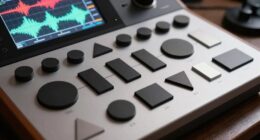

Adjusting the attack parameter in your envelope is the fastest way to change your sound’s character. A quick attack makes the sound punchy and aggressive, while a longer attack creates a softer, more withered tone. By fine-tuning this parameter, you can instantly shift from dull to lively or smooth to sharp. If you keep experimenting with envelope tweaks, you’ll discover even more ways to shape your sound dynamically and effectively.
Key Takeaways
- Adjusting the attack parameter quickly shifts the sound from soft to sharp onsets.
- Modulating decay and sustain alters the percussiveness or smoothness of the sound.
- Small envelope tweaks can dramatically change the sound’s emotional character.
- Quick changes to release time affect how the sound fades, impacting its overall mood.
- Envelope shape customization allows rapid transformation of sound personality and presence.
Have you ever wondered how a simple adjustment can transform your entire sound design? It’s often the small tweaks that make the biggest difference, especially when it comes to shaping the character of a sound. One of the most effective tools for this is envelope modulation, which controls how a sound evolves over time. By tweaking its parameters, you can quickly shift a sound’s personality from dull to lively, aggressive to smooth. This quick change can be a game-changer in your production, allowing you to craft sounds that stand out and fit perfectly into your mix.
In essence, the envelope dictates how a sound begins, sustains, and fades away. It’s like the shape of the sound’s life cycle—attack, decay, sustain, and release. When you adjust these stages, you’re engaging in sound design at a fundamental level. For instance, increasing the attack time results in a softer onset, making the sound more gentle. Conversely, decreasing the attack creates a sharp, punchy start that grabs attention immediately. Modulating the decay and sustain can make a sound feel more percussive or more ambient, depending on your goal.
When you focus on envelope modulation, you unlock a versatile method to change a sound’s character quickly. For example, by applying modulation to the attack or decay parameters, you can create dynamic, evolving sounds that feel alive and organic. This technique is especially useful for synthesizers, where subtle or dramatic adjustments to the envelope can turn a static tone into a vibrant, expressive instrument. You don’t need complex effects—just a simple tweak to the envelope can produce a noticeable, impactful change. Understanding how envelope parameters interact is crucial for achieving the desired sound evolution, especially since the way these parameters influence sound shaping directly impacts the final tone. Additionally, exploring how envelope shape influences the overall tone allows for even more tailored sound design. Recognizing how different envelope shapes contribute to the emotional quality of a sound can further enhance your creative control. To truly master sound design, it’s helpful to understand how envelope modulation interacts with other synthesis parameters, creating even more nuanced sonic variations.
The key is understanding how these parameters interact and how they influence the overall sound. Small adjustments to the envelope’s attack or release can make a sound feel more aggressive, mellow, or whimsical. When you experiment with envelope modulation, you gain immediate feedback, allowing you to craft sounds that convey emotion and character with precision. This tweak is fast, intuitive, and highly effective—making it a favorite among producers and sound designers who want to shape their sounds on the fly. In just moments, you can elevate a plain waveform into a distinctive, memorable sound that compliments your entire mix.
envelope generator for synthesizer
As an affiliate, we earn on qualifying purchases.
As an affiliate, we earn on qualifying purchases.
Frequently Asked Questions
Does the Envelope Tweak Work With All Guitar Amps?
Yes, the envelope tweak works with most guitar amps, but results vary based on your amp settings and tone. You should experiment with different tweak techniques to find what suits your gear best. Adjust the envelope parameters while listening closely, as each amplifier responds uniquely. Keep in mind that some amps might need slight modifications in your approach, but overall, it’s a versatile method to shape your sound quickly across various setups.
Can I Use the Envelope Tweak on Bass Guitar?
Yes, you can definitely use the envelope tweak on bass guitar. For example, a bassist wanting a punchier, more aggressive tone might apply the envelope tweak to emphasize attack and sustain. This technique adjusts the envelope of your bass signal, shaping how it responds dynamically. By tweaking the envelope settings, you’ll find it transforms your bass guitar’s character, making it more lively and fitting for various styles.
How Long Does It Take to Hear Noticeable Changes?
You’ll notice changes in your guitar tone almost immediately after adjusting the envelope tweak. It’s quick because it directly impacts your amp settings and how your guitar’s attack and decay behave. As soon as you tweak the envelope, listen carefully; subtle shifts in tone or attack can be heard instantly. For more drastic changes, experiment a bit longer, but generally, you’ll feel the effect within a few seconds to a minute.
Are There Any Common Mistakes to Avoid When Applying the Tweak?
You should avoid common mistakes like improper pedal placement and rushing the settings adjustment. Make certain you position the pedal correctly to achieve the desired effect, and take your time tweaking the settings gradually. Rushing can lead to a less natural sound. Always listen closely as you adjust, and make small changes to find the perfect tone. This careful approach helps you avoid mistakes and guarantees a faster, more effective transformation.
Can the Envelope Tweak Be Combined With Other Effects?
Yes, you can definitely combine the envelope tweak with other effects for unique sounds. For example, using envelope modulation with reverb can create a shimmering, evolving soundscape. Tweak customization allows you to fine-tune how the envelope interacts with these effects, giving you full control. Experimenting with this combo can lead to dynamic textures, making your sound design more expressive and tailored to your musical vision.
Conclusion
Now that you’ve learned this simple envelope tweak, you can instantly transform your sound and add a fresh character to your tracks. It’s like discovering a secret passage in a castle—unexpected and powerful. Don’t be afraid to experiment and find your unique tone. Remember, even a modern producer like yourself can channel the spirit of a vintage pioneer with just a little tweak. Embrace the magic and let your tracks tell their story, just like those legendary producers of yore.