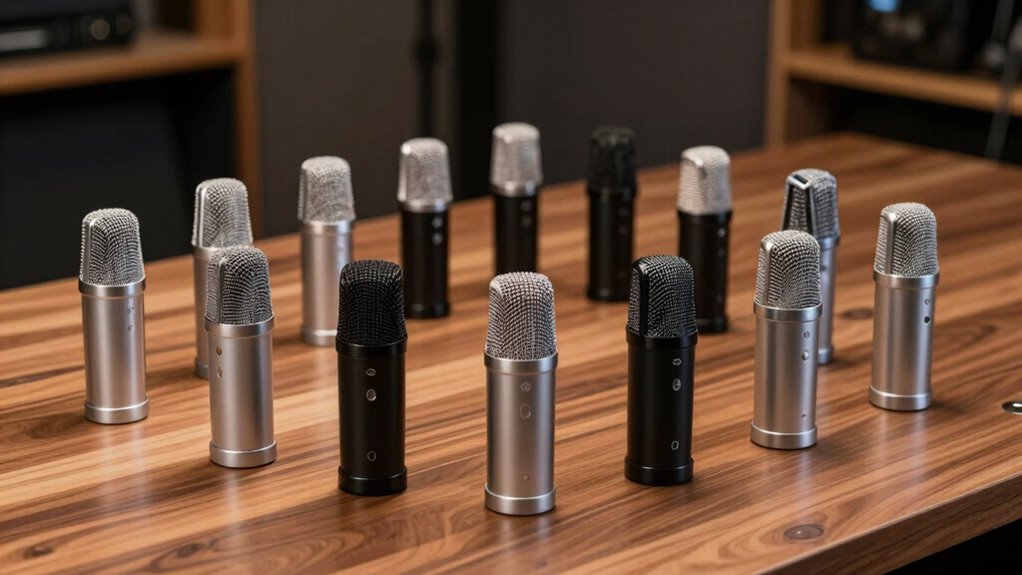
A small diaphragm condenser microphone pair is the go-to tool for capturing acoustic guitar, drum overheads, piano, strings, and ensembles with the detail and stereo imaging that single mics can’t deliver. The standout option here is the sE Electronics SE8 matched pair, which offers extended frequency response, low self-noise, and hand-matched capsules at a price that undercuts more famous competitors. If budget leads your decision, the Rode M5 matched pair delivers remarkably consistent performance for the money, while the Universal Audio SP-1 pairs solid hardware with UAD plugin emulation for hybrid recording workflows. The main tradeoffs in this category come down to matched-pair consistency, included accessories like stereo bars and shockmounts, and whether you’re paying extra for bundle items you may already own. Keep reading for the full breakdown of all nine options.
Complete the kit

Key Takeaways
- The sE SE8 matched pair earned the top spot because its hand-matched capsules and lower self-noise give it a measurable edge over the sE7 and Rode M5 for critical stereo work like drum overheads and classical recording.
- The Rode M5 appeared three times in different bundles — the bare pair is the best value, while the bundles only make sense if you genuinely need the stereo bar, stand, and cables included.
- The sE7 sits below the SE8 in price and performance, making it the smarter entry point for beginners who want sE’s house sound without the flagship price.
- The Universal Audio SP-1 is the only option here with bundled software emulation, making it the clear choice for producers who record into a UAD-equipped interface.
- Across all nine listings, nearly identical mics were sold in wildly different bundles — the microphone itself matters less variability-wise than choosing the bundle that matches accessories you actually lack.
| sE Electronics SE8 Pair of Small Diaphragm Condenser Microphones |  | Best Overall | Polar Pattern: Cardioid (Unidirectional) | Frequency Response: 20 Hz – 20 kHz | Signal-to-Noise Ratio: 78 dB | VIEW ON AMAZON | See Our Full Breakdown |
| Rode M5 Compact 1/2″ Condenser Microphone Matched Pair, XLR |  | Best Value | Polar Pattern: Cardioid (Unidirectional) | Frequency Response: 20 Hz – 20 kHz | Signal-to-Noise Ratio: 75 dB | VIEW ON AMAZON | See Our Full Breakdown |
| Universal Audio SP-1 Standard Pencil Microphone, Matched Pair – Bundle with 2 XLR Cables |  | Best for Hybrid Studios | Polar Pattern: Cardioid (Unidirectional) | Channels: 2 (matched pair) | Impedance: 200 ohms | VIEW ON AMAZON | See Our Full Breakdown |
| Rode M5-MP Matched Pair Small-Diaphragm Cardioid Condenser Microphones with SB20 Stereo Bar |  | Best Stereo Kit | Polar Pattern: Cardioid (Unidirectional) | Frequency Response: 20 Hz – 20 kHz | Max SPL: 140 dB | VIEW ON AMAZON | See Our Full Breakdown |
| SE Electronics sE7 Small Diaphragm Cardioid Condenser Microphone (Pair) |  | Best Mid-Range Step-Up | Polar Pattern: Cardioid (Unidirectional) | Frequency Response: 20 Hz – 20 kHz | Max SPL: 136 / 156 dB (with pad) | VIEW ON AMAZON | See Our Full Breakdown |
| sE Electronics sE8 XLR Small Diaphragm Condenser Microphones – Matched Pair with Mounting Bar & Case |  | Best Premium Pick | Type: Condenser Microphone | Diaphragm: 3-micron gold-sputtered | Polar Pattern: Cardioid (optional Omni capsule) | VIEW ON AMAZON | See Our Full Breakdown |
| Rode M5-MP Matched Pair Small-Diaphragm Condenser Microphones Bundle with Stereo Bar, Boom Stand, and XLR Cables |  | Best Complete Starter Kit | Connectivity: XLR | Matching: Within 1 dB | Frequency Response: 20 Hz to 20 kHz | VIEW ON AMAZON | See Our Full Breakdown |
| SE Electronics sE7 Small Diaphragm Cardioid Condenser Microphone |  | Best Value Single Mic | Polar Pattern: Cardioid | Frequency Range: 20 Hz – 20 kHz | Max SPL: 136/156 dB SPL | VIEW ON AMAZON | See Our Full Breakdown |
| sE Electronics sE7 Small-Diaphragm Condenser Microphone (Matched Stereo Pair) with Accessories |  | Best Balanced Pair for the Money | Polar Pattern: Unidirectional (cardioid) | Frequency Response: 80 Hz and up | Signal-to-Noise Ratio: 78 dB | VIEW ON AMAZON | See Our Full Breakdown |
| small diaphragm condenser microphone pair | Polar Pattern | Frequency Response | Connector |
|---|---|---|---|
| sE Electronics SE8 Pair of Sma | Cardioid (Unidirectional) | 20 Hz – 20 kHz | XLR (phantom power required) |
| Rode M5 Compact 1/2" Condenser | Cardioid (Unidirectional) | 20 Hz – 20 kHz | XLR (phantom power required) |
| Universal Audio SP-1 Standard | Cardioid (Unidirectional) | — | XLR |
| Rode M5-MP Matched Pair Small- | Cardioid (Unidirectional) | 20 Hz – 20 kHz | XLR (phantom power required) |
| SE Electronics sE7 Small Diaph | Cardioid (Unidirectional) | 20 Hz – 20 kHz | XLR |
| sE Electronics sE8 XLR Small D | Cardioid (optional Omni capsule) | — | — |
| Rode M5-MP Matched Pair Small- | — | 20 Hz to 20 kHz | — |
| SE Electronics sE7 Small Diaph | Cardioid | — | — |
| sE Electronics sE7 Small-Diaph | Unidirectional (cardioid) | 80 Hz and up | — |
More Details on Our Top Picks
sE Electronics SE8 Pair of Small Diaphragm Condenser Microphones
The sE8 pair earns the top spot because it does the hardest thing well: translating fast transients — a plucked string, a hi-hat, the attack of a piano — without smearing or harshness. The gold-sputtered handcrafted capsules and sophisticated backplate design give it a level of detail the Rode M5 approaches but doesn’t quite match, especially in the top octave where cheaper pencils turn brittle. Compared with the sE7 from the same maker, the sE8 adds switchable attenuation pads and low-cut filters, which matters if you’re close-miking drums or loud amps. The tradeoff is straightforward: this is the most expensive option here, and its delicate diaphragms demand careful handling and proper shockmounts.
Pros:- Handcrafted capsules with exceptional transient response and natural tonal balance
- Switchable pads and low-cut filters handle loud sources flexibly
- Factory-matched pairs deliver tight, consistent stereo imaging
- High SPL handling and low noise suit both studio and stage work
Cons:- Premium price well above the rest of this lineup
- Delicate diaphragms require careful handling and transport
- Needs phantom power and a quality XLR chain to shine
Best for: Engineers and serious home studio owners recording acoustic guitar, piano, drums overheads, or classical ensembles who want reference-grade transient detail
Not ideal for: Budget-limited buyers or anyone recording in untreated, rough-handling environments — the price and fragile capsules punish both
- Polar Pattern:Cardioid (Unidirectional)
- Frequency Response:20 Hz – 20 kHz
- Signal-to-Noise Ratio:78 dB
- Max SPL:159 dB (with pad)
- Connector:XLR (phantom power required)
- Enclosure:Brass
- Form Factor:Small diaphragm, matched pair
Our verdict“If stereo recording is central to your work and budget allows, the sE8 pair is the pick everything else here is measured against.”
Rode M5 Compact 1/2″ Condenser Microphone Matched Pair, XLR
For most buyers, the Rode M5 matched pair is the smartest spend on this list. It delivers roughly 85–90% of the sE8’s refinement at a meaningfully lower price, with a 1/2-inch gold-sputtered capsule that stays smooth rather than spiky on acoustic instruments and choirs. The 10-year warranty is the quiet differentiator — no one else here backs their mics like that, and it changes the math for anyone recording outside a padded studio. Windshields and stand mounts come in the box, so you’re recording out of the box. The compromise is the lack of pads and filters: on loud sources you’ll wish you’d spent up for the sE8’s switching, and it needs an XLR interface rather than USB.
Pros:- Excellent price-to-performance ratio against premium rivals
- 10-year warranty — the strongest coverage in this roundup
- Includes windshields and stand mounts for immediate use
- Well-matched capsules with low self-noise for clean stereo work
Cons:- No attenuation pad or low-cut filter on the mic itself
- XLR-only, requiring an audio interface with phantom power
- Buying a pair costs more than a single mic upfront
Best for: Project studio owners and gigging musicians who want dependable stereo recording of acoustic instruments, drum overheads, or ensembles without premium pricing
Not ideal for: Anyone wanting a USB plug-and-play setup, or engineers who regularly capture very loud sources needing onboard pads
- Polar Pattern:Cardioid (Unidirectional)
- Frequency Response:20 Hz – 20 kHz
- Signal-to-Noise Ratio:75 dB
- Self-Noise:19 dB-A
- Impedance:200 ohms
- Connector:XLR (phantom power required)
- Warranty:10 years
- Enclosure:Brass
Our verdict“The M5 pair is the default recommendation for buyers who want professional stereo results while spending sensibly.”
Universal Audio SP-1 Standard Pencil Microphone, Matched Pair – Bundle with 2 XLR Cables
The UA SP-1 pair plays a different game than everything else here. Its headline feature is Hemisphere mic modeling, which lets you reshape its character to emulate classic pencil condensers after the fact — a workflow the Rode M5 and sE8 simply don’t offer. For producers working ITB who want tonal flexibility without buying five pairs of mics, that’s a genuine advantage. The bundle includes two XLR cables, so the essential chain is covered out of the box. The tradeoffs are real though: modeling works best inside UA’s ecosystem, so it rewards users already invested in that platform, and beginners may find the software layer adds complexity that a straightforward pair like the M5 avoids.
Pros:- Hemisphere modeling provides multiple classic mic voicings from one pair
- Pristine stereo fidelity for detailed instrument capture
- Bundle includes XLR cables for a complete setup
- Equally at home in studio tracking and live capture
Cons:- Full value depends on UA’s software ecosystem
- Added setup complexity compared to plug-in-and-record pairs
- May require additional accessories for specific stereo arrays
Best for: Producers and engineers already using Universal Audio interfaces or UAD software who want software-shappable mic character
Not ideal for: Simpler analog-only setups or buyers outside the UA ecosystem — much of the value is locked to the modeling software
- Polar Pattern:Cardioid (Unidirectional)
- Channels:2 (matched pair)
- Impedance:200 ohms
- Power Source:48V phantom power
- Connector:XLR
- Weight:4.48 oz (pair)
- Dimensions:5 x 0.93 x 0.93 in (per mic)
- Special Feature:Hemisphere mic modeling
Our verdict“Choose the SP-1 if your workflow lives inside Universal Audio’s world and you want modeling flexibility alongside clean capture.”
Rode M5-MP Matched Pair Small-Diaphragm Cardioid Condenser Microphones with SB20 Stereo Bar
This is the M5 pair reimagined as a complete stereo solution. The microphones are the same trusted design praised elsewhere in this roundup, but the included SB20 stereo bar with pre-marked ORTF and XY positions removes the most common beginner mistake in stereo recording: guesswork placement. Compared with the standalone Rode M5, you’re paying a modest premium for hardware that makes correct array geometry nearly automatic — genuinely useful for piano, drum overheads, and choir work. Against the sE7 pair, which ships with only clips, this bundle saves you a separate stereo bar purchase. The weaknesses are documentation-related rather than sonic: no published weight specs, and you may still want threaded boom stands, since the bar assumes solid mounting underneath.
Pros:- SB20 stereo bar with pre-marked ORTF and XY positions eliminates placement guesswork
- Same low-noise, wide-response M5 capsules as the standalone pair
- Consistent matching delivers accurate stereo imaging
- Mic clips included for standard mounts
Cons:- Slightly redundant if you already own stereo mounting hardware
- Missing published specs like weight and detailed build info
- Still needs sturdy stands and XLR cabling beyond the bundle
Best for: Recordists setting up their first serious stereo rig — piano, choirs, drum overheads — who want correctly spaced arrays without math
Not ideal for: Buyers who already own a stereo bar or prefer spaced-omni and Blumlein techniques the pre-marked positions don’t cover
- Polar Pattern:Cardioid (Unidirectional)
- Frequency Response:20 Hz – 20 kHz
- Max SPL:140 dB
- Self-Noise:19 dB-A
- Connector:XLR (phantom power required)
- Included Accessories:SB20 stereo bar, mic clips
- Stereo Bar Dimensions:6.7 in W x 9.4 in L
Our verdict“The easiest on-ramp to properly configured stereo recording — worth it for the bar alone if you don’t own one.”
SE Electronics sE7 Small Diaphragm Cardioid Condenser Microphone (Pair)
The sE7 pair sits neatly between the Rode M5 and its bigger sibling the sE8. With a signal-to-noise ratio of 87 dB and a 136 dB SPL ceiling (156 dB with its pad), it’s actually the quietest and most SPL-capable mic on paper in this lineup — impressive at its mid-range price. The hand-selected matching gives stereo imaging that holds together on classical and ensemble work. Where it trails the sE8 is tonal sophistication: the flagship’s more refined backplate design resolves fine detail the sE7 slightly rounds off. And its known sensitivity to handling noise means you’ll want shockmounts or solid stands, particularly compared with the sturdier-feeling M5. It’s the sensible middle path — better than entry-level, short of reference-grade.
Pros:- 87 dB signal-to-noise ratio — the best measured figure in this batch
- Handles up to 156 dB SPL with pad engaged for loud sources
- Hand-selected matched pairs for precise stereo localization
- Solid, professional-grade build with mounting clips included
Cons:- Notably sensitive to handling noise without shockmounts
- Lacks the sE8’s tonal refinement and onboard filtering
- Requires 48V phantom power and full XLR infrastructure
Best for: Intermediate recordists upgrading from budget pencils who want quieter capsules and strong SPL handling without flagship pricing
Not ideal for: Casual podcasters or phone-adjacent recorders — phantom power, XLR, and handling-noise sensitivity make it overkill and fussy
- Polar Pattern:Cardioid (Unidirectional)
- Frequency Response:20 Hz – 20 kHz
- Max SPL:136 / 156 dB (with pad)
- Signal-to-Noise Ratio:87 dB
- Sensitivity:19 mV/Pa
- Power:48V phantom power
- Connector:XLR
- Weight:9.12 oz (pair)
Our verdict“A smart halfway house between the M5’s value and the sE8’s excellence — ideal for upgrading recordists who’ve outgrown entry-level gear.”
sE Electronics sE8 XLR Small Diaphragm Condenser Microphones – Matched Pair with Mounting Bar & Case
For buyers who want the last word in transparency and low self-noise, the sE8 pair sits at the top of this lineup. The handcrafted 3-micron gold-sputtered capsule is the key differentiator here: compared with the sE7 pair from the same manufacturer, the sE8 resolves finer detail and keeps noise floors lower, which matters most on quiet sources like fingerpicked acoustic guitar or distant orchestral work. The dual switchable pads (-10/-20 dB) and two low-cut positions give it more flexibility than the Rode M5-MP bundle when tracking loud sources like drum overheads or brass.
The tradeoff is straightforward: this is the priciest tier of pencil mics in the roundup, and ambient or room recording demands an optional omni capsule that costs extra. Casual home recorders will get more value from cheaper options.
Pros:- Handcrafted gold-sputtered capsule delivers exceptional detail and transparency
- Ultra-low self-noise suits quiet, critical recordings
- Dual pads and two low-cut filters handle both delicate and loud sources
- Rugged all-metal build with a proper case and mounting bar
Cons:- Omni pattern for ambient recording requires a separately purchased capsule
- Premium price puts it out of reach for hobbyists
Best for: Engineers recording quiet acoustic sources, classical ensembles, or anything where ultra-low noise and detail retrieval are the priority
Not ideal for: Budget-limited home studios or anyone who mostly needs room miking — the omni capsule costs extra and the price is hard to justify for casual use
- Type:Condenser Microphone
- Diaphragm:3-micron gold-sputtered
- Polar Pattern:Cardioid (optional Omni capsule)
- Pads:Switchable -10 dB and -20 dB
- Filters:Low-cut at 80 Hz and 160 Hz
- Connectivity:XLR
- Includes:Matched pair, mounting bar, windscreens, clips, case
Our verdict“If capturing maximum detail with minimal noise is the goal and the budget allows, the sE8 pair is the upgrade worth making over the sE7.”
Rode M5-MP Matched Pair Small-Diaphragm Condenser Microphones Bundle with Stereo Bar, Boom Stand, and XLR Cables
Most matched pairs arrive as two mics and nothing else, leaving buyers to source a stereo bar, stand, and cables separately. This Rode M5-MP bundle solves that in one purchase, packaging the mics with a stereo bar, boom stand, and XLR cables — everything needed for a first drum-overhead or choir session. The pair itself is matched within 1 dB, which keeps stereo imaging tight and phase behavior predictable when spaced or ORTF mounted.
Compared with the bare Rode M5 matched pair sold without accessories, this bundle trades a slightly higher total price for genuine convenience — a fair deal for anyone starting a stereo rig from scratch. The self-noise of 20 dB is respectable but doesn’t challenge the sE8, and beginners may find the multi-piece stereo setup fiddly at first. It needs 48V phantom power, so verify the interface supplies it.
Pros:- Everything included: mics, stereo bar, boom stand, and XLR cables
- Tight matching within 1 dB for accurate stereo imaging
- Handles 140 dB SPL, safe close to loud sources
- Versatile across drums, choir, orchestra, and studio work
Cons:- Requires 48V phantom power from an interface or mixer
- More expensive than buying a bare pair when accessories aren’t needed
Best for: First-time stereo recordists building a drum overhead, choir, or acoustic guitar rig who don’t already own stands, bars, or cables
Not ideal for: Engineers who already own mounting hardware — the bare M5 pair costs less and performs identically
- Connectivity:XLR
- Matching:Within 1 dB
- Frequency Response:20 Hz to 20 kHz
- Maximum SPL:140 dB
- Self-Noise:20 dB
- Power Requirements:+48V phantom power
- Includes:Matched pair, stereo bar, boom stand, XLR cables
Our verdict“The smartest single-purchase entry point into stereo recording — skip it only if you already own the mounting gear.”
SE Electronics sE7 Small Diaphragm Cardioid Condenser Microphone
Sometimes one pencil condenser is enough — a single guitar cab, a solo piano spot, or a hi-hat doesn’t require a matched pair. This sE7 single delivers the core sound of the sE7 stereo pair at roughly half the outlay, with the same switchable -20 dB pad and low-cut filter that make the family practical on loud stages. The 156 dB SPL ceiling with the pad engaged means it can sit right up against a cranked amp without flinching, something cheaper pencil mics can’t promise.
Compared with the sE8, the single sE7 gives up some refinement and omni capability but keeps the durable all-metal housing and gold-plated XLR. The obvious limitation for this roundup: no stereo imaging, and no second mic to grow into later. Buyers eyeing ensemble or overhead work should pay the extra for the sE7 matched pair instead.
Pros:- Natural, balanced sound quality typical of the sE line
- Handles up to 156 dB SPL with the -20 dB pad engaged
- Switchable pad and low-cut filter add placement flexibility
- All-metal housing and gold-plated XLR for reliable long-term use
Cons:- Single mic only — no stereo capability out of the box
- Requires a phantom power source, ruling out simple USB-style setups
Best for: Home recordists who need one dependable spot mic for guitar, piano, percussion, or amp duties without paying for a pair
Not ideal for: Anyone doing stereo work — overheads, ensembles, or choir — who will immediately wish they’d bought the matched pair version
- Polar Pattern:Cardioid
- Frequency Range:20 Hz – 20 kHz
- Max SPL:136/156 dB SPL
- Sensitivity:19 mV/Pa
- Pad:Switchable -20 dB
- Filters:Switchable low-cut
- Power:48V phantom power
- Includes:Mic clip, windscreen
Our verdict“A smart buy for mono spot-miking on a budget, but stereo recordists should go straight to the sE7 matched pair.”
sE Electronics sE7 Small-Diaphragm Condenser Microphone (Matched Stereo Pair) with Accessories
The sE7 matched pair occupies the sweet spot this roundup keeps circling: stereo imaging and consistency from the sE family at a price well below the sE8. Compared with the Rode M5-MP bundle, the sE7 pair edges ahead on build and pad flexibility while Rode counters with its included stand and cables — so the choice comes down to whether accessories or mic performance matters more. The selectable pads and filters make this pair comfortable on both delicate piano sessions and loud overhead duty, and accurate localization keeps spaced-pair and ORTF arrangements honest.
Tradeoffs exist. The published frequency response starting around 80 Hz means less low-end reach than the Rode pair’s 20 Hz spec — a real consideration for drum rooms and piano bodies — and it still needs external phantom power. Self-noise is higher than the sE8’s too.
Pros:- Consistent matching for accurate stereo imaging and localization
- Selectable pads and filters cover both quiet and loud sources
- Bundled with XLR cables and pop filters
- Professional build quality at a mid-tier price
Cons:- Frequency response rolls off below roughly 80 Hz, limiting low-end capture
- Higher self-noise than premium options like the sE8
Best for: Project studios wanting professional-grade stereo recording of overheads, piano, and acoustic instruments without paying sE8 money
Not ideal for: Buyers chasing deep low-end extension or the lowest possible noise floor — the Rode M5 and sE8 serve those needs better
- Polar Pattern:Unidirectional (cardioid)
- Frequency Response:80 Hz and up
- Signal-to-Noise Ratio:78 dB
- Impedance:200 ohm
- Connectivity:XLR
- Power:48V phantom power
- Includes:Matched pair with XLR cables and pop filters
Our verdict“The most sensible middle path in this lineup — a genuine stereo workhorse unless sub-80 Hz detail or ultra-low noise is non-negotiable.”

How We Picked
I evaluated each matched pair on four buyer-relevant criteria: sonic consistency between the two mics, self-noise and frequency response, build quality, and the real value of included accessories. Because this roundup includes multiple bundle configurations of the same microphones, I also compared what each listing actually ships with — a stereo bar and case can save you $50–100 if you don’t own them, or add dead weight if you do. Ranking reflected how well each option serves a buyer at its price point, not raw specs alone.
The ranking logic favors matched-pair certification and measurement data first, since poor matching ruins stereo imaging — the single most important outcome for this category. From there, I weighed accessory bundles against street price, then considered extras like plugin bundles or included cabling. Options that duplicated other listings were ranked by which bundle offered the better value, and I called out where buying the bare pair makes more sense than the bundle.
| small diaphragm condenser microphone pair | Polar Pattern | Connector |
|---|---|---|
| sE Electronics SE8 Pair of Sma | Cardioid (Unidirectional) | XLR (phantom power required) |
| Rode M5 Compact 1/2" Condenser | Cardioid (Unidirectional) | XLR (phantom power required) |
| Universal Audio SP-1 Standard | Cardioid (Unidirectional) | XLR |
| Rode M5-MP Matched Pair Small- | Cardioid (Unidirectional) | XLR (phantom power required) |
| SE Electronics sE7 Small Diaph | Cardioid (Unidirectional) | XLR |
| sE Electronics sE8 XLR Small D | Cardioid (optional Omni capsule) | — |
| Rode M5-MP Matched Pair Small- | — | — |
| SE Electronics sE7 Small Diaph | Cardioid | — |
| sE Electronics sE7 Small-Diaph | Unidirectional (cardioid) | — |
Factors to Consider When Choosing Small Diaphragm Condenser Microphone Pair
Before settling on a pair, it helps to understand what actually separates a smart purchase from an expensive mistake in this category. These are the factors that shaped my rankings and the ones I’d weigh most heavily before spending.Matching Tolerance and Stereo Imaging
The entire reason to buy a matched pair instead of two identical single mics is capsule and circuitry consistency. Even mics from the same production run can vary by a couple of decibels in sensitivity, which causes image shift and phase problems when spaced or in ORTF configurations. Reputable manufacturers measure and pair units that fall within tight tolerances — sE and Rode both do this for their matched-pair SKUs, and it’s why I ranked certified pairs above buying two singles. A common mistake is assuming any two identical models will match; the savings rarely justify the risk for stereo work. If a listing doesn’t explicitly say matched pair, treat it as two individual microphones and adjust your expectations accordingly.
Self-Noise and Sensitivity
Self-noise is the spec that quietly determines how much detail survives in quiet sources. A pair with 16 dB of self-noise will hiss audibly on delicate fingerstyle guitar or distant orchestral capture, while a quieter pair around 12–14 dB keeps the noise floor below the room itself. This spec matters less for loud sources like drum overheads, where the signal easily overwhelms the floor — which is why budget pairs like the Rode M5 remain defensible for that job. Sensitivity also affects your gain staging: quieter preamps may struggle with low-sensitivity pencil mics on soft sources. Match your noise-floor needs to your actual recording scenarios before paying for premium specs you won’t hear.
Capsule Size and Off-Axis Response
Half-inch capsules, like those in the Rode M5, generally offer tighter polar patterns and better off-axis rejection than larger designs, which reduces room bleed when miking ensembles. However, smaller capsules can exhibit more off-axis coloration — sounds arriving from the sides may sound duller or phasey. The sE SE8’s reputation rests partly on its smoother off-axis behavior, which matters enormously for orchestral and choir recording where much of the sound arrives off-axis. If you record in a treated room with close miking, this matters less than if you’re capturing a full ensemble in a reverberant space. Think about where sound comes from in your sessions, not just where you point the mics.
Bundles: Real Value or Padding?
Three of the nine listings here are the same Rode M5 pair sold with different accessory packages, and that pattern repeats across the category. A bundle with a stereo bar is genuinely useful if you plan ORTF or XY configurations, since a decent bar costs $30–60 on its own. Bundled XLR cables are usually the cheapest quality tier, and included boom stands rarely match what an existing stand already does. My advice: price out the bare pair plus the one or two accessories you actually need, and only buy the bundle when it beats that total. Bundles make sense for first-time buyers building a kit from zero, and almost nobody else.
Pad and Filter Options
A built-in attenuation pad (typically -10 or -20 dB) lets you place these mics on loud sources — snare drums, guitar amplifiers, brass — without overloading the capsule. Likewise, a low-cut switch reduces rumble from stands and HVAC before it hits your preamp. The SE8 includes both switches; cheaper models sometimes omit them. If your pair will live exclusively on acoustic instruments in a quiet room, you can skip this feature and save money. But versatility is the whole point of pencil condensers, and pairs with pads and filters will stay useful as your recording scenarios expand.
Long-Term Ecosystem and Resale
sE Electronics and Rode both have long-established service networks and consistent product lines, which affects long-term ownership more than most buyers expect. If one mic in your pair fails or gets damaged years from now, replacement and repair availability determines whether your stereo setup survives. Universal Audio’s SP-1 ties you into their ecosystem, which is a benefit if you use UAD interfaces and a limitation if you ever change platforms. Resale value also tracks brand stability — Rode pairs hold value well because demand stays constant. Cheaper no-name matched pairs exist, but the savings evaporate if a discontinued product can’t be repaired or matched later.
Frequently Asked Questions
Can I just buy two of the same microphone instead of a matched pair?
You can, but you’re accepting a gamble with your stereo image. Manufacturers measure matched pairs and select units whose sensitivity and frequency response fall within tight tolerances — typically within a decibel of each other. Two random units of the same model can vary enough to pull the stereo image toward one side or cause comb filtering in spaced-pair techniques. For casual mono-adjacent recording, the savings might be worth it. For anything where listeners will notice imaging — drum overheads, ensembles, acoustic guitar in stereo — buy the certified pair.
Is the sE SE8 worth the extra money over the sE7?
The SE8 earns its premium through lower self-noise, a hand-selected matched pair process, and slightly more refined high-frequency detail. Whether that matters depends on your sources: for loud drum overheads, the difference is subtle enough that most listeners wouldn’t identify it. For quiet, detailed material — fingerstyle guitar, string quartets, distant choir capture — the SE8’s lower noise floor and tighter matching become clearly audible. If budget forces a choice, the sE7 pair is not a compromise that will embarrass you; it’s simply the version for people whose recordings won’t be scrutinized at high resolution.
Which Rode M5 bundle should I buy if I already own cables and stands?
If you already have cabling, buy the bare M5 matched pair and add a stereo bar separately only if you plan XY or ORTF setups. The bundles in this roundup add a stereo bar, boom stand, and XLR cables — useful for someone building a first recording kit, but redundant if your studio is already equipped. Bundled stands and cables are typically entry-level quality, so upgrading gear you already own with mediocre replacements is a step sideways. Do the math: if the bundle costs less than the bare pair plus a standalone stereo bar, it becomes worth buying even for the accessories’ resale value alone.
Do I need phantom power for these microphones?
Yes — every option in this roundup is a condenser requiring +48V phantom power from your interface or preamp. This is standard on virtually all audio interfaces and mixing consoles made in the last two decades, so it’s rarely a problem. Where it bites people is with cheap adapters, some field recorders, and legacy gear that omits phantom supply. Check your interface’s specs before buying, and remember that phantom power drains battery-powered recorders faster. There’s no dynamic equivalent at this size and detail level, so plan your power chain accordingly.
Is the Universal Audio SP-1 worth it if I don’t use UAD plugins?
Not really — the SP-1’s headline advantage is its bundled UAD plugin collection, which models classic stereo mic techniques and preamp emulations inside Apollo interfaces and LUNA software. Without that ecosystem, you’re left with a solid but conventional pencil pair that faces stiff competition from sE’s offerings at similar prices. If you record through Universal Audio hardware, the integration is genuinely useful and changes how you work. If you’re on any other platform, the SE8 or a well-priced Rode M5 bundle serves you better for the same or less money.
Conclusion
For best overall, the sE Electronics SE8 matched pair with mounting bar and case is the pick that balances performance, matching quality, and included accessories at a serious-recorder price. The best value goes to the bare Rode M5 matched pair — it’s the entry point that doesn’t cut corners on consistency. Beginners building a first stereo kit should look at the sE7 pair or the M5 bundle with stereo bar and stand, since those packages remove the guesswork from setup. The best premium choice is the SE8 in its fully accessorized configuration for anyone doing critical acoustic or classical work. For specific needs: the Universal Audio SP-1 bundle is the clear choice for UAD-based studios, and the Rode M5 bundle with boom stand suits mobile recorders who want a complete overhead rig in one purchase. Whichever route you take, buy the pair — not two singles — and match the bundle to what your studio is actually missing.