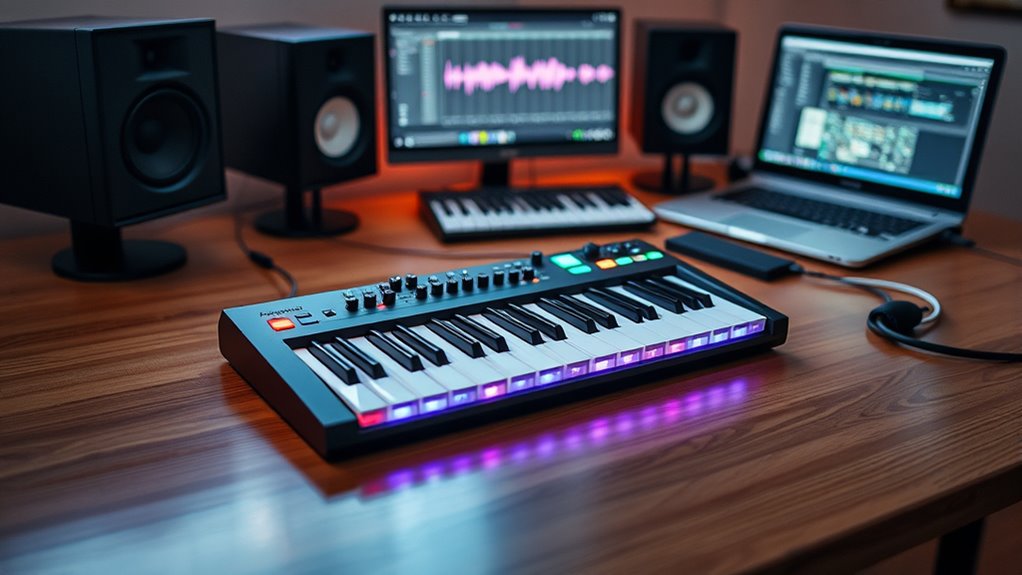
Finding the right MIDI keyboard for Ableton can transform your music production experience, whether you’re a beginner or a seasoned producer. The Arturia KeyLab Essential mk3 stands out as the best overall choice for its versatile controls and bundled software. For portability, the Akai MPK Mini Plus offers a compact design with powerful features, while the Novation Launchkey 61 MK4 provides an excellent balance of control and integration. Buyers often face tradeoffs between key count, build quality, and price—more keys mean greater versatility but typically come with a higher cost or larger size. Keep reading for a detailed breakdown of the top options tailored to different needs.

Get audio and creator gear delivered free with Prime
- Fast, free delivery on millions of items
- Prime Video, Amazon Music and more included
- Member-only deals all year
Complete the kit


Key Takeaways
- The best MIDI keyboard for Ableton balances key count, tactile feel, and integration features, depending on your workflow.
- Compact options like the Akai MPK Mini Plus excel for portability, but may lack some advanced controls found in larger models.
- Software bundles and DAW integration can significantly enhance your setup but often come at a premium or with added complexity.
- Build quality varies widely; investing in a sturdy, well-made controller pays off in durability and consistent performance.
- Price ranges reflect feature sets—higher-priced models typically offer more controls, keys, and customization options.
| Arturia KeyLab Essential mk3 — 49-Key USB MIDI Keyboard Controller with Analog Lab V Software Included |  | Best Overall for Deep Integration and Versatility | Number of Keys: 49 | Connectivity Technology: USB | Additional Features: 8 velocity- and pressure-sensitive pads, 9 faders, 9 encoders, Digital Display | VIEW ON AMAZON | See Our Full Breakdown |
| Akai Professional MPK Mini Plus 37-Key USB MIDI Keyboard Controller |  | Best for Portability and Live Performance | Number of Keys: 37 | Octaves: 3 full octaves | Connectivity: USB, MIDI I/O, CV/Gate | VIEW ON AMAZON | See Our Full Breakdown |
| Akai Professional APC Key 25 MK2 25-Key USB MIDI Keyboard Controller |  | Best for Live Clip Launching and Compact Control | Number of Keys: 25 | Pad Matrix: 5×8 RGB pads | Connectivity: USB | VIEW ON AMAZON | See Our Full Breakdown |
| Arturia KeyLab Essential mk3 USB MIDI Keyboard Controller, 88 Keys – Black |  | Best for Full-Range Piano Feel and Deep DAW Integration | Number of Keys: 88 | Connectivity Technology: USB | Supported Software: Ableton Live Lite | VIEW ON AMAZON | See Our Full Breakdown |
| Arturia KeyLab Essential mk3 61-Key MIDI Controller Bundle with Software and Accessories |  | Best for Extended Play and Value Bundle | Number of Keys: 61 | Connectivity Technology: USB | Additional Features: Velocity Sensitive Keys, Pads | VIEW ON AMAZON | See Our Full Breakdown |
| Arturia KeyLab Essential Mk3 61-Key USB MIDI Controller Keyboard, White Bundle with 2-Year CPS Protection and MIDI Cable |  | Best Overall | Number of Keys: 61 | Connectivity: USB-C, MIDI Out, Sustain/Modulation/Expression pedal inputs | Included Software: Analog Lab V, Ableton Live Lite, Model D, Komplete Select, Loopcloud, Melodics | VIEW ON AMAZON | See Our Full Breakdown |
| Novation Launchkey 61 MK4 USB MIDI Keyboard Controller |  | Best for Versatility with Creative Tools | Number of Keys: 61 | Connectivity Technology: USB | Supported Software: Ableton, Logic Pro, Cubase, HUI | VIEW ON AMAZON | See Our Full Breakdown |
| M-Audio Oxygen 49 MKV USB MIDI Keyboard Controller |  | Best for Full Control and Software Bundle | Number of Keys: 49 | Velocity-sensitive Keys: Yes | Drum Pads: 2 banks of 8 backlit pads | VIEW ON AMAZON | See Our Full Breakdown |
| Arturia KeyStep Pro 37-Key Controller and Sequencer – Black |  | Best for Sequencing and Hardware Integration | Number of Keys: 37 | Connectivity Technology: USB | Additional Features: 4-track polyphonic sequencer, 16-track drum sequencer, aftertouch | VIEW ON AMAZON | See Our Full Breakdown |
| Akai Professional LPK25 25-Key USB MIDI Keyboard Controller |  | Best for Portable Simplicity | Number of Keys: 25 | Key Type: Synth action | Power Source: USB | VIEW ON AMAZON | See Our Full Breakdown |
| 25-Key MIDI Keyboard Controller Portable USB MIDI Controller with Arpeggiator and Velocity Sensitive Keys |  | Best for Portability and On-the-Go Production | Number of Keys: 25 | Connectivity Technology: USB | Additional Features: Arpeggiator, Velocity Sensitive Keys, Loop Function, Transpose, Octave Range up to 10 | VIEW ON AMAZON | See Our Full Breakdown |
| Akai Professional MPK Mini MK3 25-Key USB MIDI Keyboard Controller |  | Best for Versatile Studio and Travel Use | Number of Keys: 25 | Key Type: Velocity-sensitive | Pads: 8 backlit MPC-style pads | VIEW ON AMAZON | See Our Full Breakdown |
| NUX NTK-49 MIDI Keyboard Controller with 49 Keys, 9 Faders, 8 Control Knobs, and Built-In Mouse Control Pad |  | Best for Versatile Performance and Navigation | Number of Keys: 49 | Connectivity Technology: USB | Additional Features: Arpeggiator, Smart Scale, Transpose/Octave Shift | VIEW ON AMAZON | See Our Full Breakdown |
| Korg microKEY 25 USB MIDI Keyboard |  | Best for Simplicity and Portability | Number of Keys: 25 | Connectivity Technology: USB | Additional Features: Velocity-sensitive, octave shift, key transpose, arpeggiator | VIEW ON AMAZON | See Our Full Breakdown |
| Novation Launchkey 25 MK3 MIDI Keyboard Controller |  | Best for Ableton Live Integration and Creative Modes | Number of Keys: 25 | Connectivity Technology: USB | Additional Features: Scale and Chord modes | VIEW ON AMAZON | See Our Full Breakdown |
| midi keyboard for ableton | Number of Keys | Connectivity Technology | Additional Features |
|---|---|---|---|
| Arturia KeyLab Essential mk3 | 49 | USB | 8 velocity- and pressure-sensitive pads, 9 faders, 9 encoders, Digital Display |
| Akai Professional MPK Mini Plu | 37 | — | — |
| Akai Professional APC Key 25 M | 25 | — | — |
| Arturia KeyLab Essential mk3 U | 88 | USB | — |
| Arturia KeyLab Essential mk3 6 | 61 | USB | Velocity Sensitive Keys, Pads |
| Arturia KeyLab Essential Mk3 6 | 61 | — | — |
| Novation Launchkey 61 MK4 USB | 61 | USB | Scale and Chord modes, Arpeggiator |
| M-Audio Oxygen 49 MKV USB MIDI | 49 | — | — |
| Arturia KeyStep Pro 37-Key Con | 37 | USB | 4-track polyphonic sequencer, 16-track drum sequencer, aftertouch |
| Akai Professional LPK25 25-Key | 25 | — | — |
| 25-Key MIDI Keyboard Controlle | 25 | USB | Arpeggiator, Velocity Sensitive Keys, Loop Function, Transpose, Octave Range up to 10 |
| Akai Professional MPK Mini MK3 | 25 | — | — |
| NUX NTK-49 MIDI Keyboard Contr | 49 | USB | Arpeggiator, Smart Scale, Transpose/Octave Shift |
| Korg microKEY 25 USB MIDI Keyb | 25 | USB | Velocity-sensitive, octave shift, key transpose, arpeggiator |
| Novation Launchkey 25 MK3 MIDI | 25 | USB | Scale and Chord modes |
More Details on Our Top Picks
Arturia KeyLab Essential mk3 — 49-Key USB MIDI Keyboard Controller with Analog Lab V Software Included
The Arturia KeyLab Essential mk3 stands out for its comprehensive control surface, making it a top choice for producers who want deep DAW integration and a wide range of sounds. Compared to the Akai MPK Mini Plus, it offers more physical controls like faders and encoders, which enhance hands-on mixing and editing. However, its 49 keys may fall short for players seeking a full-range piano experience. The included software bundle and customizable controls make it a flexible option, but the complex setup can be daunting for beginners. This model is ideal for intermediate to advanced users who need extensive control and are willing to invest time in configuration.
Pros:- Deep DAW integration with custom scripts for popular software
- Versatile presets including modern synths and orchestral sounds
- Intuitive controls with RGB-backlit pads and real-time feedback
Cons:- Limited to 49 keys, which may not suit all players
- Requires USB connection, no standalone mode
- Some users may find the software bundle complex for beginners
Best for: Producers and performers seeking a versatile, feature-rich MIDI controller for studio and live use.
Not ideal for: Beginners or players requiring a full 88-key experience without additional controls or complexity.
- Number of Keys:49
- Connectivity Technology:USB
- Additional Features:8 velocity- and pressure-sensitive pads, 9 faders, 9 encoders, Digital Display
- Supported Software:Ableton Live, FL Studio, Logic Pro, Cubase, Bitwig Studio
- Instrument Key:Any
- Compatible Devices:PC, Mac
Our verdict“This controller offers rich features for serious producers who prioritize control and software integration over keyboard size.”
Akai Professional MPK Mini Plus 37-Key USB MIDI Keyboard Controller
The Akai MPK Mini Plus excels as a portable solution, combining 37 mini keys with extensive connectivity, including MIDI, CV/Gate, and USB, making it suitable for musicians on the go. Unlike the Arturia KeyLab Essential mk3, it offers a smaller footprint, which is ideal for limited space or mobile setups. Its included software, MPC Beats, and NKS compatibility with Native Instruments expand its creative potential, but the limited number of keys can restrict complex keyboard parts. The 64-step sequencer adds to its appeal for live performance and beat-making, though the controls may seem overwhelming initially. This pick makes the most sense for producers and performers who prioritize portability and versatile connectivity over full-range keyboard features.
Pros:- Compact design ideal for portable music production
- Extensive connectivity options including MIDI and CV/Gate
- NKS integration for seamless sound library control
- Includes MPC Beats software and Splice access
Cons:- Limited keys may hinder complex keyboard parts
- Requires external power or USB connection for operation
- Initial control layout can be complex for newcomers
Best for: Mobile producers and live performers needing a compact, feature-packed MIDI controller.
Not ideal for: Classical pianists or users requiring a full 88-key piano feel for their workflow.
- Number of Keys:37
- Octaves:3 full octaves
- Connectivity:USB, MIDI I/O, CV/Gate
- Pads:8 RGB MPC pads
- Built-in Sequencer:64-step with 1 drum track and 1 melody/Chord track
- Software Included:MPC Beats
Our verdict“This controller is perfect for musicians who need a portable, flexible device with advanced connectivity options.”
Akai Professional APC Key 25 MK2 25-Key USB MIDI Keyboard Controller
The Akai APC Key 25 MK2 is tailored for live performers, with a 5×8 RGB pad matrix for launching clips and 25 velocity-sensitive keys. Its tight integration with Ableton Live makes it a favorite among electronic musicians who focus on real-time control. Unlike the Arturia KeyLab Essential mk3, it lacks faders and encoders, focusing more on clip launching and simple parameter control. The small size is excellent for stage use but may limit expressive keyboard playing. Its included Ableton Live Lite and virtual instrument pack add value, but the limited keys restrict melodic complexity. This makes it ideal for performers who prioritize clip-based workflows and live improvisation over full-range keyboard playing.
Pros:- Seamless Ableton Live integration for clip launching
- Compact and portable design for stage use
- Responsive velocity-sensitive keys
Cons:- Limited to 25 keys, not suitable for complex keyboard parts
- No standalone operation—requires a computer
- Lacks additional controls like faders or knobs
Best for: Ableton Live users seeking an intuitive, portable device for performance-centric workflows.
Not ideal for: Musicians who need a full keyboard for melodic or harmonic composition.
- Number of Keys:25
- Pad Matrix:5×8 RGB pads
- Connectivity:USB
- Includes:Ableton Live Lite, virtual instrument pack
- Octave Buttons:Up and Down
- Platform:Mac, Windows
Our verdict“This controller caters to live performers who want quick, intuitive Ableton control in a compact form factor.”
Arturia KeyLab Essential mk3 USB MIDI Keyboard Controller, 88 Keys – Black
The Arturia KeyLab Essential mk3 88-key offers a realistic piano experience with its full 88 keys, making it ideal for pianists and composers who need a full-range keyboard. Compared to smaller controllers like the Akai MPK Mini Plus, it provides a more authentic playing feel, though at the expense of portability. Its deep DAW integration, especially with Arturia’s software modes, enhances workflow for production and performance. However, limited details on build quality and lack of additional physical controls like knobs or faders may be a downside for advanced users seeking tactile mixing controls. This model is best suited for keyboard-focused musicians working mainly in a studio environment.
Pros:- Full 88-key piano feel for expressive playing
- Deep DAW integration with software modes
- Supports multiple platforms including Mac and Windows
Cons:- Limited information on build quality and durability
- No physical controls like knobs or faders
- Warranty details are generic and not specific
Best for: Pianists and composers needing a full 88-key keyboard with strong DAW support.
Not ideal for: Travelers or live performers prioritizing portability and stage setup simplicity.
- Number of Keys:88
- Connectivity Technology:USB
- Supported Software:Ableton Live Lite
- Platform:Mac, Windows 10/11
- Material:Plastic
- Warranty:Amazon.com 30-Day Return Guarantee
Our verdict“This controller is best suited for keyboardists requiring a realistic piano experience paired with seamless DAW integration.”
Arturia KeyLab Essential mk3 61-Key MIDI Controller Bundle with Software and Accessories
The Arturia KeyLab Essential mk3 61-key bundle extends the keyboard range to 61 keys, offering more melodic flexibility than smaller controllers like the Akai APC Key 25 MK2. The included accessories—sustain pedal, MIDI cable, and keyboard cover—add significant value for new or touring musicians. While it shares the deep DAW integration and software bundle with the 49-key version, the extra keys make it more suitable for players who need greater range without upgrading to an 88-key controller. The USB-only connection and absence of built-in speakers or standalone features mean it remains a studio-dependent device. This bundle suits those who want a versatile, full-range MIDI controller with added accessories for immediate setup.
Pros:- Extended 61 keys for more melodic options
- Includes valuable accessories like sustain pedal and cover
- Deep DAW integration with versatile modes
Cons:- Limited to USB connectivity only
- No built-in sounds or speakers
- No standalone operation—requires a computer
Best for: Intermediate musicians and producers seeking a mid-sized keyboard with comprehensive software and accessories.
Not ideal for: Travelers or minimalists who need a compact, lightweight controller with no extras.
- Number of Keys:61
- Connectivity Technology:USB
- Additional Features:Velocity Sensitive Keys, Pads
- Supported Software:Ableton Live, UVI Grand Piano, NI The Gentleman Piano
- Platform:Mac, Windows 7/10
- Included accessories:Sustain pedal, MIDI cable, keyboard cover
Our verdict“This controller is ideal for musicians wanting a full-range keyboard combined with a practical accessory bundle and software support.”
Arturia KeyLab Essential Mk3 61-Key USB MIDI Controller Keyboard, White Bundle with 2-Year CPS Protection and MIDI Cable
The Arturia KeyLab Essential Mk3 stands out for its seamless integration with Ableton and extensive software suite, making it a versatile choice for both studio producers and live performers. Compared with the Novation Launchkey 61 MK4, it offers more comprehensive software options and a durable, eco-friendly build, but its complexity can overwhelm beginners who prefer straightforward setups. The 61-key layout provides ample range for most playing styles, and the RGB pads and responsive faders enhance control precision. However, it requires external power via USB-C, which might be a hassle for some setups, and its feature set could be excessive for casual users.
Pros:- Seamless DAW integration with pre-mapped controls and custom scripts
- Touch-sensitive RGB pads and responsive faders for precise control
- Includes comprehensive software suite for immediate music production
- Eco-friendly design with durable construction
Cons:- May be complex for complete beginners without prior MIDI experience
- Limited to 61 keys, which might be restrictive for some players
- Requires external power source via USB-C
Best for: Intermediate to advanced producers and performers seeking deep integration with Ableton and a durable, eco-conscious design.
Not ideal for: Beginners or those preferring a plug-and-play experience without extensive setup, due to its feature complexity and power requirements.
- Number of Keys:61
- Connectivity:USB-C, MIDI Out, Sustain/Modulation/Expression pedal inputs
- Included Software:Analog Lab V, Ableton Live Lite, Model D, Komplete Select, Loopcloud, Melodics
- Material:Recycled plastic
- Protection:2-year extended CPS protection
Our verdict“This controller is ideal for musicians who want extensive features, software integration, and durability, accepting a steeper learning curve.”
Novation Launchkey 61 MK4 USB MIDI Keyboard Controller
The Novation Launchkey 61 MK4 excels in versatility, especially with its onboard creative features like scale, chord, and arpeggiator modes, making it perfect for hands-on music creation in Ableton. While the Arturia KeyLab Essential Mk3 offers more software options, the Launchkey’s quick access to creative modes makes it a favorite for live performers and producers who enjoy immediate musical experimentation. Its 16 FSR drum pads with polyphonic aftertouch and semi-weighted keys deliver expressive control, but the setup can be complex for beginners who might prefer simpler interfaces. Its sizable form factor also demands dedicated space, which might not suit mobile setups.
Pros:- Extensive onboard creative modes including scale, chord, and arpeggiator
- Responsive FSR drum pads with polyphonic aftertouch for expressive beats
- Deep DAW integration with major software support
- Semi-weighted keys for a more expressive feel
Cons:- Setup may be challenging for beginners unfamiliar with MIDI controllers
- Heavy and large, requiring dedicated space
- No standalone sounds—dependent on DAW or software
Best for: Producers and performers who prioritize onboard creative tools and quick setup for live or studio use.
Not ideal for: Beginners or those with limited space, due to its complexity and size, and users who want standalone instruments without DAW reliance.
- Number of Keys:61
- Connectivity Technology:USB
- Supported Software:Ableton, Logic Pro, Cubase, HUI
- Additional Features:Scale and Chord modes, Arpeggiator
- Instrument Key:Any
- Supported Devices:PC, Synthesizer, Groovebox
Our verdict“This controller suits experienced musicians seeking flexible creative tools and DAW integration, despite its learning curve and size.”
M-Audio Oxygen 49 MKV USB MIDI Keyboard Controller
The M-Audio Oxygen 49 MKV offers a balanced mix of full-size keys and extensive control options, making it attractive for those who want a flexible MIDI controller with a substantial software bundle. Compared to the Akai MPK Mini Plus, which is more portable, the Oxygen 49 provides more keys and control surfaces for detailed editing and performance. Its 8 knobs, 9 faders, and 16 drum pads support complex arrangements, but the setup can be overwhelming for newcomers due to its numerous features. The 49-key layout strikes a good middle ground for pianists and beatmakers, but it might still be too limited for those who need a full 88-key experience.
Pros:- Full-size velocity-sensitive keys for expressive playing
- Extensive control with knobs, faders, and multiple drum pads
- Includes wide software bundle for creative production
- Supports NKS for seamless Native Instruments integration
Cons:- Setup can be complex for users new to MIDI controllers
- Limited to 49 keys, which may restrict extensive piano playing
- Some users might find the software bundle overwhelming
Best for: Intermediate producers who need a versatile, feature-rich MIDI controller with comprehensive software support.
Not ideal for: Beginners or portable producers who prefer a smaller, lightweight setup, or those needing standalone hardware.
- Number of Keys:49
- Velocity-sensitive Keys:Yes
- Drum Pads:2 banks of 8 backlit pads
- Assignable Knobs:8
- Assignable Faders:9
- Included Software:MPC Beats, Ableton Live Lite, Hybrid 3, Mini Grand, 5 MPC Expansion packs
Our verdict“Ideal for producers seeking a feature-packed controller with deep software integration, accepting a steeper learning curve.”
Arturia KeyStep Pro 37-Key Controller and Sequencer – Black
The Arturia KeyStep Pro distinguishes itself through its advanced sequencing capabilities and hardware connectivity, making it suitable for electronic musicians who combine MIDI, CV, and hardware gear. Unlike the larger controllers, its 37 keys prioritize sequencing and modulation over extensive playing range, perfect for those focused on studio sequencing or live hardware setups. The 4-track polyphonic sequencer and 16-track drum sequencer provide substantial creative flexibility but come with a complex interface that may intimidate newcomers. Its support for CV/Gate outputs makes it especially appealing for users integrating vintage synths or modular setups.
Pros:- Versatile connectivity including USB, MIDI, and CV outputs
- Powerful 4-track polyphonic sequencer plus 16-track drum sequencer
- Velocity and aftertouch for expressive control
- Supports hardware and software integration seamlessly
Cons:- Interface complexity requires time to master
- Limited to 37 keys, restricting performance range
- Higher price point for advanced features
Best for: Electronic producers and live performers who need advanced sequencing and hardware integration, especially with modular gear.
Not ideal for: Pianists or performers seeking a full-range keyboard for expressive playing or beginners unfamiliar with sequencing workflows.
- Number of Keys:37
- Connectivity Technology:USB
- Additional Features:4-track polyphonic sequencer, 16-track drum sequencer, aftertouch
- Hardware Interface:USB, CV/Gate/Mod outputs
- Platform:Windows
- Control Method:Keyboard Controller
Our verdict“This is best suited for electronic musicians and live performers needing comprehensive sequencing and hardware control, despite its learning curve.”
Akai Professional LPK25 25-Key USB MIDI Keyboard Controller
The Akai LPK25 offers a compact, lightweight design ideal for mobile music makers and minimal setups. Its 25 keys and simple controls make it straightforward for beginners or those who need a quick, portable solution for Ableton Live. While it lacks the advanced controls of larger controllers like the M-Audio Oxygen 49 MKV, its small footprint makes it perfect for on-the-go musicians who prioritize portability over extensive range or control surface features. Its limited octave range and absence of pads or knobs mean it’s less suited for complex performances or detailed editing but excels in quick idea capture and basic MIDI control.
Pros:- Compact and highly portable for on-the-go use
- Responsive synth-action keys with velocity sensitivity
- Plug-and-play USB connectivity for quick setup
- Affordable price point for entry-level users
Cons:- Limited to 2 octaves, restricting melodic range
- No additional controls like knobs or pads for advanced editing
- Lacks built-in sounds or standalone features
Best for: Traveling musicians, DJs, and beginners who want a lightweight, easy-to-use MIDI controller for simple music creation.
Not ideal for: Producers needing extensive control surfaces or pianists requiring a full 88-key experience, as well as users seeking built-in sounds or standalone operation.
- Number of Keys:25
- Key Type:Synth action
- Power Source:USB
- Connectivity:USB
- Preset Slots:8
- Dimensions:Less than 13 inches across
Our verdict“Best suited for beginners and portable musicians who need a simple, lightweight MIDI control option for Ableton.”
25-Key MIDI Keyboard Controller Portable USB MIDI Controller with Arpeggiator and Velocity Sensitive Keys
This compact MIDI controller stands out for its lightweight, portable design, making it perfect for musicians who produce music in various locations. Compared with larger controllers like the Novation Launchkey 25 MK3, its size limits complex performances but offers broad compatibility and essential controls, ideal for quick sessions or mobile setups. The inclusion of an arpeggiator, velocity-sensitive keys, and octave controls ensures expressive playing despite its small footprint, but it lacks onboard sounds or advanced features seen in premium models. Its reliance on compatible devices with USB-C or MIDI output means it’s straightforward to set up but not as versatile for studio-focused users needing extensive onboard controls.
Pros:- Compact and portable design ideal for mobile production
- Full performance controls including arpeggiator and octave adjustment
- Broad DAW compatibility with plug-and-play setup
Cons:- Limited to 25 keys, restricting complex arrangements
- Lacks onboard sounds or effects
- Requires compatible devices with USB-C or MIDI output
Best for: Musicians and producers who need a lightweight, portable MIDI keyboard for mobile music creation or travel.
Not ideal for: Producers requiring extensive control options or onboard sounds, as this model focuses on portability over features.
- Number of Keys:25
- Connectivity Technology:USB
- Additional Features:Arpeggiator, Velocity Sensitive Keys, Loop Function, Transpose, Octave Range up to 10
- Platform Compatibility:Windows, iOS, Mac
- Supported Software:GarageBand, FL Studio, Ableton Live, Logic Pro, Cubase
- Hardware Interface:USB Type C, 3.5mm TRS MIDI output
Our verdict“This controller is best suited for mobile musicians who prioritize portability over extensive features.”
Akai Professional MPK Mini MK3 25-Key USB MIDI Keyboard Controller
The Akai MPK Mini MK3 provides a balanced mix of control options in a compact form, making it a favorite for producers who want versatility on the move. Unlike the simpler Korg microKEY 25, it includes MPC-style drum pads, multiple knobs, and a joystick for expressive control, which can enhance both beat-making and melodic work. The extensive software bundle, including MPC Beats and virtual instruments, adds value, but its 25 keys limit performance complexity, especially for pianists or players needing more range. While setup can require some initial configuration, its NKS support and compatibility with various DAWs make it a flexible choice for studio and live environments.
Pros:- Compact size with comprehensive control including pads and knobs
- Includes extensive software bundle and NKS support
- Seamless integration with popular DAWs
Cons:- Limited to 25 keys, not suitable for full-range piano performance
- May require software setup for optimal use
- Some users find controls initially complex
Best for: Producers and beatmakers seeking a portable, feature-rich MIDI controller with performance pads and extensive software support.
Not ideal for: Pianists or keyboardists looking for a full-range instrument with more than 25 keys, due to limited key count.
- Number of Keys:25
- Key Type:Velocity-sensitive
- Pads:8 backlit MPC-style pads
- Controls:8 knobs, 4-way thumbstick, arpeggiator
- Compatibility:Universal, DAW integration
- Included Software:MPC Beats, 3 Virtual Instruments, 2GB sound content
Our verdict“This model is ideal for mobile producers and beatmakers who want versatile control packed into a small footprint.”
NUX NTK-49 MIDI Keyboard Controller with 49 Keys, 9 Faders, 8 Control Knobs, and Built-In Mouse Control Pad
The NUX NTK-49 offers a larger, 49-key semi-weighted keyboard, making it suitable for performers and producers who need more expressive control. Its built-in mouse control pad and extensive performance features like arpeggiator, scale modes, and multiple faders and knobs set it apart from smaller controllers like the Korg microKEY 25. While its compatibility with Cubase LE and Windows makes it appealing to PC users, it’s less suitable for Mac users or those seeking a simple, plug-and-play device. The complexity of its controls might intimidate beginners, but it provides a comprehensive toolset for more experienced users who want to perform and produce with one device.
Pros:- Full-size velocity-sensitive keys with aftertouch
- Built-in mouse control pad for navigation
- Multiple performance tools including arpeggiator and scale modes
Cons:- Limited to Windows platform, not specified for Mac
- Potentially complex for users new to MIDI controllers
- No standalone power supply info
Best for: Music producers and performers who want a full-size, feature-rich MIDI controller with navigation tools and extensive controls.
Not ideal for: Beginners or Mac users, due to platform limitations and complexity of controls.
- Number of Keys:49
- Connectivity Technology:USB
- Additional Features:Arpeggiator, Smart Scale, Transpose/Octave Shift
- Platform:Windows
- Control Method:Touch
- Included Software:Cubase LE
Our verdict“This controller suits experienced users needing a larger, versatile device with navigation and performance features on Windows.”
Korg microKEY 25 USB MIDI Keyboard
The Korg microKEY 25 emphasizes simplicity and portability, making it a good choice for beginners or musicians who need a straightforward MIDI controller. Its velocity-sensitive keys and basic controls like octave shift, transpose, and arpeggiator provide essential functions without overwhelming users. Compared with the Akai MPK Mini MK3, it lacks pads and extensive knobs, but its plug-and-play setup and no driver requirement make it easier for newcomers. However, the limited 25 keys restrict performance scope, and it does not include onboard sounds or advanced features, so it’s best for those who want a basic, reliable controller for Ableton or other DAWs.
Pros:- Compact and lightweight for portability
- Velocity-sensitive keys for expressive playing
- No driver installation required, easy to connect
Cons:- Limited to 25 keys, not suitable for full performances
- No onboard sounds or advanced controls
- Lacks features like pads or extensive knobs
Best for: Beginners or mobile musicians seeking a simple, no-fuss MIDI controller for basic music production.
Not ideal for: Advanced producers or performers needing more keys and controls for complex arrangements.
- Number of Keys:25
- Connectivity Technology:USB
- Additional Features:Velocity-sensitive, octave shift, key transpose, arpeggiator
- Platform:Mac, Windows
- Control Method:Touch
Our verdict“This controller is perfect for newcomers or those who prioritize simplicity and portability for Ableton sessions.”
Novation Launchkey 25 MK3 MIDI Keyboard Controller
The Novation Launchkey 25 MK3 excels at integrating seamlessly with Ableton Live, offering deep control over sessions with dedicated controls, modes, and expressive keys. Its ability to switch between scale, chord, and arpeggiator modes enhances creative workflows, especially for live performances or improvisation. Compared to the Akai MPK Mini MK3, it lacks MPC-style pads but makes up for it with dedicated Ableton controls and modes that streamline production. Its limited 25 keys may not satisfy keyboard players seeking full-range expression, but for Ableton users, this controller offers unmatched integration and mode versatility, especially when used with Ableton’s native features.
Pros:- Deep Ableton Live integration with dedicated controls
- Velocity-sensitive keys and expressive pads
- Modes for chords, scales, and arpeggiator for creative flexibility
Cons:- Limited to 25 keys, restricting performance range
- Requires external software or setup for full functionality
- No included stand or case
Best for: Ableton Live users who want deep integration and creative modes to enhance live and studio production.
Not ideal for: Producers or performers requiring more than 25 keys or a broader range of controls for complex keyboard performances.
- Number of Keys:25
- Connectivity Technology:USB
- Additional Features:Scale and Chord modes
Our verdict“This controller is best for Ableton users who want tailored control features and modes for creative production.”
How We Picked
Our evaluation focused on key factors that matter most to Ableton users: performance, ease of use, build quality, software integration, and value for money. We prioritized controllers with intuitive layouts, reliable MIDI transmission, and seamless Ableton integration, including dedicated controls and mappings. Compatibility with different operating systems and software bundles also influenced rankings. To ensure relevance, we balanced features against price, picking models that offer both versatility and durability, while avoiding overly complex or limited options. The ranking reflects a combination of user-friendly design, control richness, and overall value.Factors to Consider When Choosing Midi Keyboard For Ableton
Choosing the right MIDI keyboard for Ableton involves considering several factors that influence your workflow, budget, and setup. The right controller should match your skill level, musical style, and space constraints. Beyond basic features, understanding how controls, key feel, and software compatibility impact your experience will help you make a more informed decision. Avoid common pitfalls like overpaying for unnecessary features or selecting controllers that don’t integrate well with Ableton. Here’s what to keep in mind:Number of Keys and Portability
Deciding between 25, 49, 61, or 88 keys depends on your playing style and space. Smaller controllers are highly portable and ideal for on-the-go setups but can limit performance expressive possibilities. Larger models with more keys resemble traditional pianos, offering a more familiar feel but at the expense of size and weight. Consider your typical working environment and whether you prioritize mobility or playing comfort.
Build Quality and Key Feel
The tactile feel of keys varies from semi-weighted to synth-action, affecting how naturally your playing feels. A sturdy build enhances durability, especially for frequent travel or live use. Cheap plastic keys might save money but can feel less responsive. If you plan to play for extended sessions, investing in a controller with weighted or semi-weighted keys can make a noticeable difference in expressiveness.
Control Layout and Integration
Beyond keys, consider the presence of knobs, faders, pads, and transport controls. These features are essential for hands-on mixing and performance in Ableton. Many controllers offer dedicated Ableton controls, simplifying session management and device mapping. Be wary of models with cluttered layouts or limited control options, which can hinder workflow rather than enhance it.
Software and DAW Compatibility
Bundled software can add significant value, especially if it includes Ableton-specific features or virtual instruments. Ensure the controller supports your DAW without requiring complex setup. Some models come with Ableton Live Lite or Analog Lab software, which can be beneficial for expanding your sound palette. Confirm compatibility with your operating system and any other software you use regularly.
Price and Long-Term Value
Higher-priced controllers often provide better build quality, more controls, and deeper integration, making them worthwhile investments for serious producers. However, budget options can be sufficient for beginners or casual producers, especially if they focus on core functionality. Consider your long-term needs—spending more now could save you from needing an upgrade soon, but balance that against your current budget.
Frequently Asked Questions
Should I choose a controller with weighted keys for Ableton?
Weighted keys mimic a traditional piano feel and can improve your playing dynamics, especially if you perform with expressive techniques or plan to use your setup for piano practice. However, most MIDI controllers for Ableton use synth-action keys which are lighter and more responsive for electronic music production. The choice depends on your playing style—if you prioritize realism and expressiveness, weighted keys are worth considering, but for general production and control, synth-action keys are often sufficient and more portable.
Is it better to get a MIDI controller with built-in pads and knobs?
Including pads and knobs greatly enhances hands-on control over Ableton, allowing for dynamic clip launching, parameter tweaking, and mixing without relying solely on mouse and keyboard. These controls facilitate a more intuitive workflow, especially during live performances or complex sessions. However, more controls can add to the cost and clutter, so assess whether you’ll actively use these features. Models with dedicated Ableton integration tend to make better use of these controls.
Can I use a smaller MIDI keyboard for complex Ableton projects?
Yes, smaller controllers like 25-key models can handle basic MIDI tasks and are highly portable, making them suitable for simple setups or mobile production. However, for intricate arrangements or expressive playing, larger keyboards with more keys provide greater flexibility. Keep in mind that limited keys might restrict performance nuances and the ability to play full chords comfortably, so match your controller size with your production complexity.
Do I need special software to use a MIDI keyboard with Ableton?
Most MIDI controllers are class-compliant and work with Ableton out of the box via standard MIDI messages, requiring no special drivers. However, manufacturers often include software bundles that can expand your creative options or simplify control mappings. Check compatibility with your operating system and whether additional setup is needed. For seamless integration, controllers with dedicated Ableton control surfaces are preferred.
When should I consider investing in a premium MIDI controller for Ableton?
If you rely heavily on hands-on control, perform live, or produce professionally, investing in a premium controller can offer more durability, advanced controls, and deeper DAW integration. These models often feature high-quality keys, extensive modulation options, and customizable layouts, saving time and improving workflow. For hobbyists or beginners, however, more affordable options often suffice, so consider your specific needs and budget before stepping up to premium models.
Conclusion
For most users, the Arturia KeyLab Essential mk3 strikes an excellent balance of features, build quality, and value, making it the ideal choice for serious producers and those seeking a versatile, future-proof controller. Beginners or casual users will appreciate the Akai MPK Mini Plus for its portability and straightforward controls. For those with a larger setup or performing live, the Novation Launchkey 61 MK4 offers expansive control and deep Ableton integration. Budget-conscious buyers should consider smaller models like the Akai Professional LPK25 for basic needs, while professionals aiming for premium quality might explore higher-end options with weighted keys and extensive controls. Tailor your choice to your production style, workspace, and long-term goals to find the best midi keyboard for Ableton in 2026.
Halloween Picks

ELAMAS 11ft Animatronic Flying Witch Halloween Decoration

9 ft Halloween Inflatable Haunted Castle with Dragon and Ghost

Spirit Halloween 4 Ft. 6 In. Scary Sitting Scarecrow Animatronic
As an affiliate, we earn on qualifying purchases.