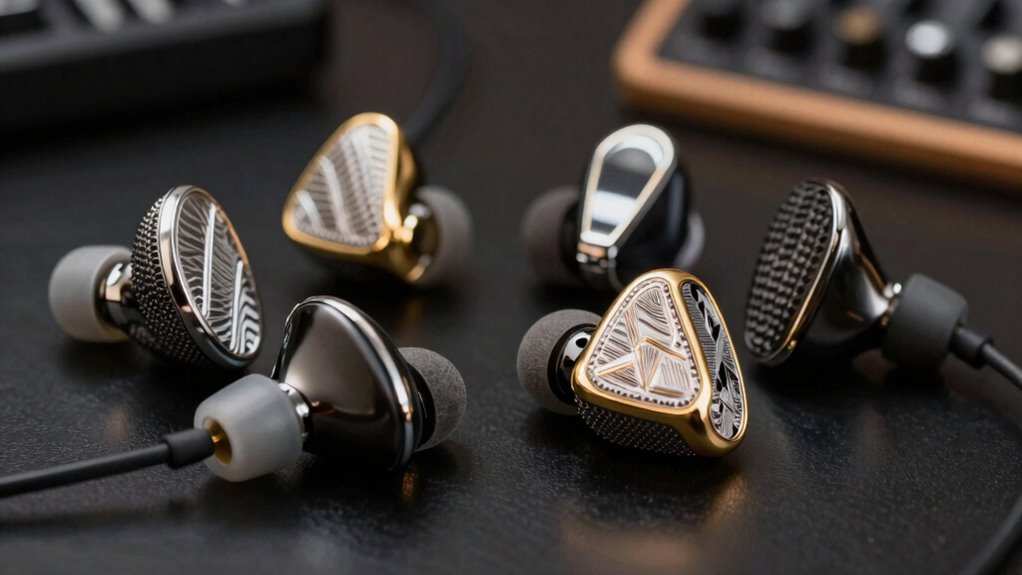

Finding high end in ear monitors for mixing means hunting for one thing above all: neutrality. A flattering pair of earphones will lie to you about your bass levels and mask problems in your upper mids, and those lies only surface once your track leaves the studio. After comparing the current field, two models rise to the top for different reasons. The CrinEar Reference REF5 earns my top spot because its five-driver hybrid architecture and diffuse-field tuning were built specifically for critical evaluation rather than casual enjoyment. The Shure SE425 takes the value crown, pairing dual high-definition drivers with stage-proven durability at a price that undercuts the rest of this lineup. The main tradeoff you will weigh throughout this guide is accuracy versus musicality: the most honest monitors here are rarely the most fun to listen to, and the most luxurious pairs make small compromises in transparency. Cable options, isolation, and fit also separate these five more than their price tags might suggest.

Get audio and creator gear delivered free with Prime
- Fast, free delivery on millions of items
- Prime Video, Amazon Music and more included
- Member-only deals all year
Complete the kit



Key Takeaways
- The CrinEar Reference REF5 is the only pick here tuned to a diffuse-field target, making it the most trustworthy mixing reference of the five.
- The Shure SE425 delivers near-reference clarity for mixing on a budget, but its reinforced cable and pro accessories add stage-oriented bulk.
- The Technics EAH-TZ700 is the most luxurious and fun-sounding option, yet its bass-forward character makes it a secondary check rather than a primary monitor.
- Balanced 4.4mm connections on the CrinEar and Technics models reduce noise when paired with balanced sources, which matters for quiet, detailed mixing.
- The BASN MMCX stands out for sheer accessory value with two upgraded cables, but its elevated bass requires calibration against reference monitors.
| CrinEar Reference Five-Driver Hybrid In-Ear Studio Monitors |  | Best Overall for Mixing | Driver Configuration: 2 dynamic + 3 balanced-armature hybrid | Dynamic Drivers: Dual HODWS woofers | Balanced-Armature Drivers: Dual Sonion midrange + Knowles supertweeter | VIEW ON AMAZON | See Our Full Breakdown |
| Shure SE425 PRO Sound Isolating Wired Earbuds |  | Best Value Reference | Driver Type: Dual high-definition MicroDrivers | Connectivity: 3.5mm detachable cable | Connector: Gold-plated MMCX with lock-snap | VIEW ON AMAZON | See Our Full Breakdown |
| Technics Premium In-Ear Monitors EAH-TZ700 |  | Best Premium Sound | Driver: 10mm dynamic with magnetic fluid | Weight: 7 grams without cables | Finish: Graphite black with gold-plated MMCX | VIEW ON AMAZON | See Our Full Breakdown |
| Shure SE215 PRO Sound Isolating Wired Earbuds |  | Best Entry Point | Sound Isolation: Up to 37 dB | Driver Type: Single dynamic MicroDriver | Cable: Detachable MMCX, 360-degree rotation | VIEW ON AMAZON | See Our Full Breakdown |
| BASN MMCX In-Ear Monitor, Triple Driver, Gold Obsidian |  | Best Accessory Bundle | Drivers: Triple: 2 dynamic + 1 balanced armature | Connector: MMCX detachable | Cable Length: 1.5 meters, 2 cables included | VIEW ON AMAZON | See Our Full Breakdown |
| high end in ear monitors for mixing | Connectivity |
|---|---|
| CrinEar Reference Five-Driver | — |
| Shure SE425 PRO Sound Isolatin | 3.5mm detachable cable |
| Technics Premium In-Ear Monito | Wired MMCX |
| Shure SE215 PRO Sound Isolatin | Wired 3.5mm |
| BASN MMCX In-Ear Monitor | — |
More Details on Our Top Picks
CrinEar Reference Five-Driver Hybrid In-Ear Studio Monitors
This is the pick that most directly answers the question this guide asks. While the other four models are excellent earphones, most of them were tuned with at least one ear on enjoyment. The CrinEar Reference REF5 was tuned for evaluation: its −1.0 dB/octave diffuse-field target is the same philosophy behind calibrated studio references, which means what you hear through it maps predictably to how your mix will translate on speakers, cars, and earbuds downstream. Compared with the Shure SE425, the REF5 reaches deeper and resolves fine detail in the midrange that dual MicroDrivers blur slightly, and its Knowles supertweeter keeps the top octave present without the brittleness that makes long sessions unpleasant.
The hybrid architecture is the structural reason for this. Two HODWS dynamic woofers handle low-frequency duties while dedicated Sonion midrange drivers and a supertweeter cover the range where mixing judgment happens, so no single driver is stretched across conflicting demands. The CNC-machined aluminum shells feel closer to a boutique custom IEM than a universal-fit product, and the modular cable with both 3.5mm and 4.4mm terminations gives you a genuine upgrade path if you later add a balanced headphone amp to your interface chain. The tradeoff is honesty with no sugar coating: this is not the pair for bass-heavy casual listening, and the three-month accessory warranty is stingy given the price. For mixing, though, those flat characteristics are the entire point.
Pros:- Diffuse-field neutral tuning built specifically for critical mixing decisions
- Five-driver hybrid design keeps mids and treble detailed without strain
- Machined aluminum shells feel durable and seal consistently
- Modular cable covers both single-ended and 4.4mm balanced sources
Cons:- Strictly honest tuning will expose flaws in源 material and pleasantries elsewhere
- Accessory warranty of only three months falls short for the price class
Best for: Producers and engineers who want a primary mixing reference with genuinely neutral tuning and balanced-output flexibility.
Not ideal for: Listeners who want one pair for both studio work and enjoyable casual listening with emphasized bass or sparkle.
- Driver Configuration:2 dynamic + 3 balanced-armature hybrid
- Dynamic Drivers:Dual HODWS woofers
- Balanced-Armature Drivers:Dual Sonion midrange + Knowles supertweeter
- Tuning:−1.0 dB/octave diffuse field
- Shell Material:CNC-machined aluminum
- Cable Terminations:3.5mm single-ended and 4.4mm balanced
- Warranty:1 year earphones, 3 months accessories
Our verdict“If mixing accuracy is the job, the REF5 is the tool in this lineup that does the job most directly.”
Shure SE425 PRO Sound Isolating Wired Earbuds
The SE425 sits in a sweet spot the other models circle around but do not occupy: reference-grade midrange honesty at a working-musician price. Its dual high-definition MicroDrivers are tuned flat through the presence region, which is exactly where vocal level decisions, guitar masking, and snare EQ live. Compared with its sibling the SE215, the second driver resolves separation between instruments that the single-dynamic SE215 flattens together, and that separation is what lets you hear masking problems instead of guessing at them. It does not dig as deep or image as precisely as the CrinEar REF5, but it covers maybe eighty percent of that monitor’s mixing utility for noticeably less money.
Where the SE425 pulls ahead of everything here is durability and serviceability. The lock-snap gold-plated MMCX connector, reinforced replaceable cable, and wireform over-ear fit are borrowed from Shure’s stage lineup, so this is a monitor you can throw in a gig bag nightly and still trust for a morning mix session. The passive isolation is strong enough to mix at lower, safer volumes, which protects your ears across long projects. The compromises are real but predictable: bass extension rolls off earlier than the hybrid designs, the thick pro cable feels bulky at a desk, and the accessory loadout includes stage gear you may never touch. For a first serious mixing IEM that will survive years of abuse, nothing else in this lineup matches it.
Pros:- Flat, detailed midrange ideal for level and EQ decisions
- Locking MMCX connector with reinforced replaceable cable
- Strong passive isolation supports safer monitoring volumes
- Cheapest credible mixing reference in this comparison
Cons:- Subbass rolls off earlier than hybrid multi-driver rivals
- Bundled stage accessories and stiff cable add unnecessary bulk for studio-only users
Best for: Engineers and gigging musicians who want trustworthy neutral mids, rugged build, and replaceable parts without boutique pricing.
Not ideal for: Buyers who want deep subbass extension or a lightweight, minimal desk-only cable setup.
- Driver Type:Dual high-definition MicroDrivers
- Connectivity:3.5mm detachable cable
- Connector:Gold-plated MMCX with lock-snap
- Cable:Reinforced, replaceable
- Fit:Over-ear wireform, sleeves in S/M/L
- Included:Carrying case, 1/4-inch adapter, fit kit
Our verdict“The SE425 is the smart money pick: honest enough to mix on, tough enough to tour with.”
Technics Premium In-Ear Monitors EAH-TZ700
The EAH-TZ700 is the luxury statement of this group, and its 10mm magnetic-fluid driver is the reason it sounds unlike anything else here. Magnetic fluid damps driver distortion at the source, producing exceptionally clean highs and a rich, textured low end from a single dynamic driver. In direct comparison with the CrinEar REF5, the Technics is the more seductive listen: bass has more physical weight, treble shimmers, and well-produced material sounds gorgeous. That is simultaneously its strength and its limitation for mixing, because that richness leans musical rather than strictly neutral, and a mix balanced on the TZ700 alone may come out bass-shy elsewhere.
Where it earns a place in a mixing workflow is as a secondary translation check, the same role a good consumer-grade playback system plays in a calibrated room. If your primary reference is the REF5 or SE425, the TZ700 tells you how your mix will feel to listeners who press play on premium consumer gear. Technically it is superbly executed: both balanced and unbalanced cables ship in the box, the four ear tip sizes in round and oval shapes make seal-fitting straightforward, and at seven grams per side it is the lightest wear in this lineup for marathon sessions. The price is the highest consequence, and the wired-only design feels increasingly old-fashioned next to multi-cable modular rivals. Buy it when you want one pair that satisfies audiophile cravings and doubles as a check system, not as your sole mixing truth.
Pros:- Magnetic-fluid driver delivers unusually clean, distortion-free reproduction
- Includes both balanced and unbalanced cables
- Four tip sizes in two shapes make a reliable seal easy to find
- Featherweight 7g-per-side build suits very long sessions
Cons:- Musical, bass-rich character is not neutral enough to be a sole mixing reference
- Highest price in the lineup with wired-only connectivity
Best for: Audio enthusiasts and engineers who want premium single-driver fidelity plus a high-end translation reference alongside a neutral monitor.
Not ideal for: Anyone intending to rely on a single pair as their only mixing reference, or buyers watching their budget.
- Driver:10mm dynamic with magnetic fluid
- Weight:7 grams without cables
- Finish:Graphite black with gold-plated MMCX
- Cables Included:Balanced and unbalanced
- Ear Tips:Four sizes, round and oval
- Connectivity:Wired MMCX
Our verdict“A gorgeous audiophile instrument that belongs in a monitoring chain as a check, not as the judge.”
Shure SE215 PRO Sound Isolating Wired Earbuds
The SE215 is the gateway into serious monitoring, and I include it because plenty of people mixing their first records should not spend REF5 money before they know what neutrality feels like. Its single dynamic MicroDriver produces warm, forgiving sound with enhanced bass, and up to 37 dB of passive isolation lets you work quietly in untreated rooms or shared spaces. Compared with the SE425, the difference is immediately audible in the mids: the SE215 blends instruments together where the SE425 separates them, which means masking problems hide more easily. That is the core tradeoff, and it is an honest one at this price.
What makes the SE215 defensible in a mixing context rather than a casual-listening one is its shared platform with the pro lineup. The detachable 360-degree rotating MMCX cable, over-ear fit, and sleeve fit kit are identical in philosophy to the SE425’s, so it teaches good monitoring habits, and upgrading the cable or tips later is trivial. Isolation is genuinely excellent, among the best passive figures available, which keeps monitoring levels low and mixes less fatigued. The honest caution: its elevated low end will make you under-mix bass if you treat it as gospel, so pair it with reference tracks or studio speakers and cross-check. As a training tool, a mobile editing headphone, or a stage monitor that occasionally mixes, it is the right first step.
Pros:- Up to 37 dB passive isolation for quiet, safe monitoring
- Detachable rotating MMCX cable keeps the pair serviceable
- Secure over-ear fit with multiple sleeve options
- Lowest cost of entry into pro-grade monitoring
Cons:- Enhanced bass response will mislead low-end mixing decisions
- Single driver lacks the midrange separation of the SE425 and REF5
Best for: Beginner producers and podcasters building their first monitoring setup who want isolation, durability, and upgradability cheaply.
Not ideal for: Engineers who need a primary neutral reference, since the boosted bass will skew low-end decisions.
- Sound Isolation:Up to 37 dB
- Driver Type:Single dynamic MicroDriver
- Cable:Detachable MMCX, 360-degree rotation
- Included Sleeves:Flex and foam, S/M/L
- Fit:Over-ear
- Connectivity:Wired 3.5mm
Our verdict“The SE215 buys you into the monitoring ecosystem cheaply, as long as you remember it flatters the bottom end.”
BASN MMCX In-Ear Monitor, Triple Driver, Gold Obsidian
The BASN MMCX plays a different game from the others: instead of competing on driver exoticism, it competes on sheer completeness. Two dynamic drivers and a balanced armature produce a V-shaped-leaning presentation with punchy bass and clear, forward vocals, and the box arrives with two upgraded MMCX cables, nine pairs of silicone tips, and three pairs of memory foam, a bundle that out-equipment anything else here including the Technics. Next to the Shure SE215, it is a clear step up in resolution and frequency reach; next to the SE425, it trades a bit of midrange neutrality for more low-end muscle and a livelier top.
For mixing, that character puts it in a useful but limited role. The triple-driver array genuinely separates sources better than any single-driver option in this guide, so masking and balance problems are audible, yet the elevated bass means you will want a reference track or two nearby to calibrate how hard you are pushing the low end. Where it shines is the hybrid engineer-musician lifestyle: the spare cable means a broken lead never ends a session, memory foam tips give long-wear isolation for stage and studio alike, and the twelve-month warranty covers the whole package rather than carving out accessories as CrinEar does. Fit patience is required, since isolation and bass response both depend on seating the tips properly, and it is wired-only like everything here. For the price, the flexibility is hard to beat.
Pros:- Triple-driver design separates instruments far better than single-driver rivals
- Two upgraded cables plus twelve tip pairs in the box
- Memory foam options extend comfort for long sessions
- Twelve-month warranty covers the full package
Cons:- Bass-forward tuning colors mixing decisions without cross-referencing
- Requires careful tip fitting to achieve rated isolation and balance
Best for: Working musicians who move between stage and a project studio and want maximum included gear with solid detail retrieval.
Not ideal for: Mixing engineers seeking strict neutrality, since the bass emphasis colors low-end judgment.
- Drivers:Triple: 2 dynamic + 1 balanced armature
- Connector:MMCX detachable
- Cable Length:1.5 meters, 2 cables included
- Ear Tips:9 silicone pairs + 3 memory foam pairs
- Color:Gold Obsidian
- Warranty:12 months
Our verdict“A stage-first hybrid that mixes credibly, provided you treat its bass enthusiasm with a reference track.”

How We Picked
Because mixing demands honesty rather than excitement, I evaluated every model here against three questions. First, is the tuning neutral enough to trust? A monitor with boosted lows or scooped mids will systematically skew your EQ and level decisions, so diffuse-field or reference-style tuning counted heavily in my ranking. Second, does the driver architecture cover the full frequency range evenly? Single dynamic drivers, hybrid arrays, and balanced-armature designs each distribute energy differently, and I favored configurations that maintain detail in the mids where mixing decisions live. Third, can the hardware survive daily studio and stage duty? Detachable MMCX cables, robust shells, and included fit kits extended the practical lifespan of each pick. I also weighed connectivity flexibility, since balanced 4.4mm terminations open up cleaner signal paths with compatible interfaces, and I penalized options whose warranty or accessory coverage lagged behind their price. Comfort and isolation factored in as well, because long mixing sessions punish anything that fatigues your ears physically before it fatigues them sonically.
Factors to Consider When Choosing High End In Ear Monitors For Mixing
Choosing between these five comes down to how honest you need your monitors to be, what you will plug them into, and how hard you will use them physically. These are the factors that actually separate the picks above.Tuning Neutrality
The single biggest differentiator in this lineup is tuning philosophy. The CrinEar REF5 targets a diffuse-field curve, the closest an IEM gets to a calibrated studio monitor, which is why it leads for mixing. The Shure SE425 follows with a flat midrange that favors accuracy where most mix decisions occur. The BASN and SE215 both lift the low end for musicality, and the Technics adds richness on both ends. A colored pair is not a bad purchase, but it should be a second or third reference, never your only one.
Driver Architecture
Single dynamic drivers, like those in the SE215 and Technics, offer cohesive sound but limited separation. Balanced-armature and hybrid arrays, as in the SE425, BASN, and REF5, divide the frequency spectrum across dedicated drivers, which produces the instrument separation that reveals masking problems in dense arrangements. If you mix pop, rock, or anything layered, hybrid designs earn their premium.
Cables and Connectivity
Every model here uses detachable MMCX cables, which extends lifespan since cables fail before drivers do. The difference is in what ships in the box: the REF5 and Technics include balanced 4.4mm options that reduce noise and increase headroom with compatible interfaces and amps, while the BASN doubles up on single-ended cables for redundancy. If your audio interface has a balanced output, prioritize a pair that supports it.
Isolation and Comfort
Passive isolation lets you mix at lower volumes, which protects hearing accuracy over long sessions. The SE215’s 37 dB figure leads the pack; foam tips, included with several models here, consistently out-isolate silicone. Weight matters too: the Technics at seven grams per side is the easiest all-day wear, while over-ear wireform fits like the Shures stay put when you move.
Warranty and Serviceability
Check what the warranty actually covers. CrinEar covers earphones for a year but accessories for only three months, while BASN covers everything for twelve. Shure’s replaceable-part ecosystem means cables and tips are cheap to swap indefinitely, which effectively lowers long-term cost of ownership despite higher upfront pricing on some models.
Frequently Asked Questions
Can I mix an entire record on in-ear monitors instead of studio speakers?
Yes, but only with the right pair and the right habits. In-ear monitors like the CrinEar Reference REF5, with its diffuse-field tuning, deliver a level of neutrality that rivals mid-priced studio speakers, and their sealed isolation removes room acoustics from the equation entirely, which is a genuine advantage in untreated spaces. The risk is that IEMs bypass the physical sensation of bass that speakers provide through your body, so low-end level decisions can drift. Most professional workflows use IEMs as the primary tool and cross-check on speakers, headphones, and consumer earbuds before finalizing, which catches translation errors early.
How many drivers do I actually need for mixing?
Driver count matters less than tuning and implementation, but it does affect what you can hear. A single well-designed dynamic driver, like the Technics 10mm unit, can sound superb but tends to blend instruments together in dense arrangements. Dual and multi-driver designs such as the Shure SE425 and CrinEar REF5 assign frequency ranges to dedicated drivers, producing the separation that reveals masking between vocals, guitars, and synths. For critical mixing, a dual-driver minimum is a reasonable floor, and hybrid configurations with dynamic woofers plus balanced-armature mids and highs offer the best coverage of the full spectrum.
Is a balanced 4.4mm cable worth having for studio work?
It can be, depending on your gear. A balanced connection carries the signal on two conductors with inverted polarity, which cancels induced noise and effectively doubles available headroom when your interface or headphone amp supports it. The CrinEar REF5 and Technics EAH-TZ700 both include balanced cables, so you gain the benefit without extra purchase. If your current interface only has a standard 3.5mm output, balanced support is a future-proofing feature rather than an immediate upgrade, and you should not pay a large premium for it alone.
Why is a bass-heavy IEM a problem for mixing if it sounds good?
A bass-boosted monitor flatters your mix by making the low end feel fuller than it actually is, so you compensate by pulling bass out of the mix. The result translates as thin on every other system, which is the classic translation failure. The Shure SE215 and BASN MMCX both have elevated low ends that sound enjoyable but will bias your decisions this way. You can still use them productively by referencing commercial tracks you know well through the same pair and matching their low-end weight, or by reserving them for tracking and casual listening while mixing on a neutral pair like the REF5 or SE425.
Do foam or silicone ear tips make a difference for mixing accuracy?
They make a large and often underestimated difference. A poor seal costs you several dB of bass response, which changes your perception of the low end before any mixing decision is even made. Memory foam tips, included with the BASN and compatible with most models here, expand to fill the ear canal and provide the most consistent seal and isolation. Silicone tips in multiple sizes, as Shure supplies, offer durability and are easier to re-seat quickly. Experiment with all included sizes during a quiet listening session with familiar material, because the tips that measure best on paper are not always the ones that seal best in your ears.
Conclusion
The right choice here depends entirely on how you work. Serious mixing engineers should go straight to the CrinEAR Reference REF5, whose diffuse-field tuning and hybrid driver array make it the only pick I would trust as a primary reference. Value-driven buyers and gigging musicians get the most from the Shure SE425, which pairs honest mids with the toughest build in the group. Audio enthusiasts who also mix will love the Technics EAH-TZ700, provided they treat its rich presentation as a translation check rather than gospel. Beginners should start with the Shure SE215, learn what isolation and a sealed fit feel like, and accept its bass flattery with reference tracks. Finally, musician-producers splitting time between stage and studio get the best bundle-per-dollar from the BASN MMCX, as long as they calibrate its low end against something neutral. Whatever you choose, remember that a monitoring chain is a system: one neutral pair plus one colored pair will serve you better than any single option bought twice over.