The Zoom H4 Essential is my best overall handheld audio recorder for live shows because it balances straightforward stereo recording with added input flexibility. For a compact, simple setup, the Zoom H1 Essential is easier to carry, while the Zoom H6 Essential suits performers who need more tracks and connections. The main choice is between a recorder that captures the room quickly and one that can also take feeds from a mixer or multiple sources. Input count, handling noise, loud-stage headroom, and setup time matter as much as headline recording features. Read on for how all eight options differ and which one best fits your shows.

Get audio and creator gear delivered free with Prime
- Fast, free delivery on millions of items
- Prime Video, Amazon Music and more included
- Member-only deals all year
Complete the kit



Key Takeaways
- The H4 Essential is the most balanced pick: It offers more live-show flexibility than the compact H1 models without the larger multitrack setup of the H6.
- The H1 Essential and H1 Essential Bundle serve different priorities: The recorder is the simpler carry; the bundle adds practical accessories for managing wind and positioning.
- More tracks help only when the show needs them: The H5 and H6 make more sense when recording separate sources, while a stereo room capture may not benefit from the added setup.
- The Zoom F3 prioritizes dependable external-source recording: It is a field-recorder-style choice for users who value input-based capture over an all-in-one handheld mic setup.
- The H2 Essential and Xvive XV1-R offer distinct stereo approaches: The H2 is a dedicated handheld recorder option, while the XV1-R adds 32-bit float recording and USB microphone use.
| Xvive XV1-R Portable Stereo Audio Recorder with 32-Bit Float, X/Y Microphones, WAV/AAC Format, USB Microphone, Auto Record, for Musicians, Podcasters, Filmmakers |  | Best for Simple Stereo Capture | Microphones: Built-in X/Y stereo microphones | Recording format: WAV and AAC | Recording: 32-bit float | VIEW ON AMAZON | See Our Full Breakdown |
| Zoom H1 Essential Recorder Bundle with Case, Windscreens & Tripod |  | Best Ready-to-Go Bundle | Microphones: Built-in X/Y microphone | Recording: 32-bit float | Recording format: WAV | VIEW ON AMAZON | See Our Full Breakdown |
| Zoom H4 Essential Handheld Recorder for Musicians, Podcasters & Filmmakers |  | Best for Recording Multiple Stage Sources | Tracks: 4 | Inputs: Two XLR/TRS | Built-in microphones: Stereo microphones | VIEW ON AMAZON | See Our Full Breakdown |
| Zoom F3 Professional Field Recorder for Filmmakers & Musicians |  | Best for XLR Stage Feeds | Channels: 2 | Inputs: Two XLR/TRS | Recording format: WAV | VIEW ON AMAZON | See Our Full Breakdown |
| Zoom H2 Essential Handheld Recorder for Musicians, Podcasters & Filmmakers |  | Best for Flexible Microphone Placement | Microphones: Three built-in microphones | Recording patterns: Nine | Recording format: WAV | VIEW ON AMAZON | See Our Full Breakdown |
| Zoom H1 Essential Recorder for Musicians, Podcasters & Content Creators |  | Best for Simple, Lightweight Recording | Microphone configuration: Built-in X/Y microphones | Recording format: WAV | Recording mode: 32-bit float | VIEW ON AMAZON | See Our Full Breakdown |
| Zoom H5 4-Track Handheld Recorder for Filmmakers & Musicians |  | Best for External Mics and Expandability | Recording tracks: Four-track simultaneous recording | Inputs: Two XLR/TRS combo inputs | Phantom power: Yes | VIEW ON AMAZON | See Our Full Breakdown |
| Zoom H6 Essential Handheld Recorder for Musicians, Podcasters & Filmmakers |  | Best for Multisource Live Recording | Recording tracks: Six-track, 32-bit float recording | Inputs: Four XLR/TRS inputs | Microphone system: Interchangeable mic capsules | VIEW ON AMAZON | See Our Full Breakdown |
| handheld audio recorder for live show | Recording format | Headphone jack | Inputs | Weight |
|---|---|---|---|---|
| Xvive XV1-R Portable Stereo Au | WAV and AAC | — | — | — |
| Zoom H1 Essential Recorder Bun | WAV | 3.5 mm | — | — |
| Zoom H4 Essential Handheld Rec | — | — | Two XLR/TRS | — |
| Zoom F3 Professional Field Rec | WAV | — | Two XLR/TRS | 8.48 ounces |
| Zoom H2 Essential Handheld Rec | WAV | 3.5 mm | — | — |
| Zoom H1 Essential Recorder for | WAV | 3.5 mm | — | 92 g |
| Zoom H5 4-Track Handheld Recor | WAV | — | Two XLR/TRS combo inputs | 115 g |
| Zoom H6 Essential Handheld Rec | — | 3.5 mm | Four XLR/TRS inputs | 450 g |
More Details on Our Top Picks
Xvive XV1-R Portable Stereo Audio Recorder with 32-Bit Float, X/Y Microphones, WAV/AAC Format, USB Microphone, Auto Record, for Musicians, Podcasters, Filmmakers
The Xvive XV1-R is a straightforward choice for recording a live show from the audience when you want built-in stereo microphones and 32-bit float capture without managing external mics. Its X/Y pair is specified to handle levels up to 130 dB, giving it a useful margin for loud performances. Compared with the Zoom H2 Essential, it offers a simpler stereo approach rather than multiple microphone patterns and surround options. That makes setup easier, but gives you less flexibility when the room or placement calls for a different pickup pattern. The listed 12-hour battery life suits a typical show, and USB microphone mode adds a second use. The main live-recording compromise is the missing headphone jack: you cannot monitor the recording directly from the unit.
Pros:- 32-bit float recording reduces the need to set precise recording levels before a show.
- Built-in X/Y microphones are specified to handle sound levels up to 130 dB.
- Up to 12 hours of recording suits a full performance or extended event.
- USB microphone functionality lets it serve as a computer, tablet, or smartphone input.
Cons:- No headphone jack for checking placement or monitoring a recording.
- Requires two AA batteries, so spare cells may be needed for longer outings.
- The 128 GB storage limit is less flexible than the H2 Essential’s support for SD cards up to 2 TB.
Best for: Concertgoers and musicians who want a compact, built-in stereo recorder for loud shows and do not need to monitor through headphones.
Not ideal for: Performers who need live headphone monitoring or buyers who want several microphone patterns for adapting to different stage and room layouts.
- Microphones:Built-in X/Y stereo microphones
- Recording format:WAV and AAC
- Recording:32-bit float
- Maximum sound pressure level:130 dB
- Storage capacity:128 GB
- Battery:Two AA batteries
- Listed battery life:Up to 12 hours
- Display:1.7 inches
- USB interface:USB Type-C
Our verdict“Choose the XV1-R for uncomplicated, loud-show stereo recording, but pick the H2 Essential if you need more pickup patterns or headphone monitoring.”
Zoom H1 Essential Recorder Bundle with Case, Windscreens & Tripod
The Zoom H1 Essential bundle suits buyers who want a small stereo recorder and the basic accessories to carry and place it at a show. Its 32-bit float recording helps accommodate a performance that gets louder than expected, while the included case, foam and furry windscreens, and flexible tripod support transport and varied placement. Compared with the Xvive XV1-R, this bundle includes a headphone jack for direct checks, a meaningful advantage when setting the recorder near a stage or in a windy outdoor venue. It remains a stereo-only option, though, and its compact 0.96-inch screen offers less room for detailed settings. Buyers wanting multichannel stage inputs should step up to the Zoom H4; this H1 is built for a simpler audience recording setup.
Pros:- 32-bit float recording helps handle changes in performance volume without precise gain setting.
- The included case, windscreens, and flexible tripod make transport and basic placement easier.
- A 3.5 mm headphone jack allows direct monitoring, unlike the Xvive XV1-R.
- USB-C and 3.5 mm connections support use with computers, cameras, and smartphones.
Cons:- Stereo-only recording cannot separate individual instruments or microphones after the show.
- The 0.96-inch screen is small for reviewing settings and recording status.
- Requires two AAA batteries, adding a separate power supply to manage.
Best for: Concertgoers and beginner recordists who want an easy-to-carry stereo recorder with windscreens, a case, and a tripod included.
Not ideal for: Bands recording separate stage sources, or users who need multitrack inputs and more detailed control than a compact stereo recorder provides.
- Microphones:Built-in X/Y microphone
- Recording:32-bit float
- Recording format:WAV
- Connections:3.5 mm audio and USB Type-C
- Headphone jack:3.5 mm
- Power:Two AAA batteries
- Screen:0.96 inches
- Dimensions:5.38 × 2.12 × 1.14 inches
- Included accessories:EVA case, furry and foam windscreens, flexible tripod
Our verdict“Pick this bundle for a portable stereo setup with useful accessories included, and choose the Zoom H4 if you need inputs for separate stage sources.”
Zoom H4 Essential Handheld Recorder for Musicians, Podcasters & Filmmakers
For a live show where one stereo audience capture is not enough, the Zoom H4 Essential brings two XLR/TRS inputs and four-track recording to a handheld format. That lets a musician or small production team combine the built-in stereo microphones with external sources, such as a feed from a mixer, rather than relying solely on room sound. Compared with the simpler Zoom H1 Essential bundle, the H4 offers a more involved recording setup and greater source separation, but it also asks more of the operator. Its SD-card recording and USB-C connection suit a flexible workflow, while spoken menu guidance may help with operation. The product information does not specify 32-bit float recording, so buyers seeking that particular safeguard should compare the H4 carefully with the H1 Essential or F3. Extended use may also require external power.
Pros:- Two XLR/TRS inputs allow connection of external microphones or compatible audio sources.
- Four-track capability can combine built-in stereo ambience with additional inputs.
- Records to an SD card and connects by USB-C for flexible file handling.
- Spoken menu guidance can help users work through settings.
Cons:- More inputs and track options make operation less simple than the H1 Essential.
- The supplied product details do not confirm 32-bit float recording.
- Extended recording may require external power.
Best for: Musicians and small live-sound crews who want built-in room microphones plus two external inputs to capture separate stage or mixer feeds.
Not ideal for: Beginners seeking a minimal point-and-record setup, or buyers who need confirmed 32-bit float capture and long sessions without external power.
- Tracks:4
- Inputs:Two XLR/TRS
- Built-in microphones:Stereo microphones
- Recording media:SD card
- Connectivity:USB-C
- Recording options:Dual recording to device and SD card
- Menu guidance:Spoken menu guidance
Our verdict“Choose the H4 when you need external stage or mixer feeds alongside room sound, but favor the H1 Essential for a simpler stereo audience recording.”
Zoom F3 Professional Field Recorder for Filmmakers & Musicians
The Zoom F3 is the specialist pick here for capturing a live show’s direct feeds through external microphones or a mixer. Its dual locking XLR/TRS inputs help keep connections secure in a busy rig, while 32-bit float recording and low-noise preamps suit performances with wide volume swings. Unlike the handheld Zoom H4 Essential, the F3 is built around two external inputs rather than combining those inputs with built-in stereo microphones. That makes it a stronger fit for a planned stage or board-feed setup, but less convenient for quick audience recording without extra microphones. It supports up to 512 GB of storage and lists long recording times, although the compact unit still relies on two AA batteries. Buyers should also note the lack of built-in Wi-Fi or Bluetooth remote control.
Pros:- 32-bit float recording helps accommodate unpredictable performance peaks.
- Two locking XLR/TRS inputs provide secure connections in a live rig.
- Low-noise preamps support clean capture from external sources.
- Supports up to 512 GB of storage and lists up to 73 hours of recording time.
Cons:- No built-in microphones, so audience recording requires separate microphones or a feed.
- No built-in Wi-Fi or Bluetooth remote control.
- Requires two AA batteries, which may need replacing during extended use.
Best for: Live engineers and musicians recording two XLR stage microphones or mixer feeds who value secure connections and high-headroom capture.
Not ideal for: Concertgoers who want an all-in-one audience recorder with built-in microphones, or operators who need wireless remote control.
- Channels:2
- Inputs:Two XLR/TRS
- Recording format:WAV
- Recording:32-bit float
- Storage capacity:Up to 512 GB
- Battery:Two AA batteries
- Listed recording time:Up to 73 hours
- Dimensions:3.04 × 2.95 × 1.88 inches
- Weight:8.48 ounces
Our verdict“Choose the F3 for dependable two-input XLR capture from a stage or mixer, and choose the H4 if you also need built-in stereo microphones.”
Zoom H2 Essential Handheld Recorder for Musicians, Podcasters & Filmmakers
The Zoom H2 Essential gives live-show recordists more ways to capture a room than a conventional X/Y handheld. Its three built-in microphones and nine recording patterns let you choose among mono, stereo, and surround approaches, which can help when recording a band from different audience positions. It also combines 32-bit float recording with 96 kHz WAV capture, a headphone jack, and SD-card support up to 2 TB. Compared with the Xvive XV1-R, the H2 is more adaptable and offers direct monitoring, but its additional patterns mean more setup choices before the show. It can also act as a USB microphone while recording to SD, and Bluetooth is listed for control and sync. The tradeoff is AA-battery power, with batteries not included, and limited supplied detail about build durability.
Pros:- Three built-in microphones and nine patterns offer more placement flexibility than the XV1-R’s stereo approach.
- 32-bit float and 96 kHz WAV recording support high-resolution capture across changing performance levels.
- A 3.5 mm headphone jack allows direct checks during setup.
- Supports SD cards up to 2 TB and can function as a USB microphone.
Cons:- The range of recording patterns adds setup decisions compared with a basic stereo recorder.
- Requires two AA batteries, which are not included.
- Supplied product details give limited information about durability and build quality.
Best for: Musicians and field recordists who want to experiment with different audience-room pickup patterns and need headphone monitoring.
Not ideal for: Buyers who want the simplest possible stereo setup, or anyone needing XLR inputs for direct stage microphones and mixer feeds.
- Microphones:Three built-in microphones
- Recording patterns:Nine
- Recording format:WAV
- Recording quality:32-bit float, up to 96 kHz
- Recording modes:Mono, stereo, and surround
- Storage:SD card, up to 2 TB
- Battery:Two AA batteries
- Listed battery life:Approximately 20 hours
- Headphone jack:3.5 mm
Our verdict“Choose the H2 Essential if adaptable room capture and headphone monitoring matter more than a quick, fixed stereo setup.”
Zoom H1 Essential Recorder for Musicians, Podcasters & Content Creators
The Zoom H1 Essential is the simplest fit here for capturing a live show without carrying a larger multitrack setup. Its built-in X/Y microphones record stereo sound, while 32-bit float recording gives you more room to handle sudden volume changes than a basic fixed-level recording approach. Spoken menu guidance can also help newer users get recording without first learning a complicated interface. Compared with the Zoom H5, the H1 Essential is lighter and easier to manage, but it lacks XLR inputs for connecting external stage microphones. USB-C lets it work as a microphone with compatible devices, though it has no wireless connectivity. Choose it for a compact audience or rehearsal recording; skip it if you need multiple isolated sources or extensive input options.
Pros:- Built-in X/Y microphones capture a stereo image without extra mic gear
- 32-bit float recording accommodates changing performance levels
- Spoken menu guidance can make setup easier for beginners
- Compact 92 g body and USB-C microphone function suit portable workflows
Cons:- No XLR inputs for direct feeds from a mixer or external microphones
- Requires two AAA batteries rather than a built-in rechargeable battery
- No Wi-Fi or Bluetooth for wireless control or transfers
Best for: Solo musicians and first-time live-show recordists who want a lightweight stereo recorder with straightforward controls.
Not ideal for: Bands or sound operators who need XLR connections, multiple isolated tracks, or wireless file transfer.
- Microphone configuration:Built-in X/Y microphones
- Recording format:WAV
- Recording mode:32-bit float
- USB interface:USB-C
- Storage:SD card, up to 1 TB
- Headphone jack:3.5 mm
- Power:Two AAA batteries
- Weight:92 g
Our verdict“Choose the H1 Essential for lightweight, self-contained stereo capture, but pick the H5 if a live setup needs external inputs and more track flexibility.”
Zoom H5 4-Track Handheld Recorder for Filmmakers & Musicians
The Zoom H5 makes the most sense when a live recording needs more than the recorder’s built-in stereo microphones. Its two XLR/TRS inputs with phantom power can take feeds from microphones or compatible stage gear, and the interchangeable capsule system offers a different way to adapt than the H1 Essential, which is built around simpler stereo capture. Four-track recording lets you keep input sources separate for more control later, while USB interface operation adds studio and computer workflows. The tradeoff is an older, more involved control experience, so it is less appealing for someone who wants to press record and keep the setup minimal. Its stated SD/SDHC limit of 32 GB also offers less storage headroom than the H1 Essential’s listed capacity.
Pros:- Two XLR/TRS combo inputs support external microphones and compatible mixer feeds
- Phantom power supports condenser microphones
- Interchangeable capsules adapt the recorder to different capture setups
- Four-track recording and USB interface operation add workflow flexibility
Cons:- SD/SDHC storage is specified up to 32 GB
- Interface can take time to learn compared with the H1 Essential
- Two AA batteries may need replacement during longer recording days
Best for: Gigging musicians, small-venue recordists, and filmmakers who need two external mic or mixer inputs alongside a stereo capsule.
Not ideal for: Beginners seeking the simplest pocket recorder, or users who need large-card capacity and a low-complexity interface.
- Recording tracks:Four-track simultaneous recording
- Inputs:Two XLR/TRS combo inputs
- Phantom power:Yes
- Input capsule system:Interchangeable, including detachable X/Y capsule
- Recording format:WAV
- Storage:SD/SDHC cards up to 32 GB
- Battery life:Up to 10 hours
- Weight:115 g
Our verdict“Pick the H5 when external inputs and source separation matter more than the H1 Essential’s simpler operation and lighter build.”
Zoom H6 Essential Handheld Recorder for Musicians, Podcasters & Filmmakers
For a live show with several sources to capture, the Zoom H6 Essential offers the broadest input setup in this group: four XLR/TRS inputs, interchangeable mic capsules, and six-track 32-bit float recording. That gives an engineer room to record a stereo stage image alongside separate feeds, a major step up from the H5 and its two combo inputs. Its USB audio-interface function can also carry the recording workflow into a computer-based setup. The price of that flexibility is physical size: at 450 g and requiring four AAA batteries, it is less convenient to carry or hold for a full set than the 92 g H1 Essential. Its feature-rich operation may also be more than a solo recorder needs. Choose it when source control matters more than minimal bulk.
Pros:- Four XLR/TRS inputs accommodate several external sources at once
- Six-track 32-bit float recording provides flexible capture for changing live levels
- Interchangeable mic capsules add options beyond the built-in inputs
- USB audio-interface function supports computer-based recording workflows
Cons:- At 450 g, it is substantially heavier than the H1 Essential for handheld use
- Four AAA batteries add weight and require more battery planning
- More inputs and functions can make operation less direct for beginners
Best for: Live sound operators and bands recording multiple microphones or mixer feeds who want separate tracks for later editing.
Not ideal for: Solo gig-goers and travelers who prioritize a pocketable recorder, simple stereo capture, and fewer batteries.
- Recording tracks:Six-track, 32-bit float recording
- Inputs:Four XLR/TRS inputs
- Microphone system:Interchangeable mic capsules
- USB function:USB audio interface
- Headphone jack:3.5 mm
- Battery life:Up to 18 hours
- Power:Four AAA batteries
- Weight:450 g
Our verdict“Choose the H6 Essential for multi-source live recordings and separate-track editing, but opt for the H1 Essential if portability and simplicity lead.”
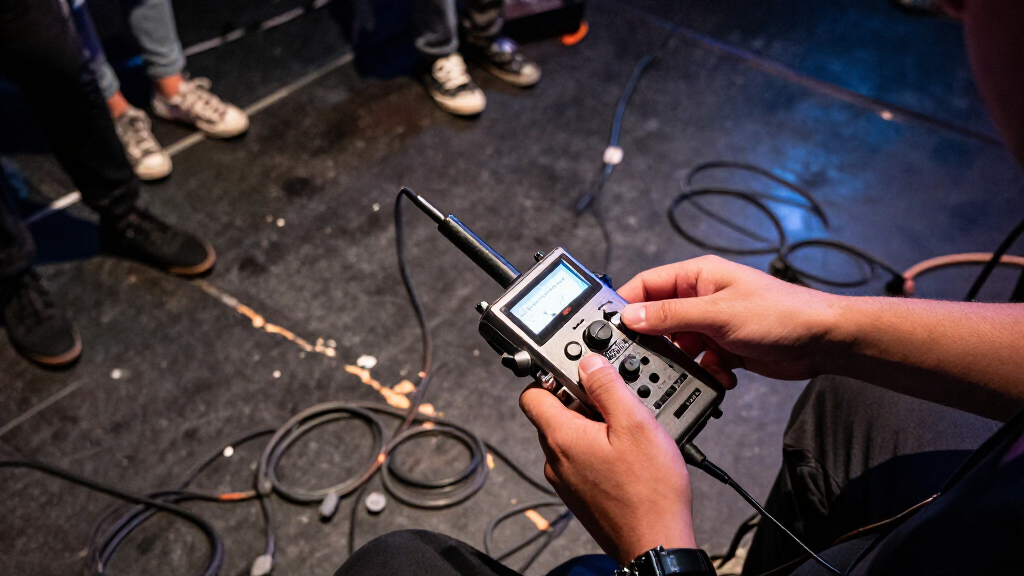
How We Picked
I ranked these recorders for the realities of live shows: unpredictable volume, limited setup time, loud crowds, and the need to get a usable recording without interrupting the performance. I weighed built-in microphone practicality, available inputs and tracks, recording format flexibility, portability, and how readily each model can fit a simple room-capture or more involved feed-based setup. I also looked at the value of included accessories where they change readiness for a show.
The ranking favors useful capability without adding unnecessary complexity. The H4 Essential leads as a balanced choice; compact H1 models rank well for uncomplicated capture, while the H5 and H6 move up for multitrack needs. The F3 is ranked for buyers building around external sources, not as a direct substitute for an all-in-one handheld recorder. The Xvive XV1-R stands out for its 32-bit float and USB role, while the H2 Essential offers a different dedicated stereo option. No single feature guarantees a clean recording: microphone placement, input level, and the room still matter.
| handheld audio recorder for live show | Recording format | Inputs |
|---|---|---|
| Xvive XV1-R Portable Stereo Au | WAV and AAC | — |
| Zoom H1 Essential Recorder Bun | WAV | — |
| Zoom H4 Essential Handheld Rec | — | Two XLR/TRS |
| Zoom F3 Professional Field Rec | WAV | Two XLR/TRS |
| Zoom H2 Essential Handheld Rec | WAV | — |
| Zoom H1 Essential Recorder for | WAV | — |
| Zoom H5 4-Track Handheld Recor | WAV | Two XLR/TRS combo inputs |
| Zoom H6 Essential Handheld Rec | — | Four XLR/TRS inputs |
Factors to Consider When Choosing Handheld Audio Recorder For Live Shows
Before choosing a recorder, decide what you want the finished recording to contain. A room recording, a mixer feed, and isolated instrument or vocal tracks place different demands on the device. These broader checks can prevent paying for connections you will not use—or arriving at a show without the setup your recording plan requires.
Decide Between Room Sound and a Mixer Feed
A built-in stereo microphone captures the performance and the room together, which can preserve crowd energy but also pick up chatter and reverberation. A feed from the venue mixer may give you clearer vocals and instruments, yet it can sound dry or unbalanced without audience ambience. Some shows call for both sources, which means planning how to record and later combine them. Ask the venue what outputs are available and whether they can provide a feed before buying around that assumption. A common mistake is treating any mixer output as a ready-made recording mix; the sound engineer may be mixing for the room, not your recorder. Choose an approach that matches the result you want, rather than assuming one capture method will suit every venue.
Match Track Count to the Job
More tracks are useful when you need separate control over several microphones or instrument feeds, but they also add routing and setup decisions. For a single stereo recording, extra tracks may sit unused while making the recorder less convenient to operate. Count the sources you genuinely need to isolate, then leave room for a backup or ambience track if the show warrants it. Check whether the recorder’s inputs accept the connections your sources provide; track count alone does not tell you that. Avoid buying a multitrack model just because a band has several performers if you will record only a stereo mix. The simpler setup is often the one you can deploy consistently in a dark, busy venue.
Treat 32-Bit Float as a Safety Net, Not a Sound Fix
32-bit float recording can offer more flexibility when adjusting recorded levels later, which may help when stage volume changes unexpectedly. It does not remove room noise, clipping in every part of the signal chain, poor microphone placement, or distortion from a source before it reaches the recorder. You still need to check connections and monitor what you can before the performance starts. If you record a mixer feed, ask about the feed level and avoid assuming the format can repair a bad signal. A recorder without this feature can still make a strong live recording when its levels are set sensibly. Give this feature extra weight when level uncertainty is your main concern, not as a substitute for setup.
Plan for Placement, Wind, and Handling Noise
Where the recorder sits can change the result more than a small feature difference between models. A stand near the audience may capture a lively balance, while a position beside a speaker can overemphasize one source or expose the microphone to high sound pressure. Handling the unit during a take can add noise, so plan to place it securely before the show begins. Windscreens are useful outdoors or near moving air, but they do not solve every problem caused by crowd movement or a poor location. Check whether a bundle includes accessories that suit your setup, then verify that the mount or tripod can be positioned safely. A few minutes of placement planning can matter more than choosing the recorder with the longest feature list.
Check Power, Storage, and File Workflow
A live recording cannot be repeated on demand, so think through power and storage before the doors open. Estimate the length of the set, leave capacity for sound checks and extra takes, and bring spare power options that match the recorder. Confirm the file format and transfer method work with your editing setup; a recordable file is only useful if you can move and manage it afterward. Larger multitrack sessions can use storage faster than a simple stereo capture, so plan for the actual number of channels and recording duration. Do not rely on a single untested memory card or a phone connection you have not tried. A basic pre-show checklist reduces avoidable interruptions better than last-minute menu changes.
Pay for Flexibility You Will Use
Spending more can make sense when you need additional inputs, separate tracks, or a recorder that fits a repeatable production workflow. It is harder to justify extra complexity for occasional room recordings that need only a stereo file. Consider how often you record, how many sources recur across shows, and whether you already own microphones, cables, and stands that change the recorder’s usefulness. A bundled kit can be a better fit when its accessories solve real setup needs, but included items should not outweigh the recorder’s core capabilities. Beginners often benefit more from a manageable workflow than from the maximum number of options. Choose the least complicated model that covers the sources and recording method you expect to use.
Frequently Asked Questions
Can I record a live show with only the recorder’s built-in microphones?
Yes, if your goal is a stereo capture of the performance and surrounding room sound. Placement becomes the main variable: too close to a speaker can make the mix uneven, while a position far from the stage may emphasize crowd noise and reverberation. Use a stable stand or secure location and avoid moving the recorder once recording begins. Built-in microphones are convenient, but they cannot isolate individual instruments after the show. If you need separate control over vocals or instruments, plan for external inputs or a mixer feed instead.
Should I choose a multitrack recorder if I only record bands?
Not automatically. A band recording can be captured as a stereo room mix or a single stereo output from the venue console, neither of which requires many separate tracks. Multitrack recording helps when you can obtain distinct sources and want to adjust their balance later. It also requires more cables, routing decisions, and time to check the setup. If you are unsure whether the venue can provide isolated outputs, ask before choosing a recorder around that plan. Otherwise, a simpler stereo-focused workflow may be the more dependable fit.
Does 32-bit float mean I do not need to set recording levels?
No. It can give you greater flexibility when adjusting levels in post, but it cannot improve a noisy room or repair a poor microphone position. It also cannot correct distortion that occurs before the signal is recorded, such as an overloaded source or faulty connection. Make a test recording when possible and listen back through headphones. Keep the signal path and placement in mind, especially when taking a feed from a venue mixer. Treat 32-bit float as added protection against level uncertainty, not a replacement for checking the setup.
Is a mixer feed always better than recording the room?
No. A mixer feed may provide clearer vocals and instruments, but it can leave out the audience and the natural blend of the venue. The house mix may also be shaped for speakers in the room rather than for a recording. A room microphone captures atmosphere, although it may include noise and reverberation. If you have the connections and a workable plan, recording both can give you more editing choices. Ask the sound engineer what outputs are available and whether the feed is appropriate for recording before the show.
What should I check before bringing a recorder to a venue?
Confirm permission to record, the venue’s rules, and whether the sound engineer can provide a feed if you want one. Check cable compatibility, power, storage capacity, and the recorder’s recording format before leaving home. At the venue, find a safe placement away from walkways and test the signal before the performance. Make sure the recorder is not relying on a connection or accessory you have not tried before. A short checklist and a backup power or storage plan can prevent technical problems from taking attention away from the show.
Conclusion
For most buyers, I would start with the Zoom H4 Essential: it is my best overall choice for balancing straightforward capture with room to take on more involved recording. The Zoom H1 Essential is my best value and best beginner pick when portability and a simpler stereo workflow matter most; choose the Bundle if its windscreens and tripod suit your setup. For premium multitrack flexibility, look at the Zoom H6 Essential, with the H5 as a more restrained step toward separate-source recording. The Zoom F3 is my pick for external-source-focused setups, while the H2 Essential suits buyers seeking a dedicated handheld stereo option. Choose the Xvive XV1-R if 32-bit float capture and USB microphone use fit your recording and computer workflow. The right choice is the one that matches your source plan, not simply the one with the most inputs.
Halloween Picks
halloween
As an affiliate, we earn on qualifying purchases.