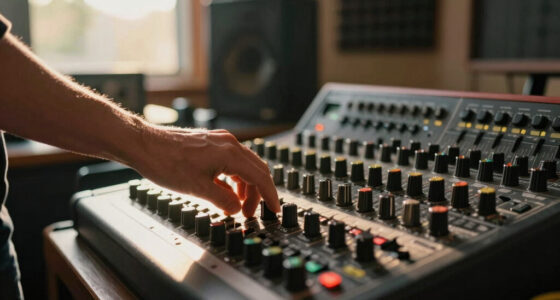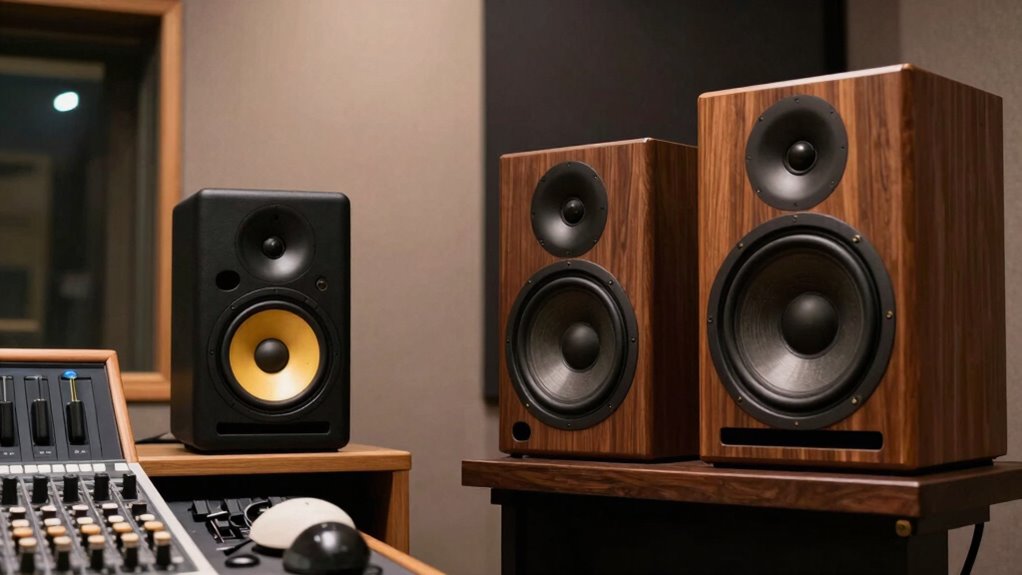

Nearfield monitors are designed to be placed within 3 feet, ideal for small spaces, focusing on direct sound with minimal room influence. Midfield monitors sit about 3 to 6 feet away, suited for larger rooms, but rely heavily on proper room treatment to perform well. You’ll get clearer sound from nearfield monitors with less acoustic adjustment, while midfield monitors provide broader coverage but need more room management. Want to understand which fits your setup best? Keep exploring to find out.

Get audio and creator gear delivered free with Prime
- Fast, free delivery on millions of items
- Prime Video, Amazon Music and more included
- Member-only deals all year
Key Takeaways
- Nearfield monitors are placed within 3 feet, emphasizing direct sound with minimal room influence, ideal for small spaces.
- Midfield monitors are positioned 3-6 feet away, suited for larger rooms, requiring careful room treatment for accurate sound.
- Nearfield monitors focus on clarity and detail by reducing room reflections, while midfield monitors provide a balanced sound across a broader area.
- Proper placement and acoustic treatment are more critical for midfield monitors to prevent sound distortion and resonance issues.
- Nearfield monitors are more practical for home studios, whereas midfield monitors are better for filling larger environments with sound.

When choosing studio monitors, understanding the differences between nearfield and midfield monitors is essential for achieving the best sound quality in your space. Your room acoustics and speaker placement play critical roles in how well your monitors perform, so knowing which type suits your environment is key. Nearfield monitors are designed to be placed close to your ears, typically within 3 feet, minimizing the influence of room acoustics on your listening experience. Because they’re used at such a close range, you can position them for ideal sound without worrying too much about reflections and room resonances. This direct sound approach makes them perfect for smaller spaces, home studios, or setups where you want direct sound with minimal interference. When you position nearfield monitors properly—placing them at ear level and forming an equilateral triangle—you guarantee that sound arrives directly to your ears with clarity and detail. Additionally, nearfield monitors reduce the need for extensive room treatments, making them a practical choice for many users. Proper placement and acoustic environment also enhance their performance, ensuring a more accurate listening experience.
Midfield monitors are larger and intended for placement farther from your listening position, usually around 3 to 6 feet away. They’re designed to fill bigger rooms and provide a more balanced sound across a wider listening area. However, their performance heavily depends on how well you manage your room acoustics. Sound reflections, standing waves, and resonances can all distort the audio if your room isn’t treated properly. Speaker placement becomes even more important here; you need to position midfield monitors carefully to avoid bass buildup or dead spots. Properly treating your room—adding bass traps, diffusers, and absorbers—can make a significant difference in how midfield monitors sound, ensuring that you get a true representation of your mix. Additionally, room acoustics can significantly influence the accuracy of your monitoring setup, especially with larger speakers. Being aware of the room’s influence helps in making informed decisions about placement and treatment, which is crucial for achieving consistent results.
As an affiliate, we earn on qualifying purchases.
Frequently Asked Questions
How Do Room Acoustics Influence Monitor Selection?
Room acoustics considerably influence your monitor choice because untreated spaces can distort sound. You need proper room treatment to reduce reflections and standing waves, ensuring accurate monitoring. Acoustic calibration helps fine-tune your system to your space, making your monitor selection more effective. Nearfield monitors are ideal for small, treated rooms, while midfield monitors suit larger, acoustically optimized spaces. Adjusting for your room’s acoustics helps you achieve clearer, more precise sound.
Can Monitors Be Used for Both Mixing and Mastering?
Yes, monitors can be used for both mixing and mastering, but proper studio placement and monitor calibration are vital. You need to position your monitors carefully to minimize room reflections and guarantee accurate sound. Regular calibration helps achieve a flat frequency response, essential for detailed listening during critical tasks like mastering. While some monitors excel at both, investing in high-quality, well-calibrated monitors enhances your ability to produce professional results across both stages.
What’s the Typical Lifespan of Nearfield and Midfield Monitors?
Your nearfield and midfield monitors can last around 5 to 10 years if you’re mindful. Think of them as reliable companions on your sonic journey—speaker placement and power requirements influence their longevity. Proper placement prevents undue strain, while matching power needs avoids damage. With regular care, these monitors stay sharp, ensuring your mixes sound pristine for years, much like a trusted friend, ready to serve your creative visions.
Are There Specific Genres Better Suited for One Type?
You’ll find that genre specialization influences which monitors work best. Nearfield monitors excel for detailed, nuanced mixing in genres like acoustic, classical, or vocal-driven music because of their close proximity. Midfield monitors suit larger, more expansive genres like rock, electronic, or film scoring, where monitor customization helps balance sound across a broader space. Choosing the right monitor type depends on your genre focus and how you customize your setup for maximum accuracy.
How Significant Is Budget When Choosing Between Nearfield and Midfield Monitors?
Budget constraints greatly influence your choice between nearfield and midfield monitors, as monitor affordability varies widely. If you’re working with a tight budget, nearfield monitors usually offer a more cost-effective solution without sacrificing quality for small to medium spaces. Midfield monitors tend to be pricier but provide broader sound coverage for larger studios. Weigh your needs and budget carefully to guarantee you select monitors that deliver the best performance within your financial limits.
Conclusion
So, now you know the truth—nearfield and midfield monitors aren’t just different; they’re like night and day in your studio! Choosing the wrong one could turn your mixes into a chaotic symphony or a bland whisper. Get it right, and you’ll be dancing with perfection, feeling like the mixing wizard you’re destined to be. Don’t settle for less—your sound deserves the ultimate monitor showdown!
Halloween Picks
halloween
As an affiliate, we earn on qualifying purchases.