
Understanding subdivision and groove helps you shape your timing and feel in music. Straight rhythm divides beats into equal parts, creating a steady, precise pulse ideal for rock and pop. Swing adds a relaxed, bouncy feel by delaying the offbeat, common in jazz and blues. Shuffle emphasizes a hypnotic “long-short” pattern for a rolling groove, often in blues and rockabilly. Exploring these styles more deeply can transform how you lock into groove and stay expressive.
Key Takeaways
- Straight groove features evenly spaced subdivisions, creating a precise, steady rhythm ideal for genres like rock and electronic music.
- Swing groove delays the second note of each pair, producing a relaxed, “bouncy” feel characteristic of jazz and blues.
- Shuffle groove emphasizes a “long-short” pattern, establishing a hypnotic, rolling rhythm common in blues and rockabilly.
- Subdivision types influence the overall feel: straight for precision, swing for natural flow, shuffle for infectious momentum.
- Mastering these grooving styles involves internalizing timing patterns to maintain consistent rhythm and emotional groove.
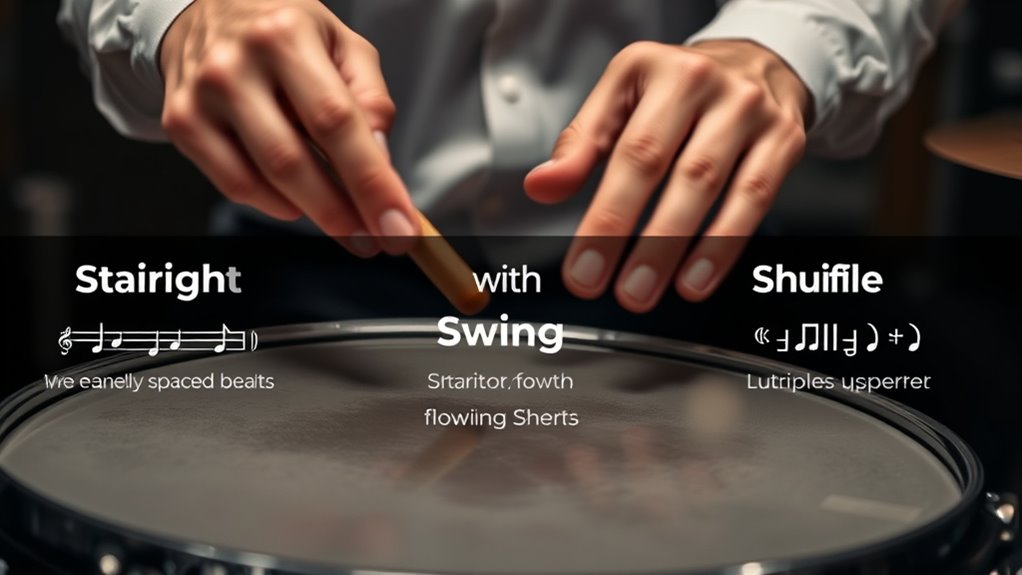
Have you ever wondered how musicians create that tight, infectious rhythm that makes you want to move? It all comes down to understanding the subtleties of subdivision and groove. When you listen closely, you’ll notice that different styles—straight, swing, and shuffle—each have their unique rhythmic feel, which directly impacts groove consistency. These variations shape how the beat feels and how listeners connect emotionally with the music. Mastering these concepts helps you develop a more versatile sense of timing and enhances your ability to lock in with other musicians. Recognizing the importance of timing accuracy can significantly improve your rhythmic feel and overall groove. Starting with straight rhythm, think of it as a steady, metronomic pulse. The subdivisions are evenly spaced, giving a clean, predictable feel. When you play straight, you’re dividing each beat into equal parts—like four quarter notes in a measure or sixteen sixteenth notes for more detail. This creates a very precise rhythmic feel, often used in genres like rock, pop, and electronic music. With straight timing, maintaining groove consistency is straightforward because each subdivision hits exactly on the beat or exactly between beats, providing a reliable, driving momentum. Your focus should be on keeping every subdivision equal, which fosters a solid foundation for the groove to sit on. Swing, on the other hand, introduces a human element, giving the rhythm a more relaxed, “bouncy” feel. Instead of dividing the beat evenly, you delay the second note of each pair, creating a triplet-based subdivision—think of it as playing the notes with a slight “lop” or “swing.” This subtle shift makes the rhythm feel more natural and expressive, often found in jazz, blues, and blues-inspired pop. When you’re swinging, your goal is to preserve groove consistency by consistently applying that delayed feel, so the rhythm flows smoothly without sounding off-beat. It’s less about strict timing and more about maintaining a feel that swings naturally, encouraging listeners to tap their feet and get caught up in the groove. Shuffle takes the swing concept a step further by emphasizing a specific pattern of uneven subdivisions, often described as a “long-short” feel. Instead of a simple swing, shuffle creates a rolling, almost hypnotic quality that’s common in blues, rockabilly, and shuffle blues. When you’re playing shuffle, focus on keeping the long and short notes in a steady, predictable pattern. Groove consistency comes from internalizing this pattern so that it feels effortless, almost like a continuous flow. Your ability to lock into this shuffle pattern gives the rhythm a hypnotic pulse, making the music irresistibly danceable. In all these styles, understanding subdivision and maintaining groove consistency are key. Whether you’re locking into a straight beat, swinging with a relaxed feel, or shuffling with a hypnotic groove, your control over rhythmic feel directly influences how compelling and infectious your music sounds.
Frequently Asked Questions
How Do I Develop a Strong Sense of Groove?
To develop a strong sense of groove, focus on rhythmic consistency and dynamic phrasing. Practice with a metronome or backing track to lock in your timing, ensuring your subdivisions are precise. Listen actively to your favorite grooves and mimic their feel, emphasizing dynamics to add expression. Play along with recordings, paying attention to how the rhythm section interacts, and gradually internalize the groove until it becomes natural in your playing.
Can Subdivision Improve My Improvisation Skills?
Yes, subdivision can markedly improve your improvisation skills by enhancing your rhythmic independence. When you practice subdividing beats, you develop a better sense of timing and internalize complex rhythms, making your improvisations more fluid and dynamic. Incorporate various improvisation techniques that focus on rhythmic subdivision to add variety and creativity to your playing, ultimately helping you stay rhythmically engaged and confident during performances.
What Are Common Mistakes Beginners Make With Shuffle?
Think of a shuffle as a rolling wave—if you don’t follow its flow, you’ll crash. Beginners often struggle with rhythmic consistency and timing accuracy, rushing or rushing ahead. They might also neglect to lock in with the groove, making the shuffle sound uneven. To improve, focus on keeping steady time and feel the groove as a guiding pulse, ensuring your shuffle stays smooth and connected.
How Does Groove Differ Across Musical Genres?
You’ll notice that groove varies across genres because of genre-specific rhythms and cultural influences. For example, jazz often emphasizes swing feel, while funk focuses on tight, syncopated rhythms. In electronic music, grooves might be more mechanical and repetitive. Your playing should reflect these nuances, adapting your timing, accents, and feel to match each genre’s unique rhythmic character and cultural roots, creating authentic and engaging music.
Are There Exercises to Master Swing Feel?
Think of mastering swing feel as tuning a vintage radio—you need to fine-tune your rhythmic accuracy and feel development. Practice along with swing recordings or metronome clicks set to swing timing. Try playing simple patterns, emphasizing the ‘long-short’ swing rhythm, and gradually increase complexity. Use exercises like triplet subdivisions or shuffle patterns to internalize the groove. Consistent practice helps you naturally lock into that irresistible swing feel.
Conclusion
Mastering subdivision and groove might seem like a subtle art, but it quietly shapes your overall feel. When you embrace the nuances of straight, swing, and shuffle, you’ll find your rhythm flowing effortlessly—like a gentle breeze guiding your music. Remember, it’s often the small, understated shifts that make your playing truly resonate. Keep exploring these subtle differences, and you’ll discover a new depth in your groove, enriching your musical journey beyond what words can fully express.