

To understand chord charts and lead sheets, focus on recognizing chord symbols like C, G7, or Am, which show the harmonic structure. These charts simplify musical notation, emphasizing chords over detailed melodies, so you can quickly accompany or solo. Familiarize yourself with how symbols relate to scales and chord progressions to play confidently. Keep exploring further, and you’ll discover how to turn these symbols into expressive musical ideas effortlessly.

Get audio and creator gear delivered free with Prime
- Fast, free delivery on millions of items
- Prime Video, Amazon Music and more included
- Member-only deals all year
Key Takeaways
- Recognize chord symbols and abbreviations to understand harmonic progressions quickly.
- Familiarize yourself with key signatures and scales to inform accurate chord interpretation.
- Use chord charts as straightforward guides for performance, focusing on chords over detailed melodies.
- Practice improvisation techniques like arpeggios and passing tones based on notation and scales.
- Develop confidence by actively translating symbols into musical ideas and anticipating chord changes.
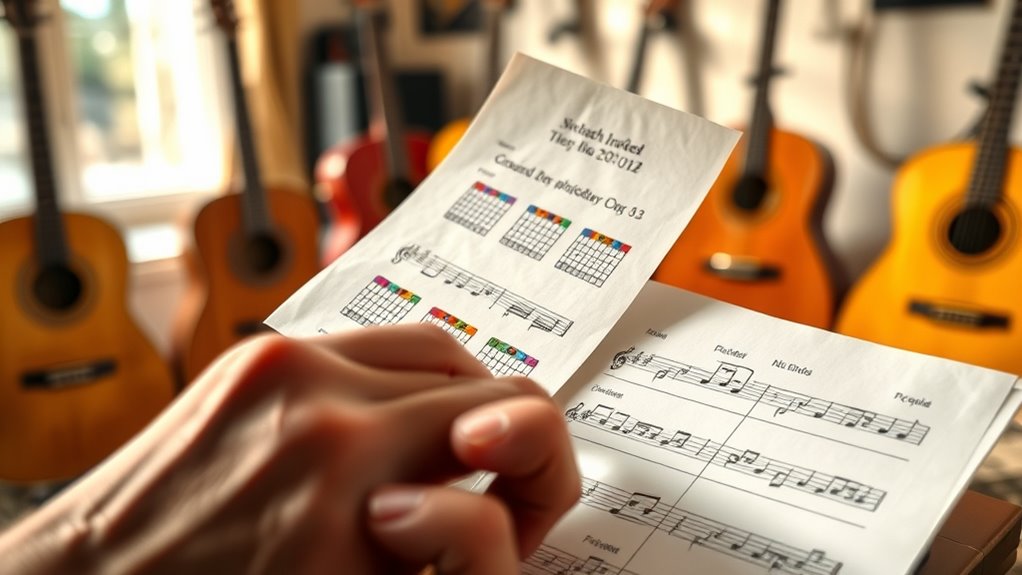
Ever wonder how to quickly interpret a chord chart and play your favorite songs with confidence? The key lies in understanding musical notation and developing solid improvisation techniques. Chord charts and lead sheets are designed to be straightforward, but if you’re new to reading them, it can seem overwhelming. Luckily, once you grasp the basics of musical notation, you’ll find it easier to navigate these sheets and bring your musical ideas to life. These charts typically focus on chords rather than detailed melodies, giving you the freedom to interpret the song in your own style. Recognizing chord symbols like C, G7, or Am helps you quickly identify the harmonic structure of a piece. This familiarity allows you to anticipate changes and keep your playing fluid, even if you’re improvising or adding embellishments.
When you approach a chord chart, start by familiarizing yourself with the notation. Most charts use symbols and abbreviations that represent chords, but understanding the underlying musical notation can deepen your grasp. For example, knowing how to read a chord symbol in relation to the key signature or scale helps you make more informed choices. As you become comfortable, you can experiment with improvisation techniques to make your performance more engaging. Instead of sticking rigidly to the written chords, you can add passing tones, arpeggios, or rhythmic variations. These improvisations make the song feel fresh and personal, and they’re often based on your understanding of musical notation and scales.
Practicing improvisation techniques alongside reading chord charts boosts your confidence and musical flexibility. Start by playing simple variations of the chords, then gradually incorporate more complex ideas like modal interchange or pentatonic improvisation. Listening to recordings of the song helps you internalize the feel and phrasing, which you can mimic or modify with your own improvisations. Understanding musical notation and how to interpret it deepens your connection to the music and enhances your ability to improvise effectively. Over time, you’ll learn to see chord charts not just as a roadmap, but as a springboard for creative expression. The more you practice, the more instinctive it becomes to translate written symbols into musical ideas that resonate with your style.
In essence, mastering musical notation and improvisation techniques transforms your approach to reading chord charts. You move beyond mere reproduction to active, expressive playing. Whether you’re accompanying others or soloing, these skills empower you to interpret charts with clarity and confidence, making every performance more dynamic and authentic.
As an affiliate, we earn on qualifying purchases.
Frequently Asked Questions
How Can I Quickly Memorize Common Chord Progressions?
To quickly memorize common chord progressions, use mnemonic devices to create memorable patterns or phrases that help you recall the sequence. Repetition techniques are also essential; play the progressions repeatedly until they become second nature. Break them down into smaller sections, practice them regularly, and gradually increase speed. Combining these methods makes it easier to internalize progressions and improves your ability to play them effortlessly in different musical contexts.
What Are the Differences Between Various Lead Sheet Formats?
Ever wonder how lead sheet formats differ? You’ll find that some focus solely on musical notation, offering detailed arrangements, while others present simplified sheet music formats, highlighting chords and melody for quick reference. The choice depends on your playing style—whether you prefer intricate details or easy-to-read visuals. Each format guides your performance differently, so explore them to discover which one makes your practice more intuitive and enjoyable.
How Do I Interpret Rhythmic Notation on Lead Sheets?
To interpret rhythmic notation on lead sheets, you should carefully study the note values, rests, and any rhythmic markings like dots or ties. Use interpretation techniques such as tapping the rhythm, counting aloud, or clapping to internalize the timing. Pay attention to how the rhythmic notation guides your phrasing and feel, ensuring your performance aligns with the intended groove and style of the piece.
Are There Apps That Help Read and Practice Chord Charts?
Think of interactive apps and notation software as your musical GPS, guiding you through chord charts with ease. Yes, many apps like iReal Pro, for example, help you practice and read chord charts by providing real-time transposition and looping features. These tools make mastering charts simple, fun, and efficient, turning practice into an engaging experience. So, whether you’re on a tablet or smartphone, these apps are your best companions for learning and improving.
How Do I Adapt Chord Charts for Different Instruments?
You can adapt chord charts for different instruments by transposing the chords to suit transposing instruments, ensuring they sound correct when played. To adapt voicings for various instruments, modify the chord shapes and voicing to fit the instrument’s range and capabilities. This way, you make the charts more accessible, helping each musician play comfortably while maintaining the song’s harmonic integrity.
Conclusion
Now that you know how to read chord charts and lead sheets, you’re ready to jam with confidence. Remember, practice makes perfect, and the more you play, the more natural it’ll feel. Don’t be afraid to experiment and trust your ears. As they say, “The more you learn, the more you earn” — in music, that means more skills and fun. Keep strumming, and enjoy every note!
Fall Picks
fall essentials
As an affiliate, we earn on qualifying purchases.