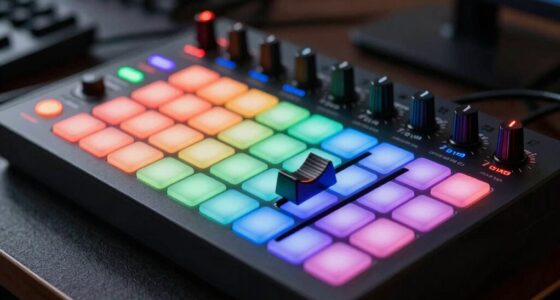

Microtonality explores pitch intervals smaller than the standard Western semitones, revealing sounds between traditional notes. It’s rooted in ancient cultures like Middle Eastern maqams or Indian ragas, emphasizing emotional and spiritual expression. Microtones challenge how we perceive sound frequencies and require specialized instruments or tuning systems. If you’re curious about how these subtle pitch shifts produce richer, more expressive music, exploring further will uncover the fascinating world of microtonal soundscapes.
Key Takeaways
- Microtonality involves intervals smaller than the traditional semitone, creating pitches between standard notes.
- It draws from diverse cultural scales like Middle Eastern maqams and Indian ragas, emphasizing expressive nuances.
- Human pitch perception can distinguish microtones with training, expanding musical expression beyond 12-tone equal temperament.
- Microtonal instruments and digital tools enable precise tuning and exploration of notes between the standard pitches.
- Composing with microtones allows for innovative sounds, emotional depth, and cross-cultural musical collaborations.
What Is Microtonality and How Does It Differ From Traditional Tuning

Have you ever wondered how musicians create sounds that feel slightly off from standard pitches? That’s where microtonality comes in. It involves exploring intonation nuances and tuning deviations beyond the familiar 12-tone equal temperament used in most Western music. Unlike traditional tuning, which divides an octave into 12 equal parts, microtonality introduces smaller intervals, allowing for a broader palette of sounds. These tuning deviations create subtle shifts in pitch, giving music a unique expressive quality. Microtonal music often sounds more expressive or unconventional because it taps into these unheard or underused pitch relationships. This approach liberates new sonic possibilities, making it distinct from traditional tuning systems that stick to standard notes. Additionally, research into sound vibrations suggests that microtonal variations can influence brainwave patterns and emotional responses, further expanding the expressive potential of microtonal music.
Historical Roots and Cultural Significance of Microtonal Music

Microtonal music has deep roots in various cultures, reflecting unique musical traditions and spiritual practices. Many ancient scales incorporate microintervals, which shape the sound and emotional expression of diverse musical styles. For example, Middle Eastern maqams use quarter tones, emphasizing a rich cultural diversity in tonal language. Similarly, Indian classical music employs microtonal nuances within ragas, connecting music to spiritual and cultural identity. In Southeast Asia, traditional gamelan and folk music also explore subtle pitch differences, highlighting the significance of microtones in cultural storytelling. These practices demonstrate that microtonality is not a modern invention but an integral part of many ancient musical systems, embodying cultural values, spiritual beliefs, and artistic expression across different societies. Additionally, the use of microtones often reflects musical innovation that has been preserved and adapted over centuries to convey complex emotional and spiritual messages.
The Science Behind Microtones: Frequencies and Pitch Perception

Understanding how microtones function involves exploring the relationship between sound frequencies and human pitch perception. Our ears interpret different frequencies as distinct pitches, but microtones challenge this by occupying the space between traditional notes. When you hear microtones, your brain performs frequency perception, distinguishing subtle differences that fall outside standard semitones. Pitch discrimination is vital here; your ability to notice tiny pitch variations allows you to perceive these in-between notes. Microtones often involve frequencies that are slightly higher or lower than conventional pitches, requiring refined pitch discrimination skills. This nuanced perception enables you to appreciate microtonal music’s unique expressiveness. Fundamentally, your auditory system’s sensitivity to frequency perception underpins how you experience and interpret these unconventional notes. Additionally, training your Pitch discrimination skills can enhance your ability to perceive microtones more distinctly.
Common Microtonal Scales and Tuning Systems

You’ll find that just intonation variations create unique tuning options based on pure interval ratios. Pentatonic microtonal systems offer simplified scales that emphasize consonance and open sound. Exploring these systems reveals how tuning choices shape the character of microtonal music. Additionally, understanding how high-resolution audio enhances sound fidelity can deepen the appreciation of microtonal nuances.
Just Intonation Variations
Just intonation variations form the foundation of many microtonal scales, offering tuning systems built around simple whole-number ratios that create pure, harmonious intervals. These systems prioritize intervallic precision, ensuring each note relates to others through exact ratios, which enhances harmonic complexity. By tuning notes to these ratios, you achieve a sound that’s deeply resonant and acoustically pure, unlike the slightly adjusted intervals of equal temperament. Different variations, such as Pythagorean or meantone tuning, emphasize distinct ratios, shaping unique sonic textures. This approach allows you to explore subtle nuances between pitches, producing rich, expressive harmonies. Understanding these variations helps you craft scales that reflect specific acoustic qualities, expanding your musical palette with tunings rooted in mathematical relationships that emphasize purity and harmonic depth. These tuning systems provide a framework for exploring the expressive potential of microtonality through precise interval relationships.
Pentatonic Microtonal Systems
Have you ever wondered how pentatonic scales create their distinctive, harmonious sound across different musical traditions? Ethnomusicology analysis shows that many cultures use pentatonic microtonal systems, often with subtle tuning variations that shape their unique sound. These scales typically feature five notes per octave, but tuning system comparisons reveal differences in interval sizes, such as just intonation versus equal temperament adaptations. Such microtonal adjustments help preserve traditional melodic characteristics and emotional expression. By examining these systems, you see how diverse tuning approaches influence musical texture and perception. This understanding highlights that even within a simple five-note framework, microtonality adds richness and complexity, allowing musicians to explore nuanced tonalities that challenge Western tuning conventions. Microtonal tuning approaches play a crucial role in shaping the emotional and cultural identity of musical pieces.
Instruments and Technologies for Microtonal Music
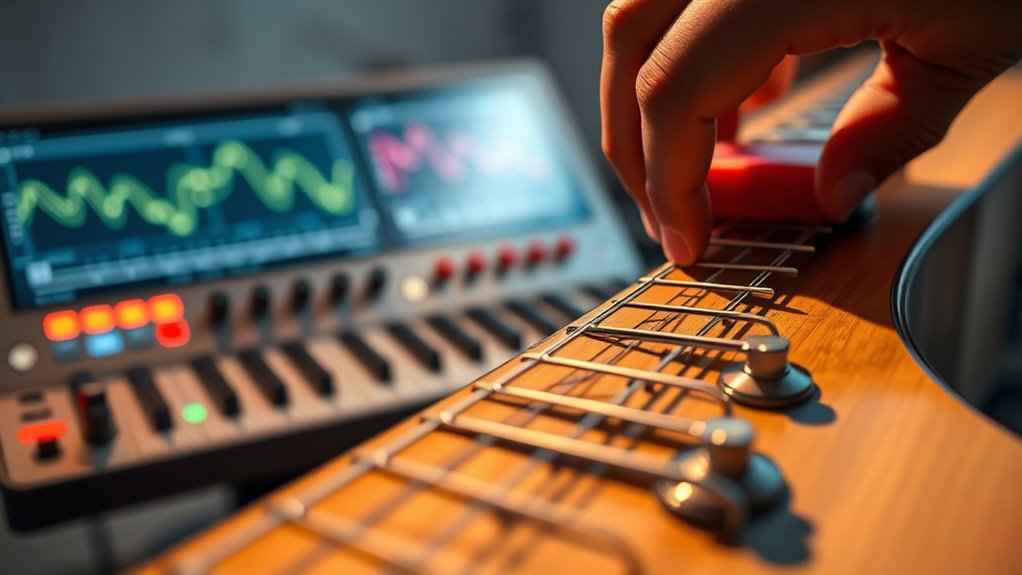
You’ll find a variety of microtonal instruments designed to produce precise pitch differences, from modified traditional instruments to specialized modern ones. Innovative technologies like digital tuners and software enable composers to explore new tuning possibilities easily. Exploring these tools opens up a world of creative microtonal expression. Additionally, understanding vetted ID times can provide valuable insights into the development and acceptance of new musical techniques and tools.
Microtonal Instruments Overview
Microtonal music requires specialized instruments and technologies that can produce pitches outside the standard Western tuning system. These instruments are designed with unique microtonal instrument design features and microtonal tuning interfaces to handle non-traditional scales. You might explore:
- Custom-built keyboards with adjustable pitch sliders
- Digital controllers that map microtonal scales to MIDI
- Fretted instruments with adjustable fret spacing
- Computer-based software synthesizers for precise tuning control
These tools let you experiment freely with microtonal tuning, giving you control over every note. Microtonal instrument design focuses on creating intuitive interfaces for orienteering between pitches. Whether hardware or software, these instruments help you realize complex tuning systems and expand your musical palette. Security considerations in digital music production are increasingly important as technology advances.
Innovative Microtonal Technologies
Innovative microtonal technologies are transforming how musicians explore and implement non-traditional tuning systems. Microtonal digital interfaces now allow for precise control of pitch, enabling you to customize scales beyond standard tuning. These interfaces improve microtonal ergonomics, making it easier to play complex tunings comfortably and accurately. Instruments like MIDI controllers and software synths can be programmed to produce exact microtones, expanding your creative possibilities. Touch-sensitive surfaces and flexible tuning options enhance your ability to experiment with nuanced pitch variations. Additionally, innovative controllers are designed to accommodate microtonal ergonomics, reducing strain and increasing performance precision. Jeep Tuning advancements empower you to explore new sonic landscapes, making microtonality more accessible and expressive than ever before.
Composing and Performing Microtonal Pieces

Composing and performing microtonal pieces requires a shift in traditional musical thinking, as composers must explore intervals smaller than the standard semitone. You’ll need to experiment with tuning systems comparison to find what suits your sound, whether using equal temperament adjustments or just intonation. Microtonal improvisation becomes essential as it allows spontaneous exploration of these tiny intervals, pushing your creative boundaries. You might encounter challenges in tuning accuracy or instrument limitations, but these can inspire new techniques. To get started, consider:
- Practicing microtonal improvisation regularly
- Comparing different tuning systems for desired effects
- Using specialized instruments or digital tools
- Listening to diverse microtonal music to broaden your perspective
- Exploring the use of hackathons as a creative platform for experimenting with microtonal compositions and innovative sound design
This approach helps you internalize microtonal nuances and craft compelling microtonal pieces.
Notable Microtonal Composers and Musical Works
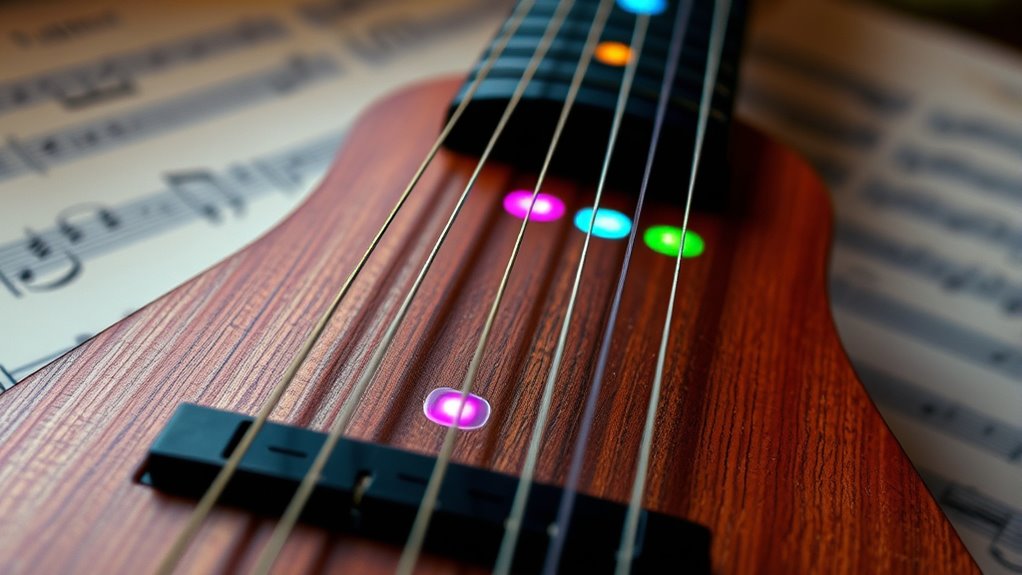
Throughout musical history, several composers have stood out for their pioneering use of microtonality, pushing the boundaries of traditional tuning systems. Composers like Iannis Xenakis, Harry Partch, and La Monte Young created groundbreaking works that showcase microtonal notation, revealing new sonic possibilities. Xenakis’s experimental pieces often incorporate non-standard tunings, while Partch built an entire custom instrument and devised a unique notation system to represent microtones precisely. Young’s minimalist compositions explore subtle pitch variations, emphasizing the expressive potential of microtonality. These composers have profoundly contributed to microtonal education, inspiring others to explore alternative tuning systems. Their works serve as essential references for understanding the scope and expressive power of notes between the notes, broadening your appreciation of musical diversity.
Challenges and Opportunities in Microtonality

While microtonality opens up a vast domain of sonic possibilities, it also presents significant challenges for musicians and listeners alike. One major obstacle is intonation challenges, as tuning systems vary widely, making it difficult to achieve consistent pitch accuracy. Additionally, cultural adaptation plays a role—listeners may find unfamiliar microtones dissonant or unsettling, requiring time to develop an ear for these nuances. For performers, mastering new tuning systems demands specialized training and practice. On the positive side, microtonality offers opportunities for innovative composition, richer emotional expression, and cross-cultural collaboration. It encourages musicians to push boundaries, explore uncharted sound worlds, and redefine musical language. Embracing these challenges can lead to groundbreaking artistic growth and expanded musical horizons.
Exploring Future Trends and Innovations in Microtonal Music

Advancements in technology and a growing interest in expanding musical horizons are fueling exciting innovations in microtonal music. AI integration allows you to create complex, personalized tunings effortlessly, opening new sonic possibilities. Virtual reality offers immersive experiences where you can explore microtonal landscapes firsthand, transforming how you perceive and interact with sound. These innovations will likely influence both composition and performance, making microtonality more accessible and engaging. Here’s a glimpse of what the future holds:
| Technology | Impact | Example |
|---|---|---|
| AI Integration | Custom microtonal tuning generation | AI composing microtonal pieces |
| Virtual Reality | Immersive microtonal environments | VR concerts and explorations |
| Augmented Reality | Interactive microtonal overlays | Live microtonal performances |
Frequently Asked Questions
How Do Microtones Affect Emotional Expression in Music?
Microtones deepen emotional nuance in music by allowing you to craft more expressive intonation. They enable you to subtly shift pitch, conveying complex feelings that standard notes might miss. By experimenting with microtones, you can evoke powerful emotional responses, making your performance more intimate and resonant. This nuanced pitch control helps you communicate emotions more authentically, giving your music a richer, more textured expressive quality that resonates with listeners on a deeper level.
Can Microtonality Be Integrated Into Western Popular Music Styles?
Imagine transforming mainstream music into a universe of endless possibilities—that’s what microtonality can do. You can seamlessly blend traditional scales with modern adaptations, creating fresh sounds that captivate listeners. Incorporating microtones into Western popular music isn’t just possible, it’s exciting. Artists experiment with these notes between the notes, adding depth and emotion that elevate their music beyond the familiar, making every song a new sonic adventure.
What Are the Best Tools for Beginners to Start Exploring Microtonality?
When starting to explore microtonality, you want the best tools for beginners to immerse themselves in microtonal tunings. Look for beginner instruments like MIDI controllers or digital tuners that allow easy adjustment of pitches. Software such as DAWs with microtonal plugins or free apps like Microtonal Piano help you experiment with different tunings. These tools make it simple to understand and create music that explores notes between the notes.
How Does Microtonality Influence Music Perception Across Different Cultures?
You’re really diving into a fascinating question. Microtonality influences music perception differently across cultures, as cultural interpretations shape how tuning variations are understood and appreciated. Some cultures embrace these subtle pitch differences, seeing them as expressive, while others may find them unfamiliar or dissonant. This diversity shows that musical meaning isn’t one-size-fits-all, and microtonality broadens how we experience sound worldwide. It’s a affirmation that perception is deeply rooted in cultural context.
Are There Standardized Notation Systems for Microtonal Music?
You might wonder if there are notation systems or standards for microtonal music. While some notation standards exist, they’re not universally accepted, and many composers create custom symbols to represent microtones. These notation systems help performers interpret pitches between traditional notes, but because microtonality varies widely across cultures and styles, standardization remains a challenge. So, while notation systems exist, they’re often adapted to fit specific musical contexts.
Conclusion
Diving into microtonality is like opening a secret garden of sound where notes bloom between the familiar, revealing new worlds of emotion and expression. With every subtle pitch shift, you discover a richer, more intricate tapestry of music that whispers stories beyond traditional boundaries. Embrace these tiny intervals—they’re your ticket to a vibrant universe where every note is a brushstroke on the canvas of sound, inviting you to explore endless sonic horizons.