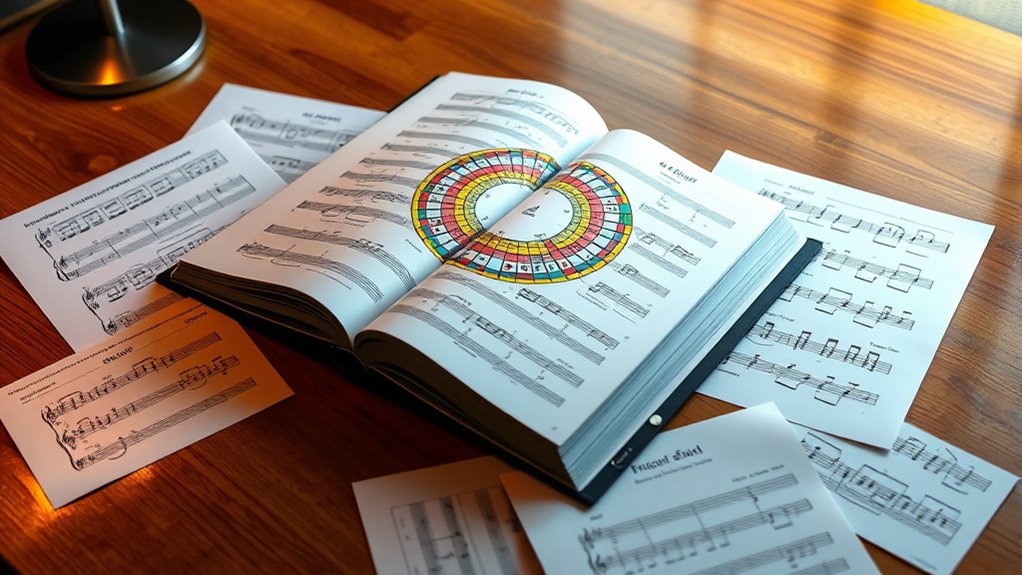

To master the circle of fifths, start by understanding its foundation as a visual map of key relationships. Practice connecting chords, shifting between related keys, and exploring transpositions. Use it to develop harmonic ideas, improvise, and compose across genres. Reinforce your knowledge with exercises in key changes and modulations. The more you incorporate it into your routine, the more intuitive it becomes. If you keep exploring, you’ll discover its full creative potential.
Key Takeaways
- Understand the circle’s structure by memorizing key signatures and their relationships through visual aids and repetitive practice.
- Apply the circle to create smooth chord progressions and modulations, reinforcing practical harmonic transitions.
- Use the circle to analyze and anticipate key changes, enhancing harmonic prediction and improvisation skills.
- Incorporate exercises like transposing and modal interchange to deepen theoretical knowledge and musical flexibility.
- Integrate the circle into daily practice routines to develop intuitive understanding and seamless application in composition and performance.
Understanding the Foundations of the Circle of Fifths

To understand the Circle of Fifths, you need to grasp its fundamental purpose: illustrating the relationships among the twelve tones of the chromatic scale. In music theory, this tool helps visualize how keys and chords connect, making it easier to understand harmony. Its roots trace back to the 17th and 18th centuries, when composers and theorists sought a systematic way to organize pitches. Historically, musicians used the circle to navigate modulations and key changes more effectively. Today, the Circle of Fifths is a cornerstone in music education, offering insight into key signatures and chord progressions. By understanding its historical context, you’ll appreciate how it evolved from theoretical concepts into a practical tool that enhances your grasp of musical structure.
Visualizing Key Relationships and Chord Progressions

You can easily see how keys relate by exploring the circle diagram, which highlights their connections. Connecting chord transitions becomes clearer when you visualize how chords move around the circle. This approach helps you understand progressions and key shifts intuitively. Additionally, understanding music education philosophies enhances your ability to apply theoretical concepts practically.
Navigating the Circle Diagram
Have you ever wondered how the circle diagram reveals the relationships between different musical keys? It visualizes diatonic harmony by showing how closely related keys share similar scale degrees. Moving clockwise, each key adds a sharp, while moving counterclockwise, it adds a flat. This helps you understand key signatures and chord progressions. When steering the circle, you can see how chords within a key relate through shared diatonic scale degrees, making transitions smoother. The diagram also highlights closely related keys—those with minimal accidentals—making modulations more natural. By visualizing these relationships, you gain a clearer picture of how chords and keys connect, giving you a more intuitive grasp of music theory and helping you craft more cohesive progressions. Honda Tuning offers insights into modifications that enhance vehicle performance, much like understanding the circle of fifths helps optimize musical harmony.
Connecting Chord Transitions
Understanding how chords relate within and across keys helps create smooth, natural-sounding progressions. Recognizing harmonic relationships and chord proximity is essential for connecting progressions seamlessly. When chords are close on the circle of fifths, they share many notes or tones, making the switch sound effortless. For example, moving from C to G or F feels natural because they have strong harmonic connections. By visualizing these relationships, you can anticipate smooth chord changes, guiding your progressions with confidence. This awareness helps you craft melodies that flow logically, avoiding abrupt shifts. Connecting chord transitions through the circle of fifths enhances your musical intuition, allowing you to navigate key relationships effortlessly and build compelling progressions that sound cohesive and polished. Sound design techniques can also be employed to create atmospheric backgrounds that emphasize these harmonic shifts.
Practicing Transposition and Modulation Techniques

Practicing transposition and modulation techniques helps you become more versatile in your playing. Start with simple transposition exercises to build your confidence across different keys. As you progress, explore key change techniques to smoothly shift between tonal centers. Incorporating industry trends into your practice can also help you stay current with evolving musical styles.
Exploring Key Techniques
To master key techniques, you need to actively practice transposing and modulating between different keys. Focus on harmonic analysis to understand how chords function across keys, and use scale construction to create seamless passages. Here are three ways to explore these techniques:
- Analyze chord progressions in various keys to identify common tones and pivot points.
- Practice constructing scales for different keys, paying attention to key signatures and accidentals.
- Experiment with modulating by applying pivot chords, ensuring smooth harmonic shifts.
- Incorporate Kia Tuning strategies, such as ECU remapping and suspension upgrades, to better understand how modifications can optimize performance during practice sessions.
Transposition Exercises
Transposition exercises are essential for developing your ability to shift melodies and harmonies seamlessly between keys. By practicing transposition, you sharpen your interval recognition skills, helping you identify the distances between notes quickly. Focus on transposing simple melodies and then progress to complex harmonies, paying attention to how intervals change in different keys. Incorporate harmonic analysis to understand how chords function across transpositions, revealing patterns that enhance your musical intuition. These exercises also prepare you for modulation, enabling smoother key changes within compositions. Regular practice improves your ear and theoretical understanding, allowing you to transpose accurately and confidently. Over time, you’ll internalize the relationships on the circle of fifths, making transposition feel natural and intuitive in your playing or composing. Developing a strong understanding of musical intervals and their role within different keys can further deepen your transposition skills.
Integrating the Circle Into Improvisation and Composition

Integrating the Circle of Fifths into improvisation and composition can considerably enhance your musical coherence and creativity. By understanding harmonic relationships, you can create smoother progressions and stronger tonal centers. Use the circle to:
- Guide your chord progressions, ensuring harmonious movement between keys.
- Develop melodies that flow logically, emphasizing relationships like fifths and relative minors.
- Plan modulations, shifting keys seamlessly while maintaining melodic development.
- Recognize how key signatures relate, allowing for more intuitive transpositions and key changes.
This approach helps you craft music with greater coherence, making your improvisations sound intentional and your compositions more dynamic. The circle acts as a roadmap, revealing how chords and keys relate, so you can explore harmonic possibilities confidently. Mastering this integration deepens your understanding of music structure, elevating your overall musicality.
Applying the Circle to Different Musical Genres

The Circle of Fifths serves as a versatile tool across a wide range of musical genres, helping you tailor harmonic progressions and melodic ideas to fit different styles. In jazz, you can use genre-specific chord voicings, like extended and altered chords, to evoke a rich, sophisticated sound. In blues, the circle guides you in creating simple yet effective progressions, emphasizing dominant chords. In pop music, it helps craft catchy melodies and smooth connections between keys. Understanding stylistic improvisation techniques allows you to adapt your improvisations to each genre’s characteristic sound. Additionally, incorporating elements like musical ambiance and textured arrangements enhances the overall mood and authenticity of each style. By applying the circle’s relationships, you develop harmonic flexibility and unique phrasing, ensuring your playing aligns with the stylistic nuances of each genre you explore.
Using the Circle to Enhance Ear Training and Sight Reading

Using the Circle of Fifths can considerably boost your ear training and sight-reading skills by providing a clear framework for understanding key relationships. It helps you develop better interval recognition and harmonic analysis by making key signatures and their connections more intuitive. To maximize its benefits:
- Practice recognizing common intervals within related keys, reinforcing your ear for sound differences.
- Use the circle to anticipate chord progressions, sharpening your harmonic analysis skills.
- Sight-read by identifying the key quickly through the circle, improving your ability to read music on sight.
- Incorporate key signatures into your practice routines to solidify your understanding of the circle’s structure and improve your overall musical literacy.
Exploring Advanced Concepts: Enharmonic Equivalents and Modal Interchange
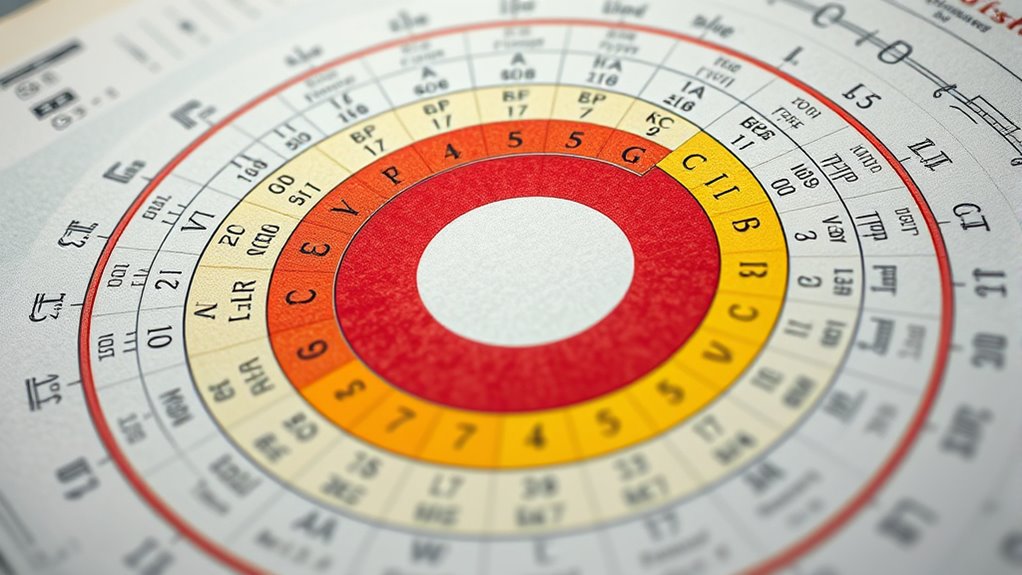
Exploring advanced concepts like enharmonic equivalents and modal interchange opens new possibilities for expanding your harmonic vocabulary. Enharmonic equivalents are notes or chords that sound the same but are written differently, such as F# and Gb. Recognizing these helps you navigate complex key changes smoothly. Modal interchange involves borrowing chords from parallel modes, enriching your harmonic palette and adding color to your progressions. By understanding how these concepts relate to the circle of fifths, you can create more expressive and surprising harmonies. Practice identifying enharmonic equivalents and experimenting with modal interchange within familiar progressions. This deepens your harmonic understanding and enables you to craft richer, more nuanced music. Mastering these advanced ideas takes your circle of fifths knowledge from basic memorization to creative application. Additionally, integrating insights from AI Entertainment can inspire innovative approaches to composition and analysis.
Developing Personal Exercises for Deepening Mastery

Building personalized exercises based on advanced concepts like enharmonic equivalents and modal interchange can markedly boost your mastery of the circle of fifths. To deepen your skills, focus on exercises that enhance harmony analysis and melodic development. Consider these approaches:
- Create chord progressions that incorporate modal interchange, then analyze how they relate to circle of fifths relationships.
- Develop melodies emphasizing enharmonic equivalents, observing how they influence harmonic transitions.
- Practice transposing familiar progressions into different keys, paying attention to the interplay between harmony and melodic movement.
These exercises challenge you to connect theoretical knowledge with practical application, reinforcing your understanding of the circle of fifths and improving your overall musical intuition. This tailored approach accelerates mastery beyond rote memorization.
Incorporating the Circle of Fifths Into Your Practice Routine
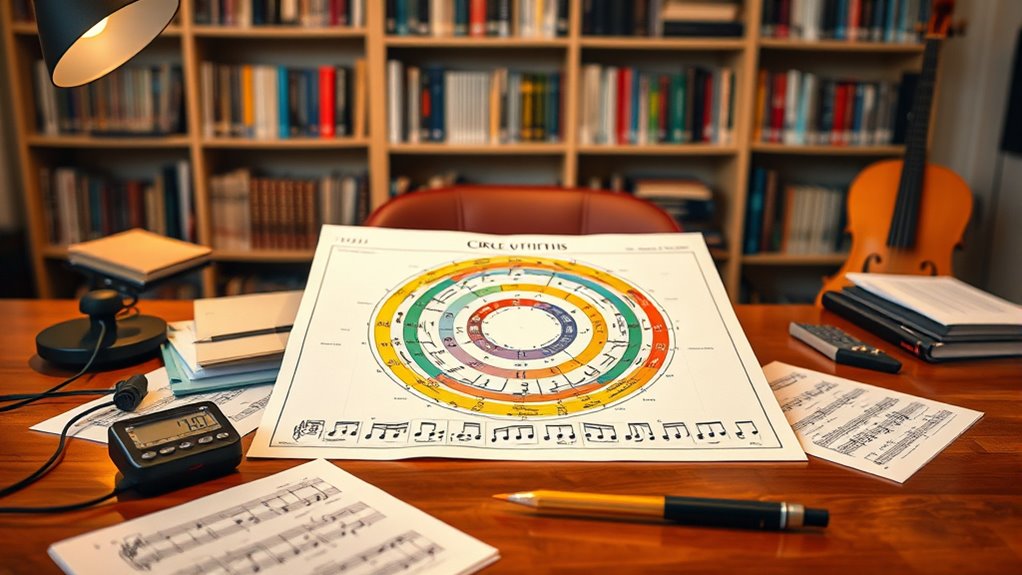
Integrating the circle of fifths into your daily practice can considerably enhance your understanding and fluency. Start by analyzing key signatures, focusing on scale degrees and their relationships. As you move around the circle, recognize how harmonic functions—like tonic, subdominant, and dominant—shift smoothly from one key to another. Practice shifting between closely related keys, paying attention to these harmonic functions and how they influence chord progressions. Use the circle to identify which scales and chords to practice, making your exercises more purposeful. Incorporate sight-reading, improvisation, or transposition exercises that emphasize these connections. Consistent use of the circle will deepen your grasp of harmonic relationships, fostering more intuitive playing and seamless modulation in your musical repertoire.
Frequently Asked Questions
How Can I Memorize the Circle More Effectively?
To memorize the circle more effectively, you should use mnemonic devices to remember the order of the keys. Visual aids, like drawing the circle repeatedly or using color-coded charts, help reinforce your memory. Practice regularly, and try linking each key to familiar songs or concepts. These strategies make the circle more intuitive, helping you move beyond mere memorization to applying your knowledge confidently in musical contexts.
What Are Common Mistakes When Applying the Circle in Composition?
When applying the circle in composition, you might fall into harmony pitfalls like overusing closely related keys or ignoring key relationships. Scale confusion also happens if you don’t consider how scales fit within the circle’s framework. To avoid these mistakes, stay aware of how keys connect and use the circle to guide smooth modulations. This helps create cohesive, interesting progressions without unnecessary tension or confusion.
How Does the Circle Relate to Contemporary Music Production?
While the circle of fifths might seem like an old friend, it’s actually a valuable tool in modern music production. You can use it for genre analysis, helping you understand harmonic structures across styles. It guides you in chord progressions, key changes, and melodic development, making your compositions more cohesive. Embracing this tool helps you craft more polished tracks, blending tradition with innovation in your music production journey.
Can the Circle Help With Understanding Non-Western Music Systems?
You might wonder if the circle helps with non-Western music systems. While it’s primarily designed for Western scales, it can offer insights into how different cultures influence music. The circle’s patterns can sometimes be adapted to understand non-Western scales, but you’ll need to explore specific cultural influences and scales beyond the circle. This understanding broadens your musical perspective and helps you appreciate diverse tuning systems worldwide.
What Are Some Creative Ways to Teach the Circle to Beginners?
Imagine turning your classroom into a musical adventure land! You can teach the circle with interactive games that make learning feel like a treasure hunt, or use visual storytelling to bring relationships between keys to life. These creative methods turn abstract concepts into exciting visual journeys, helping beginners grasp the circle’s magic effortlessly. With fun activities, you’ll make the circle unforgettable, sparking curiosity and confidence in every student.
Conclusion
Mastering the circle of fifths is your ticket to opening musical possibilities. As you move beyond memorization and start applying it creatively, you’ll find your skills growing by leaps and bounds. Keep practicing, exploring, and integrating it into your playing—think of it as planting seeds that will blossom over time. With patience and dedication, you’ll truly see the big picture come into focus, turning your musical journey into a walk in the park.