
Using chord inversions helps you achieve smooth voice leading by minimizing large leaps and creating stepwise bass movements. Inversions allow you to connect chords more naturally, reducing awkward jumps and balancing voice motion across all parts. They also help manage dissonances and guide harmonic flow towards resolutions, making progressions sound cohesive and intentional. Mastering how to use inversions effectively can enhance your harmonic progressions—if you explore further, you’ll discover even more ways to refine your voice leading.
Key Takeaways
- Use first and second inversions to create stepwise bass movement, reducing large leaps.
- Choose inversions that minimize voice crossing and awkward interval jumps.
- Leverage inversions to connect chords smoothly, maintaining consistent voice motion.
- Prioritize bass lines that move in small, logical steps through inversions.
- Apply functional inversions to emphasize harmonic flow and guide the progression naturally.
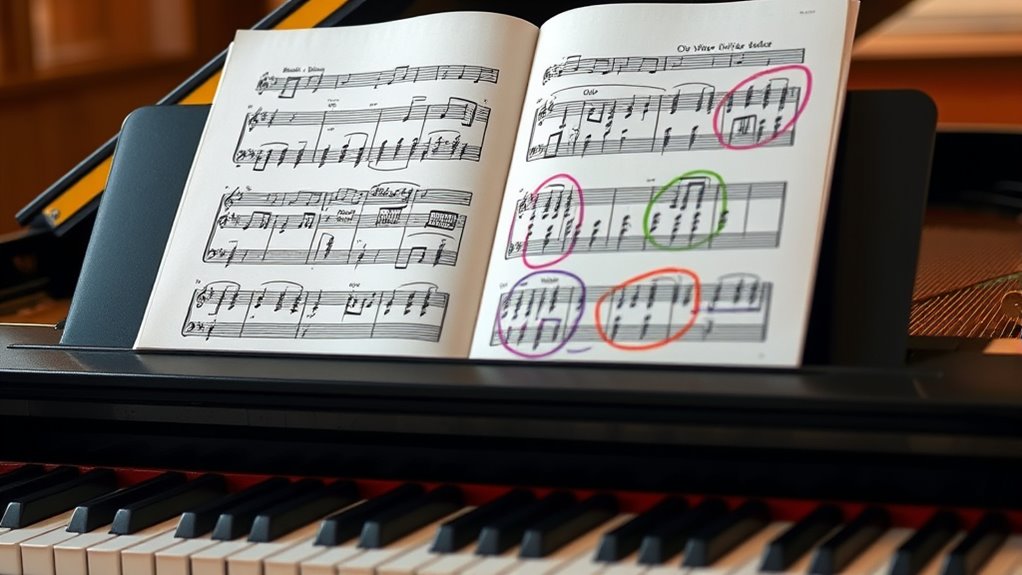
Chord inversions are essential tools for achieving smooth voice leading in your compositions and arrangements. They allow you to create seamless transitions between chords, making your progressions sound more natural and cohesive. One of the key benefits of using inversions is their ability to manage dissonance resolution effectively. When you invert a chord, you change which note is in the bass, altering how the dissonant intervals resolve. Instead of abrupt jumps or uncomfortable clashes, inversions help guide the ear smoothly from one harmony to the next by creating more stepwise bass line movement.
Chord inversions facilitate smooth voice leading and seamless transitions between harmonies.
By incorporating inversions, you gain greater control over bass line movement. Instead of large leaps that can disrupt the flow, you can craft bass lines that move in small, logical steps. For example, when moving from a root position chord to the next, instead of leaping directly, you might use the first or second inversion to connect the notes more gradually. This stepwise motion not only sounds more pleasing but also emphasizes the underlying harmonic structure, making your progression sound more intentional and polished. When your bass line moves smoothly, the overall voice leading becomes clearer, guiding listeners effortlessly through the harmonic journey.
Using inversions also helps you balance the voices within your chords. When the bass is in root position, other voices often need to move more dramatically to resolve dissonances properly. Inverting the chord positions some of these notes higher up, reducing the need for large voice crossings or awkward leaps, and ensuring each voice can move smoothly to its next target. This technique minimizes unnecessary jumps and creates a more connected sound across the entire texture.
Moreover, inversions are particularly helpful in creating sense of direction and momentum in your progressions. For instance, the second inversion often functions as a dominant or cadential chord, leading the ear naturally toward resolution. By strategically choosing inversions, you can control the flow of tension and release, guiding your harmony toward a satisfying resolution. This manipulation of dissonance resolution through inversions enhances the emotional impact of your music and maintains listener engagement. Additionally, understanding the function of different inversions can help you craft more dynamic and compelling harmonic progressions.
Frequently Asked Questions
How Do Inversions Affect the Emotional Tone of a Chord Progression?
Inversions markedly influence the emotional impact and expressive qualities of a chord progression. By changing the bass note, you create smoother shifts and highlight different notes, which can evoke feelings like tension, resolution, or longing. You feel more connected to the music, as inversions add variety and depth, making your progressions more emotionally compelling. This subtle shift helps shape the overall mood, making your composition more expressive and engaging.
Can Inversions Be Used to Modulate Between Different Keys Smoothly?
Yes, inversions can facilitate a smooth passage between keys through subtle shifts in sound. By strategically using inversions, you create a seamless key modulation, moving melodies melodiously from one tonality to another. These clever chord choices help you avoid abrupt jumps, making the modulation feel more natural. With thoughtful application, inversions act as musical bridges, guiding listeners gently from familiar keys to new tonal territories with grace and ease.
Are There Specific Inversions Best Suited for Jazz or Classical Music?
You’ll find that jazz voicings often favor rootless and drop 2 or 3 inversions for richer, more colorful sounds. In classical music, traditional inversions like first and second are used to create smooth, balanced progressions following classical techniques. Both genres choose specific inversions to enhance expression and voice leading, but jazz tends to experiment more with altered and extended voicings, while classical maintains a focus on clarity and harmonic stability.
How Do Inversions Influence the Harmonic Rhythm of a Piece?
Did you know that using inversions can change harmonic pacing by up to 30%? Inversions notably influence the voice leading intricacies, making shifts smoother or more abrupt. You’ll notice that they help control the harmonic rhythm by either accelerating or delaying chord changes, guiding listeners seamlessly through the music. By strategically choosing inversions, you shape the flow and emotional impact, giving your piece a more polished and intentional harmonic progression.
What Are Common Mistakes to Avoid When Applying Inversions for Voice Leading?
To avoid voice leading pitfalls and inversion pitfalls, you should steer clear of large leaps between chord tones, which can disrupt smoothness. Don’t forget to double the root or the fifth in inversions to maintain clarity. Also, avoid awkward leaps or parallel movements that create unwanted dissonances. Keep voice independence, and always check that each voice moves smoothly to the next chord, reducing the risk of common mistakes.
Conclusion
By exploring chord inversions, you’ll discover subtle ways to make your voice leading more graceful and connected. It’s like adding a gentle touch that guides your music smoothly along its path. When you master these techniques, your progressions become more inviting and effortless. Embrace the art of voice leading, and watch your compositions flow with newfound elegance—your listeners will thank you for the refined journey you create, even if they don’t quite notice how it all came together.