To fix desktop reflections that muddy your mix in just an hour, start by repositioning your speakers at ear level and away from reflective surfaces like walls or your desk. Add acoustic treatments such as foam panels or thick curtains behind and beside your monitors to absorb early reflections. Rearrange furniture or place rugs to reduce echo and high-frequency bounce. These quick tweaks will markedly improve sound clarity—stick around to discover more ways to achieve a professional sound.
Key Takeaways
- Position speakers at ear level and form an equilateral triangle with your listening spot to reduce reflections.
- Place acoustic treatments like foam panels or bass traps on walls behind and beside monitors to absorb early reflections.
- Keep speakers a few inches away from walls and reflective surfaces to minimize sound bouncing.
- Use rugs, curtains, or furniture to dampen reflections from hard floors and surfaces.
- Rearrange your room layout to reduce reflective surfaces and improve overall sound clarity quickly.
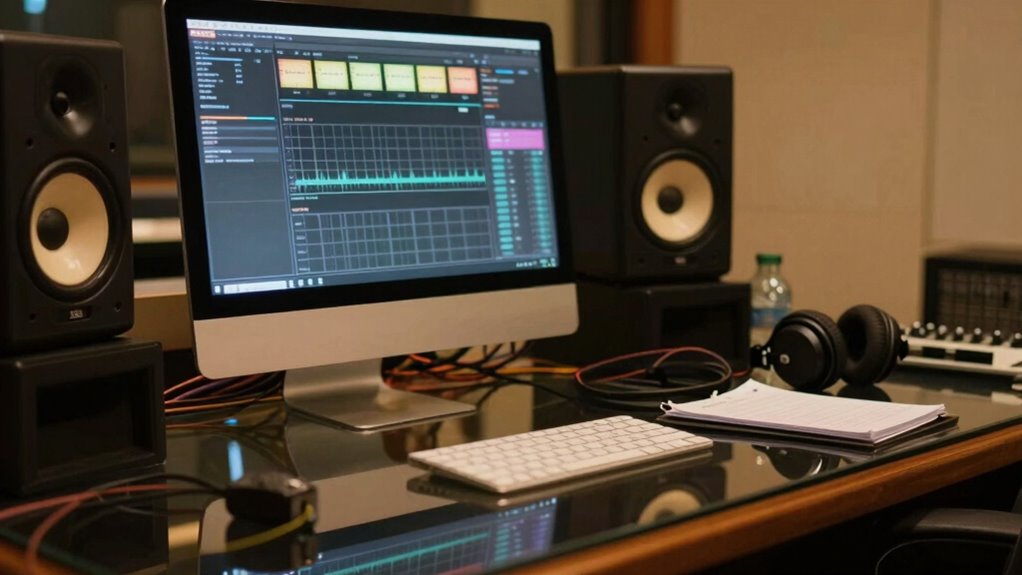
Have you ever wondered why your mixes sound muddy or undefined? It often comes down to how your environment is affecting your sound, especially the room ambiance and speaker placement. Your room isn’t just a neutral backdrop; it actively influences your perception of the mix. Reflections from walls, furniture, and surfaces can create unwanted echoes or dead spots that distort the clarity of your audio. If your speakers are positioned improperly, they can bounce sound off nearby surfaces, causing comb filtering or phase issues that muddy your mix.
Your room’s reflections and speaker placement can muddy your mix’s clarity.
To fix this quickly, start by paying attention to your speaker placement. Ideally, your monitors should be placed at ear level, forming an equilateral triangle with your listening position. Keep them away from walls—at least a few inches—so that sound isn’t bouncing directly off surfaces behind or beside them. If you notice a lack of clarity or a boomy quality, it’s often because the sound waves are reflecting off nearby walls and furniture before reaching your ears. Moving your speakers away from reflective surfaces reduces these problematic reflections and helps you hear a truer representation of your mix.
Next, consider taming the room ambiance. You don’t need a professional studio space to improve your environment. Simple acoustic treatments like foam panels, bass traps, or even thick curtains can considerably reduce early reflections and echo. Place these treatments strategically around your listening area—particularly on the walls behind and beside your speakers—to absorb excess sound energy. This minimizes the room’s influence on your perception, allowing you to make more accurate mixing decisions. Understanding room acoustics is crucial for achieving accurate sound reproduction and clarity in your mixes.
Additionally, experiment with your room’s layout. Rearranging furniture or placing rugs on hard floors can dampen reflective surfaces, reducing echo and improving sound clarity. Keep in mind that high-frequency reflections are usually the most disruptive, so focusing acoustic treatments on the upper parts of your room can make a noticeable difference.
Frequently Asked Questions
How Do I Identify if Reflections Are Affecting My Mix?
You can tell if reflections are affecting your mix by listening for muddiness or echo, especially when certain sounds seem blurred or delayed. Check your room geometry—if reflective surfaces are close, they cause problematic reflection timing. Use a mirror to spot reflective surfaces or record your room’s impulse response. If you notice these issues, it’s a clear sign reflections are impacting your mix, and you’ll need to address them.
Are There Specific Tools to Detect Unwanted Reflections?
Did you know that 60% of mixes suffer from unwanted reflections? To detect them, use reflection detection tools like Room EQ Wizard or REW, which perform acoustic analysis to identify problematic reflections. These tools analyze frequency responses and time delays, helping you pinpoint where reflections occur. With this data, you can take targeted steps to improve your room acoustics and guarantee cleaner, more accurate mixes.
Can Reflections Impact All Types of Music Equally?
Reflections can impact all music types, but their effect varies based on room symmetry and reflection timing. If your space has uneven surfaces or asymmetric layout, reflections may cause muddiness or phase issues across genres. Faster reflection timing, especially within the first 20 milliseconds, disrupts clarity regardless of music style. Adjusting your room’s symmetry and controlling reflection timing helps guarantee a cleaner, more balanced mix for any genre.
How Do Room Size and Shape Influence Reflections?
Think of your room as a canyon echoing sound. Larger rooms with expansive room dimensions create complex reflection patterns, like distant echoes bouncing unpredictably. Smaller, irregularly shaped spaces produce chaotic reflections that muddy your mix. Shape and size influence how sound waves travel and reflect, affecting clarity. To improve your mix, understand your space’s reflection patterns, and treat problematic areas to reduce unwanted reflections.
Is Professional Acoustic Treatment Necessary for Home Studios?
You don’t necessarily need professional acoustic treatment for your home studio, but it helps improve sound quality. Prioritize room aesthetics and strategic equipment placement to minimize reflections and echoes. Use DIY solutions like rugs, curtains, or foam panels to absorb sound. Properly positioning your speakers and avoiding reflective surfaces can markedly reduce desktop reflections, making your mixes clearer without investing heavily in professional treatments.
Conclusion
So, next time your mix sounds off, don’t blame your skills—blame your desktop reflections. Who knew that staring at a shiny screen could sabotage your masterpiece? It’s like trying to cook in a mirror—sure to mess things up. Fix this tiny flaw in an hour, or keep wondering why your tracks never shine. Trust me, your ears—and your fans—will thank you for ditching those pesky reflections and finally hearing your true sound.