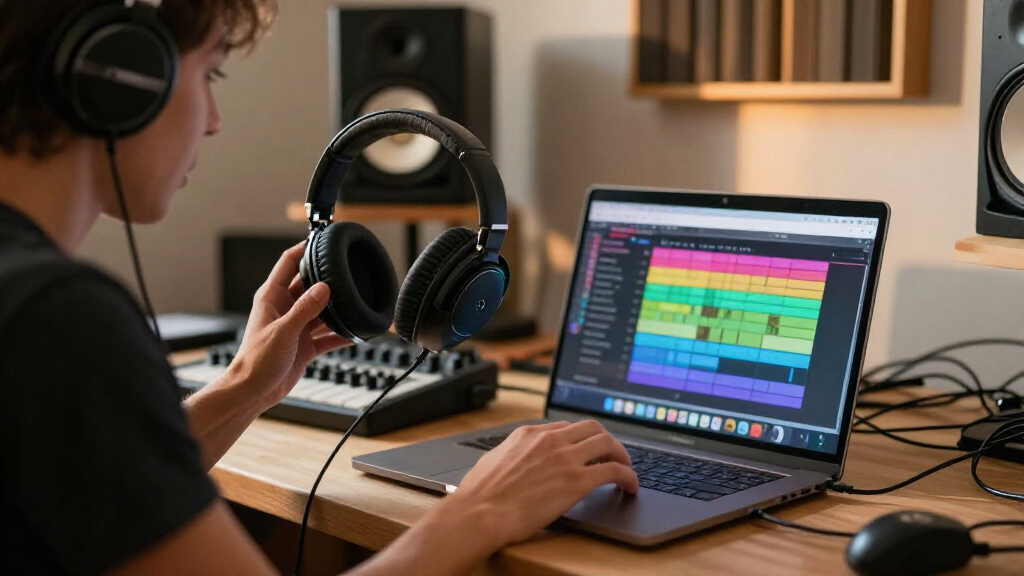
Choosing wireless headphones for music production means deciding whether freedom of movement is worth a less dependable listening path. Of these five picks, the OneOdio A70 is the only model with Bluetooth, and its wired mode makes it the clearest fit for casual production work that also needs wireless playback. For wired sessions, I would put the Audio-Technica ATH-M50x first for its detachable cable and broadly capable monitoring, while the Sony MDR7506 is a practical choice when detail and foldability matter more than wireless convenience.

Get audio and creator gear delivered free with Prime
- Fast, free delivery on millions of items
- Prime Video, Amazon Music and more included
- Member-only deals all year
That distinction matters: Bluetooth can add latency and may use audio processing that changes what you hear, so it is less dependable for recording or timing-sensitive editing. A cable is still the safer route for critical work. The OneOdio Pro-10 and Audio-Technica ATH-M20x are also wired-only, but each serves a different studio need. My ranking weighs production suitability, connection flexibility, monitoring utility, comfort, and the limitations described for each model—not wireless capability alone.
Complete the kit


Key Takeaways
- The OneOdio A70 is the only Bluetooth model here; use its wired connection for latency-sensitive production and reserve Bluetooth for less critical listening.
- The Audio-Technica ATH-M50x is the strongest all-around wired pick in this lineup, with a detachable cable, swiveling earcups, and a 45 mm driver.
- The Sony MDR7506 pairs a detailed sound description with a foldable design, but its fixed 9.8-foot cable limits convenience and mobility.
- The ATH-M20x suits tracking and louder environments through its closed-back design and isolation, though it has no wireless mode or detachable cable.
- The OneOdio Pro-10 offers single-side monitoring and dual-size jacks, but its wired-only, bulky design makes it a poor choice for anyone specifically seeking Bluetooth.
| Audio-Technica ATH-M50X Professional Studio Monitor Headphones, Black | 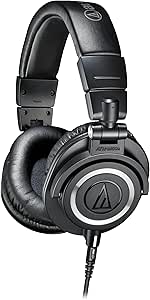 | Best Overall for Wired Production | Driver size: 45 mm | Frequency response: 20 Hz–28,000 Hz | Impedance: 38 ohms | VIEW LATEST PRICE | See Our Full Breakdown |
| OneOdio A70 Bluetooth Over-Ear Headphones, Hi-Res Wired DJ Studio – Black |  | Best Wireless-Capable Option | Connectivity: Bluetooth, 3.5 mm and 6.35 mm wired jacks | Battery life: Up to 72 hours | Driver size: 40 mm | VIEW LATEST PRICE | See Our Full Breakdown |
| Sony MDR7506 Professional Large Diaphragm Headphones | 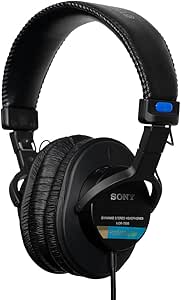 | Best for Detailed, Portable Wired Monitoring | Driver size: 40 mm | Frequency response: 10 Hz–20 kHz | Connectivity: Wired | VIEW LATEST PRICE | See Our Full Breakdown |
| Audio-Technica ATH-M20x Professional Studio Monitor Headphones, Black |  | Best for Entry-Level Tracking | Driver size: 40 mm | Frequency response: 15–20,000 Hz | Impedance: 47 ohms | VIEW LATEST PRICE | See Our Full Breakdown |
| OneOdio Pro-10 Wired DJ Over-Ear Headphones, Black |  | Best for Single-Side DJ Monitoring | Driver size: 50 mm | Impedance: 32 ohms | Sensitivity: 110 dB | VIEW LATEST PRICE | See Our Full Breakdown |
| wireless headphones for music production | Driver size | Frequency response | Design | Impedance |
|---|---|---|---|---|
| Audio-Technica ATH-M50X Profes | 45 mm | 20 Hz–28,000 Hz | Over-ear; foldable | 38 ohms |
| OneOdio A70 Bluetooth Over-Ear | 40 mm | — | Over-ear; foldable, rotatable earcups | — |
| Sony MDR7506 Professional Larg | 40 mm | 10 Hz–20 kHz | — | — |
| Audio-Technica ATH-M20x Profes | 40 mm | 15–20,000 Hz | Closed-back, over-ear | 47 ohms |
| OneOdio Pro-10 Wired DJ Over-E | 50 mm | Listed as 40 KHz; lower bound not specified | Over-ear; foldable | 32 ohms |
More Details on Our Top Picks
Audio-Technica ATH-M50X Professional Studio Monitor Headphones, Black
I rank the ATH-M50x first because it offers the most useful balance of monitoring features among these five, even though it is not wireless. Its detachable cable is a practical studio advantage: cable wear does not automatically mean the whole headphone becomes harder to use, and changing a cable can make a busy workstation easier to manage. The listed 45 mm drivers, closed-back construction, and swiveling earcups give it a flexible role for listening, tracking, and checking a mix from one ear.
Compared with the Sony MDR7506, the ATH-M50x has the stronger convenience story for cable replacement, while Sony’s foldable design and 9.8-foot fixed cable may suit a simpler desk setup. It also has a higher listed maximum frequency than the ATH-M20x, but that number alone does not establish greater accuracy. The better reason to choose this model is its combination of detachable cable, isolation, and flexible earcup movement—not a claim that specs guarantee a mix-ready tonal balance.
The tradeoff is straightforward: there is no Bluetooth, and the full-size build may feel bulky when packed. The provided note about a possible amplifier requirement should also be treated carefully: the listed impedance is 38 ohms, but whether extra amplification is useful depends on the output device and listening level. If wireless operation is a firm requirement, the OneOdio A70 is the only match here, though I would still use it wired for critical DAW work. For buyers comfortable with a cable, the ATH-M50x is my most versatile studio-oriented pick.
Pros:- Detachable cable can be replaced or changed more easily than the fixed leads on the MDR7506 and ATH-M20x.
- Closed-back construction supports isolation while tracking or working near other sound sources.
- Swiveling earcups add flexibility for one-ear monitoring and storage.
- 45 mm drivers and a listed 20 Hz–28 kHz response suit a broad range of listening tasks.
Cons:- Wired-only design does not meet a strict wireless requirement.
- Full-size construction may be bulky to carry.
- The listed specs alone do not establish a neutral response or remove the need to check mixes on other playback systems.
Best for: Producers who want a capable wired studio monitor with a detachable cable and flexible earcups for tracking and focused listening.
Not ideal for: Anyone who needs Bluetooth during production, or who wants a lightweight, compact headphone for frequent travel.
- Driver size:45 mm
- Frequency response:20 Hz–28,000 Hz
- Impedance:38 ohms
- Sensitivity:99 dB
- Cable:Detachable
- Design:Over-ear; foldable
- Warranty:2 years
Our verdict“I would choose the ATH-M50x for the broadest wired production use in this group, provided Bluetooth is not a requirement.”
OneOdio A70 Bluetooth Over-Ear Headphones, Hi-Res Wired DJ Studio – Black
The OneOdio A70 is the only product in this comparison that actually satisfies the wireless part of the brief. Its Bluetooth and wired modes let it serve two different jobs: wireless playback away from the workstation, then a cable connection for production sessions where timing and dependable monitoring matter. The supplied 72-hour battery-life figure makes it the obvious pick for someone who wants long stretches of untethered listening, though actual runtime can vary with use.
Against the wired-only ATH-M50x, the A70 wins on connection choice, but loses the stronger studio-cable convenience of a detachable lead. It has 40 mm drivers, foldable and rotatable earcups, and a built-in microphone; those features support portability and general listening, but they do not by themselves establish a flat or reference-grade sound. For editing to a click, recording, or making final mix decisions, Bluetooth is not my first choice because latency and wireless processing can complicate what you hear. The model’s wired jacks give it a more practical production mode than a Bluetooth-only design would.
The A70 is also more flexible than the OneOdio Pro-10, which has no wireless option, while the Pro-10’s single-side monitoring may suit certain DJ tasks better. Sharing audio is possible, but the product information specifies a wired connection for sharing in wired mode, so it is not a fully cable-free group-listening setup. I would pick the A70 when Bluetooth is genuinely useful outside critical production, not as a shortcut around the limits of wireless monitoring.
Pros:- Bluetooth and wired connections give it more flexibility than every other headphone in this lineup.
- Listed battery life is up to 72 hours, subject to use.
- Foldable, rotatable earcups and a light listed weight support portability.
- Includes both 3.5 mm and 6.35 mm wired jacks.
Cons:- Bluetooth may introduce latency or processing that makes it unsuitable for timing-sensitive production.
- The listed battery runtime can vary with usage.
- Audio sharing in wired mode requires a wired connection.
Best for: Home producers who want one headphone for Bluetooth listening and wired DAW sessions, and who understand when to switch to a cable.
Not ideal for: Engineers who need a dedicated, wired reference monitor or buyers who want consistent wireless monitoring for recording and precise editing.
- Connectivity:Bluetooth, 3.5 mm and 6.35 mm wired jacks
- Battery life:Up to 72 hours
- Driver size:40 mm
- Weight:8.96 ounces
- Design:Over-ear; foldable, rotatable earcups
- Materials:Aluminum fascia, protein leather, memory foam
- Microphone:Built-in HD microphone with noise reduction
Our verdict“I would choose the A70 when wireless listening is a real need, while keeping it wired for production decisions that depend on timing.”
Sony MDR7506 Professional Large Diaphragm Headphones
The Sony MDR7506 is a straightforward wired studio option with a clear practical identity: its description emphasizes detailed audio, and the foldable closed-ear design makes it easier to store or carry than a bulky fixed-frame alternative. The supplied 40 mm driver and 10 Hz–20 kHz frequency range give buyers concrete reference points, while its 8-ounce listed weight is lighter than the OneOdio Pro-10’s 415 g listing. That makes Sony the more appealing choice for a producer who moves between rooms or wants a familiar, uncomplicated wired setup.
Compared with the ATH-M50x, the MDR7506 has a non-detachable cable, so replacing a damaged lead is less convenient. The ATH-M50x also adds swiveling earcups and a detachable cable, giving it the edge for flexible tracking workflows. The Sony’s 9.8-foot cord can be useful at a desk where the interface is some distance away, but it can become clutter when working at a laptop or moving around. Its supplied connectors include a gold-plated plug and Unimatch 1/4-inch and 1/8-inch compatibility; buyers should check which adapter arrangement is included for their particular source rather than assume every device connects neatly.
This is not a wireless headphone, so it cannot compete with the OneOdio A70 for untethered playback. Its value to a production buyer lies in compact storage and direct wired monitoring, not modern connectivity. I would also avoid treating a stated frequency range or a general claim of detail as proof of mix neutrality. The short stated warranty is another practical limitation compared with the two-year warranties listed for the Audio-Technica models. Still, for a producer who wants a foldable, wired monitor and does not need a replaceable cable, the MDR7506 fills a distinct role.
Pros:- Foldable design is convenient for storage and travel.
- Closed-ear construction is described as reducing external noise.
- Listed weight of 8 ounces is lighter than the OneOdio Pro-10.
- Includes gold-plated connector hardware and 1/4-inch and 1/8-inch compatibility.
Cons:- Wired-only, with no Bluetooth option.
- Non-detachable 9.8-foot cable can be inconvenient or difficult to replace.
- Listed 90-day warranty is shorter than the two-year coverage on both Audio-Technica models.
Best for: Producers who want a light, foldable wired headphone for detailed monitoring at a desk or between work locations.
Not ideal for: Wireless-first buyers, people who need a detachable cable, or those who want the longer stated warranty of the Audio-Technica models.
- Driver size:40 mm
- Frequency response:10 Hz–20 kHz
- Connectivity:Wired
- Cord length:9.8 feet
- Connector:Gold-plated plug; Unimatch 1/4-inch and 1/8-inch
- Weight:8 ounces
- Warranty:90 days
Our verdict“I would pick the MDR7506 for portable, detailed wired monitoring, but not if cable replacement or wireless use matters most.”
Audio-Technica ATH-M20x Professional Studio Monitor Headphones, Black
The ATH-M20x is the focused, no-frills pick for tracking and monitoring in a room where isolation matters more than extra features. Its closed-back, over-ear design is described as offering sound isolation, and its 40 mm drivers are paired with a low-frequency emphasis. That combination may suit recording situations where spill is a concern, while the 9.8-foot cable gives a desktop setup room to connect to an interface or other nearby equipment.
Compared with the ATH-M50x, the M20x gives up the detachable cable and swiveling earcups, so it is less adaptable for frequent cable changes or one-ear monitoring. It also has no Bluetooth, just like the Sony MDR7506, but its stated two-year warranty is longer than Sony’s stated 90 days. The ATH-M50x remains the more flexible all-purpose wired choice in this ranking; I place the M20x here because its appeal is simpler: closed-back tracking utility without the added features of the higher-positioned Audio-Technica model.
Its basic design is not a flaw for everyone, but the fixed long cable can be awkward in a compact workspace, and the lack of wireless operation makes it a mismatch for anyone searching for Bluetooth headphones. The frequency-response listing of 15 Hz–20 kHz is useful as a specification, not a promise of accuracy across that range. I would use it as a monitoring tool and cross-check important mix decisions on other playback systems. It makes the most sense for a beginner or home-recording producer who prefers a direct, wired connection and wants isolation without needing a detachable lead or wireless mode.
Pros:- Closed-back design is suited to tracking and environments where isolation helps.
- 40 mm drivers and a low-frequency emphasis are specified for monitoring use.
- Two-year warranty is longer than the stated coverage for the Sony MDR7506.
- 9.8-foot cable provides reach to a desk-mounted interface.
Cons:- No Bluetooth or other wireless connection.
- Fixed 9.8-foot cable may feel excessive in a small workspace.
- Lacks the detachable cable and swiveling earcups of the ATH-M50x.
Best for: Newer producers and home recordists who need closed-back wired headphones for tracking and straightforward monitoring.
Not ideal for: Wireless-first users, producers who need swiveling earcups, or anyone who wants a detachable or shorter cable.
- Driver size:40 mm
- Frequency response:15–20,000 Hz
- Impedance:47 ohms
- Sensitivity:96 dB
- Cable length:9.8 feet / 2.99 m
- Design:Closed-back, over-ear
- Warranty:2 years
Our verdict“I would choose the ATH-M20x for simple wired tracking, but move up to the ATH-M50x for more connection and earcup flexibility.”
OneOdio Pro-10 Wired DJ Over-Ear Headphones, Black
The OneOdio Pro-10 is the lineup’s specialist option for DJ-style monitoring rather than a general wireless production choice. Its stated single-side monitoring feature can be useful when a producer or DJ needs to keep one ear available to hear the room or cue another source. Dual 3.5 mm and 6.35 mm jacks also offer compatibility with a range of wired gear, and the 50 mm drivers are the largest listed in this group. That driver size is a specification, not a guarantee of better accuracy or more suitable mixing.
Compared with the ATH-M20x, the Pro-10 offers a more explicit one-ear monitoring role and broader jack options, while the Audio-Technica is described around tracking and isolation. It is also heavier at a listed 415 g, so the foldable design does not make it as easy to carry as the lighter Sony MDR7506. Against the wireless-capable OneOdio A70, the Pro-10 is the less flexible choice: it has no Bluetooth and requires a cable for every session. For a desk-based DJ or producer who values its monitoring arrangement, that may be acceptable; for a mobile listener, it is a clear drawback.
The available details describe powerful bass, clear vocals, and crisp highs, but that sound profile should not be mistaken for a measured neutral reference. The frequency-response spec is supplied as “40 KHz” without a lower bound, so it does not provide a useful full range for direct comparison. Its padded cushions and adjustable headband support comfort, though the bulky build and reported cable-durability concern are relevant if it will see regular transport. I rank it fifth because its features are more specialized and its wired-only status conflicts most directly with a wireless-focused search.
Pros:- Single-side monitoring supports cueing while keeping one ear available.
- Dual 3.5 mm and 6.35 mm jacks suit a range of wired devices.
- 50 mm drivers are specified, the largest driver size in this lineup.
- Foldable design and padded, adjustable fit support storage and session comfort.
Cons:- Wired-only and does not meet a strict Bluetooth requirement.
- Listed 415 g weight and bulky design are less appealing for portable use.
- Cable durability is identified as a potential concern.
Best for: DJs and producers who want single-side monitoring and dual-size wired jacks for compatible equipment.
Not ideal for: Anyone who specifically needs wireless headphones, a lightweight travel model, or a clearly documented full frequency-response range.
- Driver size:50 mm
- Impedance:32 ohms
- Sensitivity:110 dB
- Frequency response:Listed as 40 KHz; lower bound not specified
- Connectivity:Dual 3.5 mm and 6.35 mm jacks
- Weight:415 g
- Design:Over-ear; foldable
Our verdict“I would pick the Pro-10 for its single-side DJ monitoring, not as a general-purpose wireless headphone for production.”
How We Picked
I ranked these headphones around music-production usefulness, not the number of features on a box. The first question was whether a model could connect wirelessly at all. Only the OneOdio A70 can; the other four are wired-only, so I treat them as alternatives for buyers whose priority is studio monitoring rather than wireless convenience. I also distinguish Bluetooth playback from wired monitoring because wireless latency and signal processing can get in the way of recording, editing to a beat, or judging small timing details.
Next, I compared the available information on drivers, frequency response, isolation, connection options, cable construction, and practical studio features such as swiveling or single-side monitoring. These specs offer useful clues, but they do not prove that any headphone is neutral or suitable as the sole reference for a mix. I avoid making that leap: a listed frequency range is not a substitute for a measured response, and driver diameter alone does not establish sound quality.
Finally, I considered who is likely to benefit from each design and who may find it limiting. A detachable cable can simplify replacement; a fixed long cable may suit a desk but snag elsewhere. Foldability helps with storage without making a full-size headphone truly compact. My order reflects those distinctions: the ATH-M50x leads for broad wired studio utility, the A70 earns the wireless-focused place, and the remaining models rank by the particular monitoring jobs they serve. I keep the wired models in the guide because they are relevant comparisons for anyone weighing wireless against dependable production playback.
| wireless headphones for music production | Design | Connectivity |
|---|---|---|
| Audio-Technica ATH-M50X Profes | Over-ear; foldable | — |
| OneOdio A70 Bluetooth Over-Ear | Over-ear; foldable, rotatable earcups | Bluetooth, 3.5 mm and 6.35 mm wired jacks |
| Sony MDR7506 Professional Larg | — | Wired |
| Audio-Technica ATH-M20x Profes | Closed-back, over-ear | — |
| OneOdio Pro-10 Wired DJ Over-E | Over-ear; foldable | Dual 3.5 mm and 6.35 mm jacks |
Factors to Consider When Choosing Wireless Headphones For Music Production
I would start by deciding whether wireless is a convenience or a hard requirement. That choice changes which headphones in this comparison deserve your attention.Bluetooth Convenience Versus Production Timing
Only the OneOdio A70 offers Bluetooth, so it is the only direct match for a wireless-first search. Wireless listening is useful when moving around, checking reference tracks away from the desk, or listening between sessions. For recording, editing transient-heavy material, or monitoring against a live input, a wired connection is generally the safer choice because Bluetooth can add latency and may process the signal. The A70’s wired mode is its production advantage: it lets one pair cover casual wireless use and more dependable DAW listening, though it does not turn the headphone into a laboratory reference.
The other four models are wired-only. That does not make them poor studio choices, but it does mean they cannot meet the central convenience request. I would not buy a wired-only option expecting to add Bluetooth through a workaround without checking compatibility, latency, and the intended source. If untethered playback matters most, focus on the A70; if mix decisions matter more than mobility, compare the wired picks on cable design, isolation, and fit.
Choose a Headphone for the Production Task
For broad wired use, the ATH-M50x has the most flexible feature set here, with a detachable cable and swiveling earcups. The ATH-M20x is more straightforward: its closed-back design and stated isolation make it a sensible tracking-focused option when extra convenience features are not a priority. The Sony MDR7506 combines foldability with a long fixed cable, which can work well at a desk but is less adaptable if a cable needs replacement.
If you need to monitor one ear at a time, the OneOdio Pro-10 has the clearest role. Its single-side monitoring feature and two jack sizes make it more specialized than the other wired choices. Its weight and cable concern count against regular travel, though, and its lack of wireless connectivity makes it a poor substitute for the A70. Match the role to your workflow rather than assuming one model should do every studio task.
Treat Driver and Frequency Specs as Clues
Driver diameter, impedance, sensitivity, and frequency range can help check compatibility and compare stated specifications, but they do not tell the whole story of how a headphone sounds. A 50 mm driver does not automatically outperform a 40 mm driver, and a wider published frequency range does not prove that the response is even. The Pro-10 listing is especially incomplete because it gives “40 KHz” without a lower bound, limiting the usefulness of that figure for comparison.
For production, what matters is whether you can hear relevant details consistently and whether the headphone’s tonal character leads you toward reliable choices. Since these listings do not provide independent response measurements, I would avoid treating any of the five as a guaranteed neutral reference based on specs alone. Check your mix on other headphones, speakers, or playback devices, and use familiar reference material when making critical decisions.
Cable Length, Replacement, and Portability
A long cable can be helpful when an audio interface sits at arm’s length, but it can also snag around a laptop or compact desk. The MDR7506 and ATH-M20x both list 9.8-foot cables; the Sony’s lead is non-detachable, while the ATH-M20x is also supplied with a fixed cable. The ATH-M50x’s detachable cable is the more flexible option if cable replacement or different cable lengths matter to your setup. The Pro-10 adds dual jack sizes but has a stated cable-durability concern, so I would be cautious about rough transport.
Foldable headphones are easier to store, not necessarily small or light. The Sony is listed at 8 ounces, the A70 at 8.96 ounces, and the Pro-10 at 415 g. Compare those details with how often you carry your gear. The A70 and Sony make a more compelling portability case than the heavier Pro-10, while the M50x’s detachable cable helps with setup flexibility rather than making its full-size frame compact.
Fit, Isolation, and Long Sessions
Over-ear comfort is personal: head shape, clamping force, heat, and ear-pad material can matter more than a feature list. The product descriptions identify padded or memory-foam materials on some models, but they do not provide enough information to predict fit for every listener. If possible, check the return terms and wear headphones for a short period before relying on them for long production sessions. Keep listening levels moderate, particularly during extended work.
Closed-back construction and isolation can help reduce sound leakage during tracking, which is one reason the ATH-M20x and Sony are useful wired choices. Isolation does not guarantee that a headphone is suitable for every mix decision, and it does not replace room monitoring. For a producer who records vocals or instruments, minimizing headphone spill may matter more than Bluetooth; for someone editing alone, the A70’s dual-mode flexibility could matter more.
Frequently Asked Questions
Can I produce music over Bluetooth?
You can use Bluetooth headphones for listening, arranging, and less timing-sensitive tasks, but I would avoid relying on Bluetooth for recording or precise live monitoring when latency could disrupt performance or editing. Of these five products, only the OneOdio A70 has Bluetooth, and it also supports wired connections. I would use that wired mode for DAW sessions where timing matters, then switch to Bluetooth for convenience listening.
Which headphones in this roundup are actually wireless?
The OneOdio A70 is the only wireless-capable model in the lineup; it supports Bluetooth and wired listening. The Sony MDR7506, OneOdio Pro-10, ATH-M20x, and ATH-M50x are all listed as wired-only. If Bluetooth is non-negotiable, the A70 is the direct choice here; if you can work with a cable, the ATH-M50x is my strongest all-around production pick.
Are these headphones suitable as the only reference for mixing?
I would not treat any one of these models as a guaranteed sole reference based on the supplied descriptions and specs. The listings do not include independent frequency-response measurements that establish neutrality, and driver size or frequency range does not prove a balanced sound. Use familiar reference tracks and check finished mixes on speakers and other headphones. The ATH-M50x offers the broadest wired feature set here, but that is different from proving it is accurate for every listener or mix.
Which pick is best for tracking vocals or instruments?
For wired tracking, I would compare the ATH-M20x and ATH-M50x first. Both are closed-back over-ear designs, and the M20x is specifically described as offering isolation, while the M50x adds a detachable cable and swiveling earcups. The Sony MDR7506 is another wired closed-ear option. The right choice depends on fit, leakage, and the source you need to monitor; Bluetooth is not the best mode for timing-sensitive recording.
What should I prioritize if I am new to music production?
I would first choose a connection that suits your actual workflow, then prioritize comfortable fit, useful isolation, and a cable setup that works at your desk. The ATH-M20x is a simple wired tracking choice, while the A70 offers Bluetooth for general listening as well as wired operation for production. If you want a more flexible wired option with a detachable cable and swiveling earcups, the ATH-M50x is the stronger step up in features. Whichever you choose, check mixes on more than one playback system.
Conclusion
My recommendation depends on what “wireless” means in your studio. If you want one headphone for Bluetooth listening and wired DAW work, choose the OneOdio A70 and switch to its cable for tasks where latency matters. If you are willing to stay wired for the sake of a more studio-focused feature set, the ATH-M50x is my best overall choice for its detachable cable, swiveling earcups, and closed-back design.
For a producer who values foldability and detailed wired monitoring, the Sony MDR7506 is a practical alternative, with a fixed-cable tradeoff and shorter stated warranty. Newer producers focused on tracking can consider the ATH-M20x for straightforward wired isolation. DJs who want one-ear cueing should look at the OneOdio Pro-10, while accepting its bulk, wired-only connection, and cable concern. None of these picks removes the need to check a mix across other playback systems; choose the one whose connection and monitoring features fit the work you actually do.
Fall Picks
fall essentials
As an affiliate, we earn on qualifying purchases.