
TL;DR
Thorsten Meyer AI has announced Corvus ISR, a planned wide-area motion imagery exploitation stack, and published its first synthetic tracking demonstration. The project aims to turn moving objects into searchable records on customer-controlled systems, but performance on real imagery has not been established.
Thorsten Meyer AI has announced Corvus ISR, a planned exploitation stack for wide-area motion imagery, and released an initial browser demonstration that detects and tracks objects in a fully synthetic scene. The public artifact marks the first stage of a project intended to make large volumes of persistent airborne imagery searchable on infrastructure controlled by the customer.
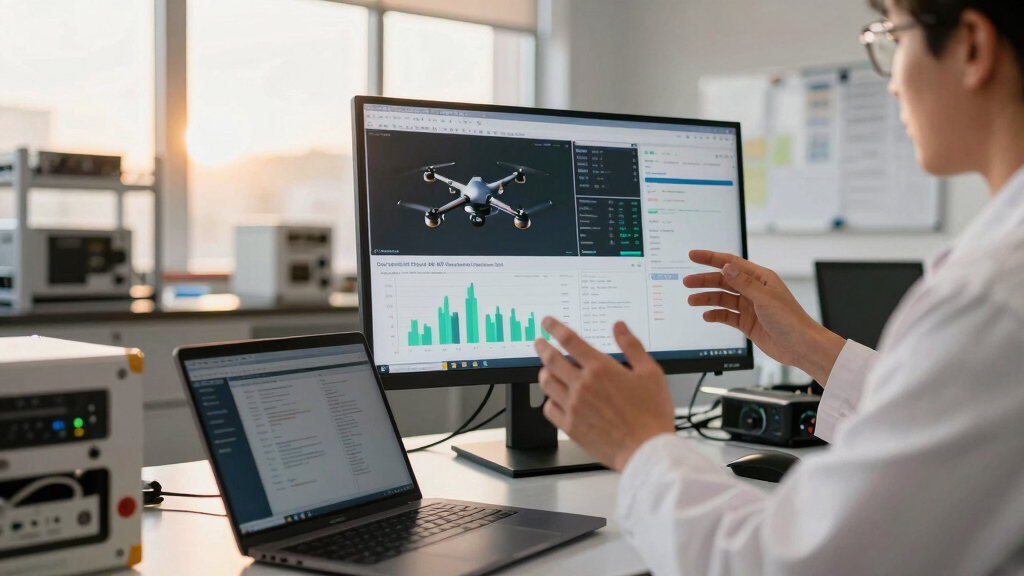
The Day 1 artifact generates a synthetic WAMI scene and applies live detection and tracking as traffic density changes. According to Meyer, every pixel is generated, with no imagery of real people or vehicles. The detector uses simple geometry rather than machine learning because the initial release is designed to test the simulation, tracking harness and display.
Meyer said the demonstration exposes declining track continuity as scene density increases, presenting that degradation as a visible limitation rather than hiding it. The supplied material does not include independent test results, accuracy rates or comparisons with existing WAMI exploitation systems, so the artifact establishes a working development concept, not operational capability.
The proposed product would detect, track and index moving objects, then store their paths in a queryable motion database. Meyer outlined two planned deployment models: a Sovereign edition for air-gapped systems without telemetry or outside dependencies, and a Governed edition intended for cloud operation under European Union jurisdiction. Neither edition has a stated release date, customer or price.
Synthetic Data Tests the Pipeline
WAMI systems can record movement across large areas for extended periods, creating more material than analysts can review manually in real time. Meyer cited the ARGUS-IS demonstrator, which produced 1.8-gigapixel imagery, as an example of the scale. Software that identifies, maintains and retrieves tracks could reduce the time needed to locate activity in that data, although Corvus has not yet shown that capability on operational imagery.
Starting with synthetic scenes gives the project known object identities, positions and paths against which detection and tracking results can be measured. It also permits public testing without publishing surveillance footage of identifiable people. Meyer argues that generated scenes can reproduce occlusion, sensor jitter, low contrast and reduced frame rates, allowing specific failure conditions to be tested repeatedly.
The proposed customer-controlled deployment model also targets concerns about data custody, external telemetry and foreign software dependencies in sensitive intelligence systems. That positioning may appeal to European public-sector buyers, but the source provides no procurement decisions or evidence of institutional demand for Corvus itself.
synthetic data generation software
As an affiliate, we earn on qualifying purchases.
As an affiliate, we earn on qualifying purchases.
Why Corvus Starts With WAMI
Wide-area motion imagery is produced by airborne camera systems designed to observe large geographic areas continuously. Meyer describes current exploitation as a bottleneck: sensors can collect extensive imagery, while analysts may need to search recorded material after an event. Corvus is being built around the premise that automated movement indexing can make the resulting archive faster to search.
Access to representative data is an early obstacle. Meyer said real WAMI imagery may be restricted, classified or expensive, while public demonstrations using actual movement data can create privacy and governance problems. Synthetic data is meant to support early engineering and measurement before the project seeks access to real sensor material.
“It’s small, it’s simplified, and it’s real.”
— Thorsten Meyer, announcing the Day 1 artifact
Operational Performance Is Still Untested
It is not yet clear how the Corvus pipeline will perform on real WAMI imagery, where sensor noise, terrain, weather, shadows, camera motion and varied object appearances may differ from the simulator. No precision, recall, false-alarm or track-fragmentation results were supplied, and no independent party has validated the demonstration.
The announcement also leaves open which machine-learning models, storage architecture and query tools will be used in later versions. There is no disclosed schedule for real-data trials, security review or deployment of either commercial edition. Claims about legal cleanliness and European compliance will depend on the final system, its users and the data processed; synthetic input alone does not establish regulatory compliance for an operational product.
Real-Data Validation Becomes the Test
Meyer plans to publish the project’s architecture choices, code increments and development mistakes through a build-in-public series. The immediate work is expected to move beyond the geometric detector toward stronger detection, tracking, indexing and benchmarking components.
The decisive milestone will be testing against representative real imagery under lawful access controls. Readers should watch for quantitative benchmarks, disclosed datasets, independent evaluation and evidence that Corvus can preserve tracks when scenes become crowded or visually difficult. Until those results appear, the release remains an early synthetic prototype supporting a broader product proposal.
Key Questions
What did Thorsten Meyer AI release?
The company released a browser-based synthetic scene that demonstrates live geometric detection and tracking. It is the first public artifact associated with Corvus ISR.
What is WAMI?
Wide-area motion imagery is persistent airborne imaging that records movement across a large area. Its scale can create a major search and analysis burden.
Does the demonstration use artificial intelligence?
The initial detector is geometric and does not use machine learning, according to Meyer. Synthetic data is being used to build and test the surrounding exploitation pipeline.
Has Corvus ISR been tested on real surveillance imagery?
No real-data test is documented in the supplied material. Current evidence covers a fully synthetic scene, so operational performance remains unproven.
How is Corvus ISR expected to be deployed?
Meyer proposes an air-gapped Sovereign edition and an EU-jurisdiction Governed edition. Release dates and final technical specifications have not been announced.
Source: Thorsten Meyer AI