
If you prefer an intuitive, visual approach to sound design, wavetable synths might suit your style, offering real-time modulation and textured, evolving sounds. On the other hand, if you enjoy precise control and creating complex harmonic textures through mathematical parameters, FM synthesizers are your go-to choice. Consider your workflow and the sonic textures you want to achieve—more details on making the right choice await as you explore further.
Key Takeaways
- Choose wavetable hardware for intuitive, visual control and evolving, textured sounds; opt for FM gear for precise harmonic complexity.
- Wavetable synthesizers excel at organic, fluid sound design with real-time modulation; FM synths are ideal for sharp, metallic, intricate textures.
- Prioritize tactile, visual interfaces if you prefer hands-on, expressive workflows; select algorithmic, menu-driven interfaces for detailed harmonic tweaking.
- For lush, evolving textures, go with wavetable; for complex harmonic content and metallic timbres, choose FM synthesis hardware.
- Consider your sonic goals and workflow style—wavetable suits organic, visual modulation; FM suits mathematical, precise harmonic exploration.
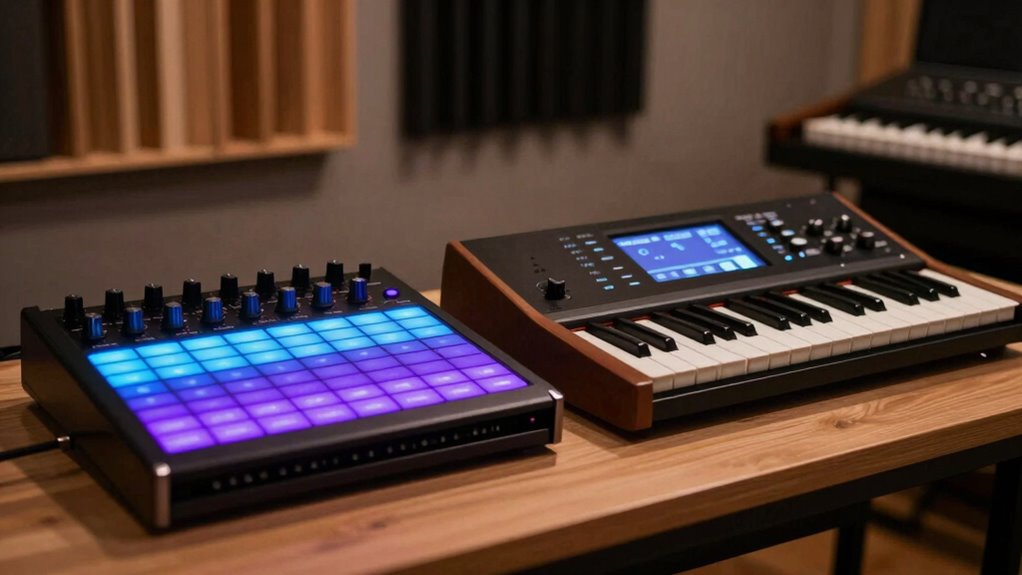
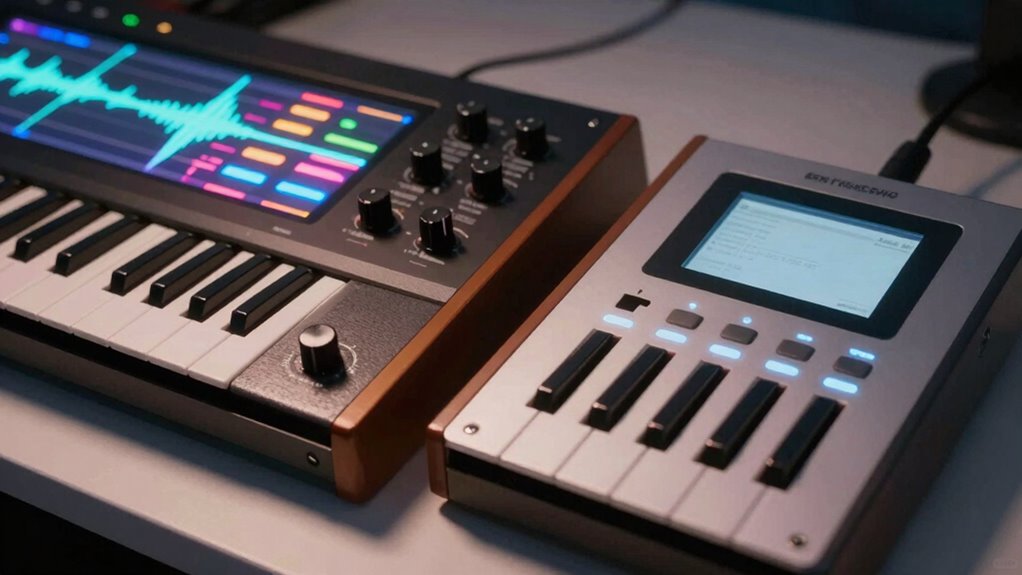
When exploring sound design strategies, consider how each synthesis technique shapes your workflow. Wavetable synthesis offers a more visual approach, where manipulating the position within the table and adjusting the amount of wavetable interpolation produces a wide range of sounds. This method is intuitive for creating evolving, textured sounds by gradually morphing between waveforms. It’s especially useful if you want a hands-on, hands-in approach that emphasizes real-time modulation and movement. Conversely, FM synthesis can be more precise and mathematically driven. By tweaking ratios, modulation indexes, and operators, you can craft complex harmonic content with a relatively small set of parameters. It’s well-suited for sound designers who want to dive deep into harmonic complexity and generate sounds that can be both aggressive and delicate. Additionally, energy-efficient hardware options for synthesis are increasingly available, making it easier to incorporate sustainable practices into your sound design workflow. Choosing the right hardware depends on your style and workflow preferences. Wavetable synthesizers often feature large, expressive interfaces with visual displays that make it easier to shape evolving sounds. They’re ideal if you prefer a more tactile, visual approach to synthesis. FM synthesizers, meanwhile, tend to be more menu-driven, with a focus on operator algorithms and modulation matrices. They’re perfect for those who enjoy detailed control over harmonic content and creating unique timbres through mathematical relationships. Both approaches have their strengths; wavetable is great for organic, flowing sounds, while FM excels at sharp, metallic, and complex textures. Ultimately, your choice hinges on what kind of sounds you want to create and how you like to work. If you’re into lush, evolving textures and enjoy visual feedback, wavetable synthesis might be your best fit. If you prefer precise control over harmonic complexity and enjoy exploring modulation math, FM synthesis can unveil a different domain of sonic possibilities. Understanding these synthesis techniques and their sound design strategies empowers you to select the hardware that complements your musical style and creative process.
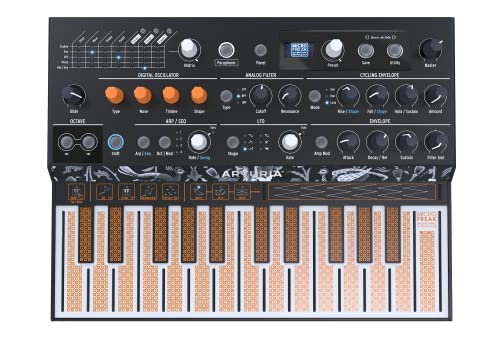
Arturia – MicroFreak Synthesizer Keyboard – 25-Key Hybrid Synth with PCB Keyboard, Wavetable & Digital Oscillators, Analog Filters
- Hybrid Synth Engine: Wavetable, physical modeling, and more
- Compact 25-Key PCB: Flat, touch-sensitive, no moving parts
- Versatile Oscillator Modes: 17 paraphonic modes including Arturia, Mutable, Noise
As an affiliate, we earn on qualifying purchases.
As an affiliate, we earn on qualifying purchases.
Frequently Asked Questions
Can Wavetable and FM Synthesis Be Combined in One Instrument?
Yes, you can combine wavetable and FM synthesis in one instrument to create hybrid synthesis. This allows you to layer sounds, blending the rich textures of wavetable with the complex timbres of FM. By doing so, you get more versatile sound design options and unique textures. Many modern synthesizers and software plugins support this integration, giving you the flexibility to craft intricate, layered sounds that stand out.
Which Synthesis Method Is Better for Live Performance?
You’ll find FM synthesis ideal for live performance because it offers quick, expressive sound changes despite its synthesis complexity. Unlike wavetable, which can require more setup and menu diving, FM allows real-time modulation and instant timbre shifts, making your performance more dynamic. Some might worry about its learning curve, but once mastered, FM’s versatility makes it perfect for spontaneous improvisation and engaging audiences on stage.
How Do I Choose Between Wavetable and FM for Sound Design?
To choose between wavetable and FM for sound design, consider waveform complexity and modulation techniques. Wavetable synthesis offers rich, evolving textures through waveform scanning, making it ideal for organic sounds. FM synthesis excels at creating bright, metallic, or complex timbres with frequency modulation. If you prefer intricate modulation options and detailed control, FM might suit you better. For more organic, evolving sounds, wavetable synthesis is a great choice.
Are There Any Notable Software Plugins for Wavetable or FM?
You’ll find plenty of software plugins for wavetable and FM synthesis that offer excellent software integration and plugin compatibility. Popular options include Xfer Records Serum for wavetable sounds, renowned for its intuitive interface and versatile modulation capabilities. For FM synthesis, Native Instruments FM8 provides rich, complex tones with seamless integration into most DAWs. Both plugins let you craft unique sounds, making it easy to incorporate them into your workflow.
What Are the Hardware Costs Differences Between Wavetable and FM Synths?
Think of wavetable synths as high-end sports cars and FM synths as reliable sedans. Wavetable hardware generally costs more due to complex oscillators and display screens, making them less affordable for beginners. FM synths tend to be more hardware-friendly, offering affordability without sacrificing sound quality. When comparing costs, FM hardware is usually cheaper, so if budget is tight, FM might be your best choice for a versatile, cost-effective option.
Conclusion
Choosing between wavetable and FM synthesis is like picking the right paintbrush for your masterpiece—you need the right tool to bring your sound to life. Wavetable offers lush, evolving textures perfect for organic sounds, while FM delivers crisp, metallic tones ideal for complex, edgy textures. Ultimately, it’s about matching your style with the right engine. Immerse yourself, experiment, and let your creativity be the compass—your perfect soundscape is just a synth away.