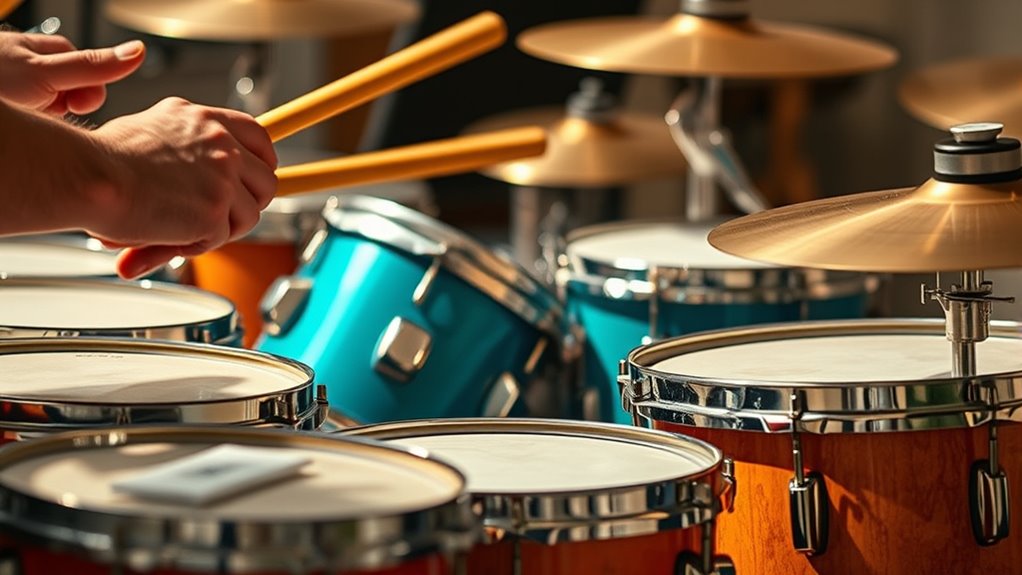

To make polyrhythms practical, break them into smaller, manageable parts and practice layering rhythms gradually. Use a metronome to keep a steady tempo and focus on internalizing subdivided beats through repetition and listening to layered patterns. Start with simple two against three rhythms, then build complexity as your coordination improves. With consistent practice and mindful listening, you’ll develop a natural feel for how these rhythms interact—keep going to uncover more techniques that will deepen your understanding.

Get audio and creator gear delivered free — and shop member deals
- Fast, free delivery on millions of items
- Access to Prime Big Deal Days deals on October 6–7
- Prime Video, Amazon Music and more included
Key Takeaways
- Break polyrhythms into manageable parts and practice slowly to build coordination and understanding.
- Use a metronome and layered exercises to internalize how different rhythms interact naturally.
- Practice subdividing beats into smaller units like sixteenths to develop internal timing and rhythmic independence.
- Gradually increase tempo and complexity, layering different rhythmic patterns for depth and mastery.
- Incorporate real-time tools like backing tracks or loop pedals to simulate layered rhythmic contexts for practical application.
Polyrhythms can seem complex at first, but with practical techniques, you can start incorporating them into your playing. The key is to break down the rhythms into manageable parts and gradually build your understanding. One effective approach involves mastering syncopation techniques. Syncopation emphasizes off-beats and irregular accents, which are essential when creating and charting polyrhythms. By practicing syncopated patterns, you train your ear and fingers to feel the internal pulse of conflicting rhythms, making it easier to layer them together smoothly.
Start with simple two against three polyrhythms, such as playing two notes in one hand while the other plays three notes in a different subdivision. To internalize this, focus on counting each rhythm separately—say, “1-2” for the duplet and “1-2-3” for the triplet—before combining them. As you get comfortable, experiment with rhythmic layering, where you stack different rhythms on top of each other. Think of rhythmic layering as building a textured fabric: each layer adds depth and complexity, but they all work in harmony. Use a metronome set to a steady tempo to keep your layers synchronized, and gradually increase your speed as your coordination improves.
Practice two against three polyrhythms by counting each rhythm separately and layering them gradually.
Another practical method involves subdividing beats into smaller units, which helps you internalize how different rhythms fit together. For example, subdivide a beat into sixteenth notes, then practice playing a simple pattern in one subdivided rhythm while overlaying a different pattern in another subdivision. This exercise enhances your ability to switch seamlessly between rhythms and develop a sense of timing and independence among your limbs or hands. Additionally, listening to recordings that feature prominent polyrhythms can boost your understanding. Focus on isolating each rhythmic layer and try to replicate them slowly. As you improve, increase the tempo and complexity. Using a loop pedal or backing track with layered rhythms can give you a real-time context to practice rhythmic layering. This immersive approach helps your brain internalize how different polyrhythms interact naturally. Consistent practice and attentive listening are key to mastering these rhythms effectively.
As an affiliate, we earn on qualifying purchases.
Frequently Asked Questions
How Can Beginners Start Practicing Polyrhythms Effectively?
To start practicing polyrhythms effectively, you should focus on metronome drills and layered exercises. Set a metronome to a steady beat and break down each rhythm slowly, gradually increasing speed. Use layered exercises to practice different rhythms simultaneously, such as playing a triplet pattern over a duplet. This method helps your brain and hands coordinate, making complex polyrhythms more manageable and natural over time.
What Are Common Mistakes When Applying Polyrhythms in Performance?
Don’t let your rhythm become a tangled web by overcomplicating things; it’s a common mistake. You might struggle with timing consistency, rushing or lagging behind the beat. Remember, simplicity is key. Focus on mastering each rhythm separately and then combine them gradually. If you rush into complex polyrhythms too soon, it can hinder your performance. Stay patient, keep your timing steady, and build confidence step-by-step.
How Do Different Musical Genres Utilize Polyrhythms Uniquely?
You’ll notice that different musical genres use polyrhythms to showcase rhythmic complexity and cultural influences. In jazz, you might find complex cross-rhythms blending seamlessly, while in African drumming, polyrhythms highlight traditional storytelling and community. In Western classical music, composers often incorporate subtle polyrhythms for sophistication, whereas in Latin genres, they emphasize danceability through layered rhythmic patterns. Each genre uniquely employs polyrhythms to evoke specific emotional and cultural expressions.
Can Polyrhythms Improve Overall Rhythmic Accuracy?
Yes, practicing polyrhythms can improve your rhythmic precision and tempo synchronization. When you work with complex rhythms, you develop better internal timing, making you more accurate across different styles. It challenges you to stay steady while managing multiple rhythmic layers, which sharpens your overall sense of timing. Over time, this enhances your ability to keep consistent tempo and execute precise rhythms in any musical setting.
What Tools or Software Assist in Mastering Polyrhythms?
To enhance your polyrhythmic skills, consider leveraging metronome apps and rhythmic training software—they serve as your discreet guides. These tools help you internalize complex time signatures with precision. Metronome apps offer adjustable beat patterns, while rhythmic training programs provide interactive exercises. Together, they create an environment conducive to steady progress, allowing you to develop nuanced rhythmic awareness and master intricate polyrhythms with confidence and finesse.
Conclusion
Once you master polyrhythms, you’ll find them weaving through your music like a vibrant tapestry, turning simple beats into intricate stories. With practice, these rhythms become second nature, uncovering new layers of expression. Remember, every complex pattern is just a puzzle waiting to be solved—your rhythmic toolbox expanding with each step. Keep experimenting, and soon, you’ll be the architect of your own rhythmic universe, where every beat sings with purpose and passion.
Fall Picks
fall essentials
As an affiliate, we earn on qualifying purchases.